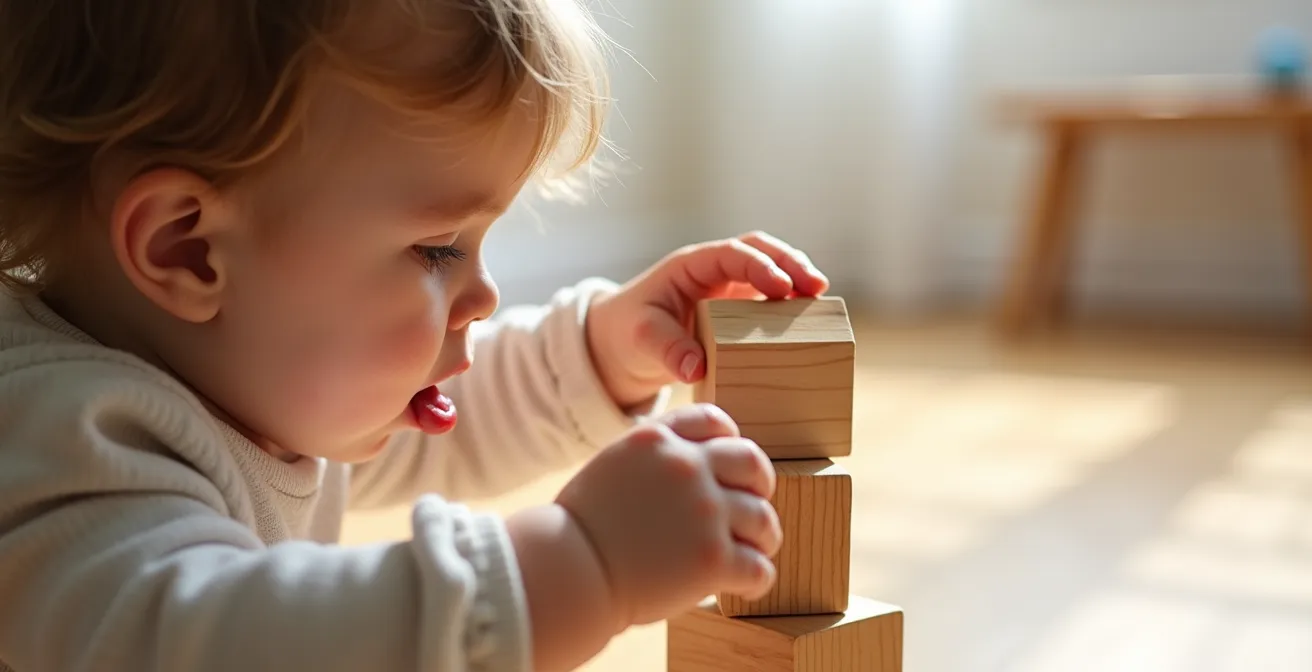
Simple wooden blocks are superior to electronic toys because they train a child’s brain in flexible, divergent problem-solving, not just prescribed pattern recognition.
- They develop foundational spatial skills that are directly linked to future mathematical success.
- They foster symbolic abstraction—the basis of all creativity—by allowing a single object to represent infinite ideas.
Recommendation: For robust, long-term cognitive development, prioritize open-ended, child-led play with simple tools like blocks over single-purpose electronic gadgets.
In an era where playrooms are saturated with the flashing lights and programmed sounds of electronic toys, many parents feel an intuitive pull back towards simplicity. This nostalgia for classic wooden blocks is often dismissed as a preference for aesthetics over function. The common assumption is that a toy with more buttons, screens, and pre-programmed activities must offer more educational value. This perspective, however, overlooks the fundamental neuroscience of how a young mind develops.
The most critical cognitive growth doesn’t come from a toy that dictates play, but from one that invites creation. While battery-powered gadgets are designed for a narrow range of interactions—press this, hear that—simple blocks are a blank canvas for the mind. They are not just toys; they are foundational tools for building the very architecture of intelligence. The value lies not in what the toy does, but in what the child does with the toy.
But what if the key to unlocking a child’s potential for higher-level thinking, mathematical ability, and creative problem-solving isn’t found in a tablet app, but in a humble pile of wood? This article moves beyond intuition to explore the research-backed evidence. We will deconstruct how the unstructured nature of block play systematically cultivates the specific cognitive skills—spatial reasoning, symbolic thought, and frustration tolerance—that are essential for intellectual development in ways that prescriptive, battery-operated toys structurally cannot.
This guide will explore the specific, research-backed mechanisms that make wooden blocks such a powerful developmental tool. By understanding the ‘why’ behind their effectiveness, you can make more informed choices about the play environment you curate for your child.
Summary: Unpacking the cognitive power of simple wooden blocks
- Why Stacking Blocks Predicts Math Skills in High School?
- Unfinished vs. Painted Wood: Which Is Safer for Teething Toddlers?
- Unit Blocks vs. Alphabet Blocks: Which Encourages Better Architecture?
- How Blocks Become Cars, Phones, and Food in Imaginative Play?
- How to Organize Heavy Blocks to Prevent Toes from Getting Crushed?
- Specific Character vs. Generic Capes: Which Sparks More Creativity?
- How to Pack Heavy Books Closest to the Back for Stability?
- How Puzzles Teach Frustration Tolerance to Toddlers?
Why Stacking Blocks Predicts Math Skills in High School?
The connection between a toddler stacking blocks and an adolescent solving algebra problems may seem tenuous, but developmental research reveals a direct and powerful link. The core skill being built is spatial reasoning: the ability to mentally visualize objects and their relationships in three-dimensional space. Block play is one of the most effective, hands-on ways for a child to develop this capacity from an early age. As they build, they are intuitively learning about gravity, balance, symmetry, and geometry.
This isn’t just theory; it’s backed by long-term data. In a landmark study, researchers found a clear positive correlation between a preschooler’s performance with blocks and their math achievement in high school. The evidence from a longitudinal study spanning 16 years demonstrated that complex block-building in early childhood was a significant predictor of higher math test scores and enrollment in advanced math courses years later. Children who build complex structures are essentially running countless physics simulations, creating a deep, intuitive understanding of principles they will later encounter formally in STEM subjects.
As child development expert Jeffrey Trawick-Smith notes, “Blocks promote a terrific amount of problem-solving and also mathematical thinking.” Every time a tower collapses, the child is presented with a problem: Why did it fall? Was the base too narrow? Was the top too heavy? This constant cycle of hypothesis, experimentation, and revision builds a resilient and analytical mindset. Unlike an electronic toy that provides a single “correct” answer, blocks teach that there are multiple pathways to a stable and successful solution, a cornerstone of advanced mathematical and engineering thought.
Unfinished vs. Painted Wood: Which Is Safer for Teething Toddlers?
As soon as a child enters the teething phase, every object becomes a potential chew toy. This makes the material and finish of their blocks a primary safety concern for parents. While brightly colored blocks are visually appealing, unfinished hardwood blocks often present a safer and more beneficial option for young toddlers. The primary advantage is the elimination of risk from potentially toxic paints, dyes, or lacquers, even those certified as “non-toxic.”
Unfinished wood provides a pure, natural surface. For a teething child, this means you can be confident that they are not ingesting any chemicals. Furthermore, the natural texture of unfinished, smoothly sanded wood offers a superior sensory experience. The subtle grain, warmth, and texture provide rich tactile input that is crucial for a toddler’s sensory development, an experience that is flattened and homogenized by a layer of paint or sealant. This tactile exploration is a form of learning in itself, helping the brain to process and categorize different textures.
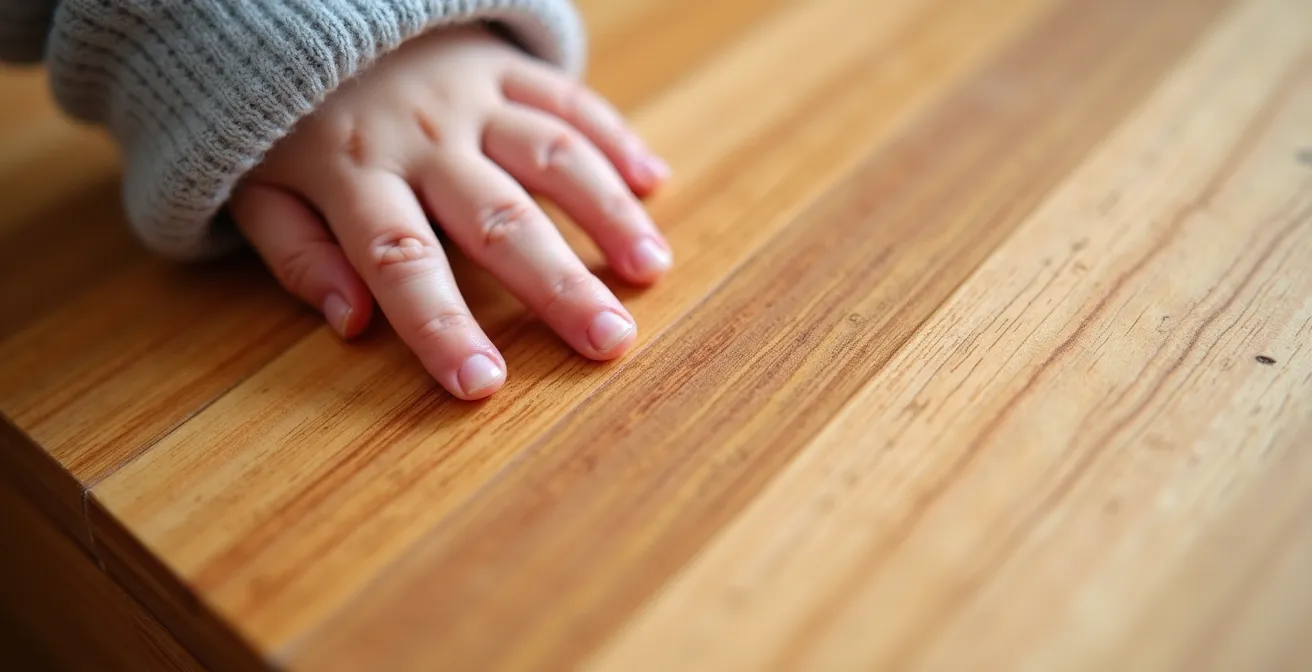
When selecting any wooden block, safety should be paramount. Opt for blocks made from solid, durable hardwoods like maple, which is less likely to splinter than softer woods. Edges should be rounded and surfaces sanded perfectly smooth to prevent any cuts or scrapes. It is also vital to choose a block size that is appropriate for your child’s age, ensuring they are large enough to not pose a choking hazard. Regular inspection for any signs of wear, such as splintering or cracking, is a necessary part of maintaining a safe play environment.
Unit Blocks vs. Alphabet Blocks: Which Encourages Better Architecture?
Not all blocks are created equal. While any block can be stacked, the design philosophy behind them dramatically influences the type and complexity of play they encourage. The two most common types, unit blocks and alphabet blocks, serve distinctly different developmental purposes. For parents aiming to foster complex building and architectural thinking, unit blocks are unequivocally superior.
Unit blocks are a precisely designed system where each block is a fraction or multiple of a standard rectangular unit. This mathematical relationship is their secret power. A child playing with unit blocks is implicitly learning about fractions, proportions, and ratios. They discover that two square blocks equal one rectangular unit, or that two triangular blocks form a square. This design enables the construction of complex, balanced structures like bridges, ramps, and cantilevers that are simply not possible with uniform cubes. The focus is purely on spatial-structural problem-solving.
Alphabet blocks, by contrast, are typically uniform cubes. While they are useful for early letter and number recognition, their uniform shape limits architectural variety. The cognitive focus is split between the act of building and the act of identifying the symbols on the faces. This can be a distraction from deep structural play. Research published in the Journal of Educational Psychology confirms that engagement with construction toys like unit blocks leads to higher levels of spatial reasoning. The following table breaks down the key differences:
| Feature | Unit Blocks | Alphabet Blocks |
|---|---|---|
| Mathematical Learning | Proportional relationships teach fractions and ratios | Limited to counting and basic stacking |
| Architectural Complexity | Multiple shapes allow bridges, cantilevers, arches | Uniform cubes limit structural variety |
| Cognitive Focus | Pure spatial-structural problem solving | Split between building and letter recognition |
| Age Range | 18 months to 8+ years | 2-5 years primarily |
How Blocks Become Cars, Phones, and Food in Imaginative Play?
One of the most profound cognitive leaps in early childhood is the development of symbolic play, which typically emerges between 18 and 24 months. This is the moment a child understands that one object can stand in for another—a cognitive skill known as symbolic abstraction. A simple wooden block, devoid of any specific features, is the perfect catalyst for this developmental milestone. Its open-ended nature doesn’t tell a child what it is; it asks them, “What could I be?”
This is where the block’s simplicity becomes its greatest strength. An electronic toy phone is, and always will be, a toy phone. It prescribes its function. As the experts at Lovevery note:
A toy phone is just a phone. A block becomes a phone when the child declares it so.
– Lovevery Development Experts, Development benefits of building blocks for kids
This act of declaration is a powerful cognitive exercise. When a child holds a rectangular block to their ear and “calls” grandma, they are performing a sophisticated mental task: holding an idea in their mind (a phone) and projecting it onto an unrelated object. This is the very foundation of creativity, abstract thought, and language itself, where abstract symbols (words) represent real-world objects and ideas.
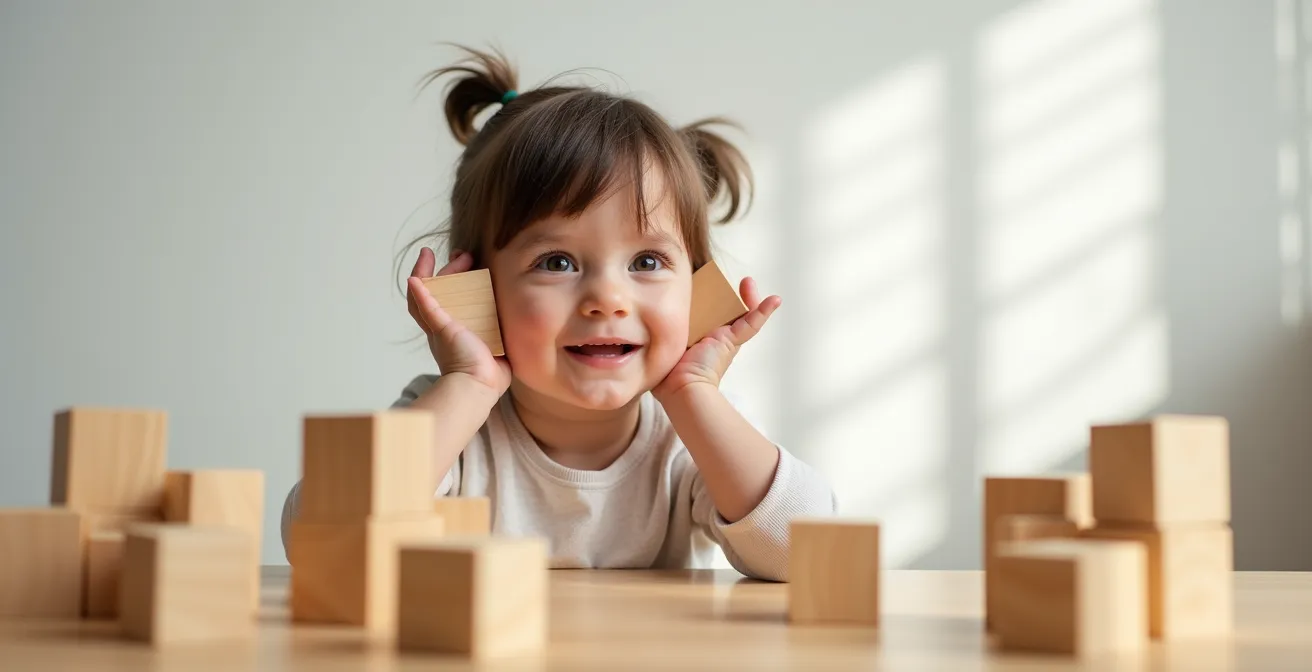
The block can be a car, a piece of cake, a spaceship, or a doctor’s tool, all within the span of a few minutes. This fluid transformation strengthens the neural pathways for flexible thinking and imagination. A battery-powered toy with a single, defined purpose can never offer this boundless landscape for the mind. It provides a destination, whereas a block provides a vehicle to go anywhere.
How to Organize Heavy Blocks to Prevent Toes from Getting Crushed?
A full set of hardwood blocks is an investment in play, but it can also be heavy and unwieldy. Creating a safe and accessible storage system is not just about tidiness; it’s about preventing injuries and empowering your child to play independently. The primary goal is to eliminate the risk of a heavy bin being overturned or large blocks falling from a height onto little feet. The key is low, open, and organized shelving.
Instead of a deep toy chest where blocks are dumped chaotically, consider using low, open shelves that are at the child’s height. This allows them to see all the available shapes and retrieve them without needing to lift or move heavy containers. It transforms cleanup from a chore into a sorting activity, reinforcing organization and categorization skills. By organizing the blocks, you are also organizing the child’s mind, helping them to see the relationships between different shapes and sizes before they even start building.
A well-designed block area encourages respect for the materials and promotes safer play habits. When children can easily access and return their own toys, they develop a sense of ownership and responsibility. The organization system itself becomes part of the learning process, and research identifies a dozen distinct educational benefits that stem from this type of structured play, including the development of crucial fine motor skills used during cleanup.
Action plan: Setting up a safe block storage system
- Use low, open shelving at the child’s height for clear visibility and easy access.
- Place the heaviest and largest blocks on the bottom shelves to create a low center of gravity and prevent tipping.
- Sort blocks by shape and size on different shelves, using visual labels (pictures of the block shapes) to guide cleanup.
- Ensure there is adequate, clear floor space around the shelving unit for safe movement and building.
- Utilize small, lightweight baskets or bins on the shelves for the smallest pieces to keep them contained.
Specific Character vs. Generic Capes: Which Sparks More Creativity?
The principle that makes wooden blocks so powerful extends to all categories of toys: the less a toy does, the more a child’s mind has to do. This is the concept of open-ended versus closed-ended play. A specific character costume, like a superhero from a movie, comes with a pre-written story, personality, and set of powers. It encourages reenactment. A generic cape, however, invites invention. The child is not just playing a character; they are creating one. Who are they? What are their powers? What is their story?
Wooden blocks are the ultimate generic “cape.” They are non-realistic items that can be anything the child imagines. This is in stark contrast to highly detailed, single-purpose toys that limit imaginative possibilities. The comprehensive TIMPANI study, which researches toy effects in preschool classrooms annually, consistently finds that children display the highest quality, most engaged play with simple, open-ended toys.
The TIMPANI Study on Play Quality
Over the course of an eight-year study, researchers consistently observed that both boys and girls displayed the most creative and complex play behaviors when given simple, wooden blocks. Interestingly, Duplo bricks also scored very highly. The researchers concluded that the key factor was the toy’s open-ended nature. As non-realistic items, they can be sorted, stacked, and used symbolically in construction play, which promotes the highest quality of play and problem-solving.
This type of play, fostered by open-ended tools, builds the cognitive flexibility and creative confidence that are essential for innovation in any field. Children who are consistently given the opportunity to create their own narratives and solve their own problems with simple tools are more likely to develop the mindset of an inventor, an artist, or a scientist. They learn to see possibilities, not just follow instructions.
How to Pack Heavy Books Closest to the Back for Stability?
The intuitive physics lessons learned during block play have direct, practical applications in a child’s everyday life. When a child builds a tall, precarious tower and places a heavy block on top, it inevitably collapses. Through trial and error, they learn to build a wide, heavy base and place lighter pieces higher up. This is not a formal lesson in physics, but an embodied understanding of center of gravity and weight distribution. It’s a spatial heuristic—a mental shortcut—that they can apply to other tasks.
Packing a backpack is a perfect real-world example. Many children will randomly stuff items into their bags, only to have an unstable, uncomfortable load that pulls on their shoulders. You can directly connect this problem to their experiences with blocks. By asking, “Where would you put the heaviest block in your tower? At the bottom or the top?” you can help them make the cognitive leap. They can then apply that same logic to packing, placing heavy textbooks closest to their back (the base) and lighter items further out.
This transfer of learning is a critical sign of deep comprehension. It shows that the child has not just memorized a fact, but has internalized a principle. This process solidifies the value of their play and reinforces the idea that the skills they are developing have relevance beyond the playroom. Here is a simple way to guide this learning transfer:
- First, practice the concept with blocks. Intentionally build a top-heavy tower together and watch it fall. Discuss why.
- Next, build a stable tower with a wide, heavy base. Test its stability.
- Then, make the connection explicit when packing a bag or loading a toy wagon: “Let’s use our ‘tower-building’ rule. Where should the heavy books go?”
- Finally, test the stability of the packed bag, reinforcing the success of applying the learned principle.
Key takeaways
- Block play in preschool is a powerful predictor of future math skills due to the development of spatial reasoning.
- Open-ended toys like blocks foster superior creativity and problem-solving compared to prescriptive, character-based toys.
- The physical principles learned through block-building, like balance and weight distribution, transfer directly to real-world tasks.
How Puzzles Teach Frustration Tolerance to Toddlers?
While both blocks and puzzles are lauded as “good” educational toys, they teach fundamentally different types of problem-solving and, consequently, different emotional skills. A puzzle is a perfect example of convergent problem-solving: there is one correct solution, and every piece has one specific place it must go. The task is to find that single solution. This process is excellent for teaching persistence, pattern recognition, and the satisfaction of reaching a predetermined goal.
Blocks, on the other hand, are the epitome of divergent problem-solving. Given a set of blocks, there are infinite possible correct solutions. There is no single “right way” to build a castle. If one design fails, the child doesn’t search for the one missing piece; they adapt, innovate, and try a completely new design. This teaches creativity, flexibility, and adaptation in the face of setbacks. According to the National Association for the Education of Young Children (NAEYC), this type of play is critical because it “encourages problem-solving, collaboration, and creativity while developing strategies to overcome obstacles.”
This distinction is crucial for understanding how to build frustration tolerance. A puzzle teaches a child to tolerate the frustration of a search for a known answer. A block tower collapse teaches a child to tolerate the frustration of a failed idea and the resilience to generate a new one. Both are valuable, but the latter is arguably more critical for real-world success, where problems rarely have one simple, predetermined solution. As developmental experts know, children who can manage the frustration of a creative setback are better equipped for complex challenges later in life. The following table highlights these different learning paths:
| Aspect | Puzzles | Blocks |
|---|---|---|
| Problem Type | Convergent (one solution) | Divergent (infinite solutions) |
| Failure Response | Try different piece | Rebuild with new design |
| Skills Developed | Persistence, pattern recognition | Adaptation, creative problem-solving |
| Emotional Learning | Patience for specific outcome | Flexibility with setbacks |
By prioritizing simple, open-ended tools like wooden blocks, you are not depriving your child of technological advancement; you are providing the essential foundation upon which all future learning is built. You are giving them the space to construct their own knowledge and build the cognitive architecture they will need to thrive in a complex world.