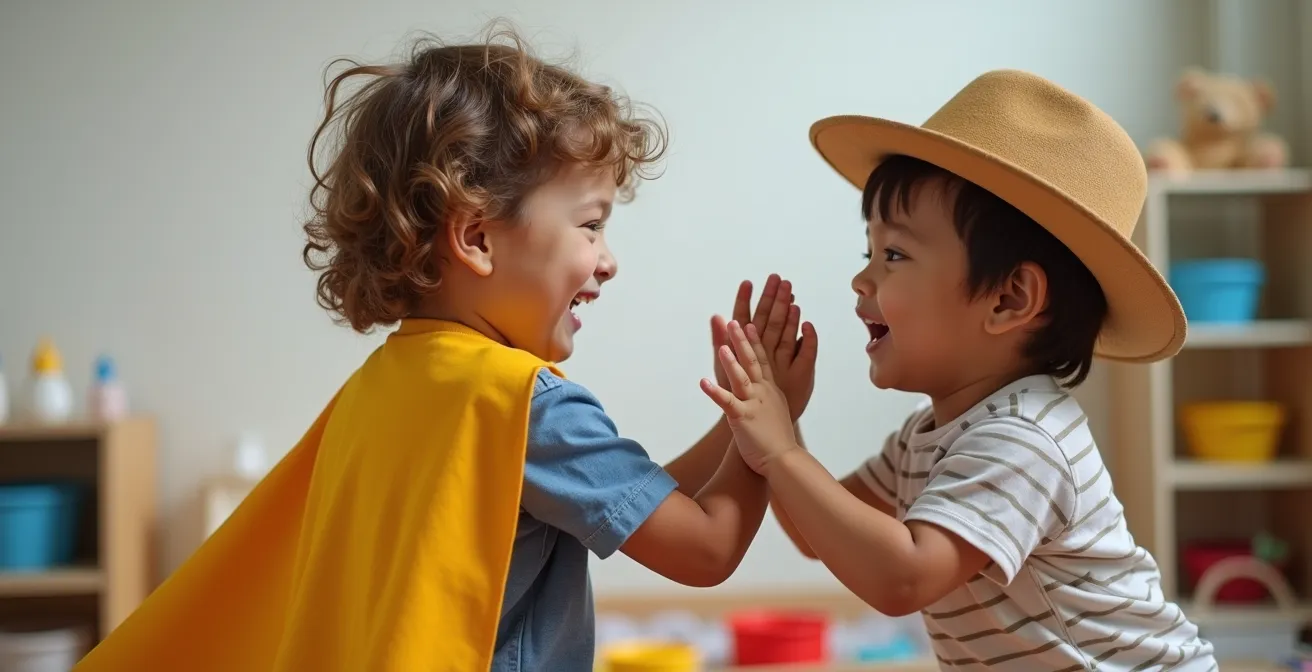
Many parents see dress-up as chaotic, messy play. However, developmental psychology reveals it’s a structured cognitive workout essential for building emotional intelligence. By embodying different characters, children are not just pretending; they are actively developing empathy, self-regulation, and abstract thinking by engaging core neurological systems like mirror neurons and the prefrontal cortex. This article unpacks the science behind the play and provides practical ways to foster this vital development.
The scene is familiar: a trail of glitter follows a small knight through the living room, while a pirate cape is repurposed as a tablecloth for a teddy bear’s feast. For many parents, the immediate reaction is a sigh at the impending cleanup. Dress-up play is often categorized as just another form of messy, chaotic fun—a way for children to burn off energy. While it is undoubtedly fun, this perspective misses the profound developmental work taking place beneath the surface of the make-believe.
Conventional wisdom tells us that pretend play is good for “imagination,” but this vague assertion does little to justify the scattered props and costumes. What if the real value of that plastic crown or makeshift superhero mask lies not just in creative expression, but in the fundamental wiring of your child’s social and emotional brain? The truth is, when a child dons a costume, they are stepping into a sophisticated psychological training ground. They are practicing how to see the world from another’s perspective, manage complex social rules, and regulate their own impulses.
This article moves beyond the platitudes to explore the concrete psychological mechanisms that make role-playing a crucible for emotional intelligence. We will delve into the neuroscience of empathy, examine how different types of props shape creativity, and offer practical strategies to guide this play in a way that maximizes its developmental benefits. By understanding the “why” behind the play, you can transform your role from a simple supervisor of messes to an intentional facilitator of your child’s emotional growth.
Explore the following sections to understand how every costume and character is a stepping stone toward a more empathetic and emotionally intelligent child.
Summary: Unlocking Emotional Growth Through Role-Play
- Why Pretending to Be Someone Else Expands a Child’s Empathy?
- How to Encourage Boys to Explore Dress-Up Beyond Superheroes?
- Specific Character vs. Generic Capes: Which Sparks More Creativity?
- The “Princess or Knight” Trap: How to Offer Neutral Role-Play Options?
- When to Allow Costumes at the Dinner Table to Support Imagination?
- Why Cooperative Games Build Empathy Faster Than Competitive Sports?
- How Blocks Become Cars, Phones, and Food in Imaginative Play?
- How to Set Up a Self-Serve Craft Station That Minimizes Mess?
Why Pretending to Be Someone Else Expands a Child’s Empathy?
Empathy isn’t an abstract virtue; it’s a cognitive skill that involves understanding and feeling what another person is experiencing. Role-playing is one of the most effective ways for a child to practice this skill. When a child pretends to be a doctor caring for a sick teddy bear or a firefighter rescuing a cat, they are actively trying to simulate the thoughts and emotions of that character. This process is a direct exercise in Theory of Mind—the understanding that others have perspectives, beliefs, and feelings different from their own. It’s the foundational building block of all social interaction.
This process is deeply rooted in our neurology. The brain contains a fascinating class of cells called mirror neurons, which fire both when we perform an action and when we observe someone else performing that same action. They are fundamental to imitation, learning, and our ability to connect with others. As researchers in Psychological Science note, this system is active from the earliest weeks of life and forms the biological basis for developing empathy.
Babies can imitate behavior two to three weeks after they’re born… Over time, babies learn that they can act with intent and variety… Eventually they realize internal states, such as desire; further down the line they develop empathy.
– Psychological Science researchers
Dress-up play supercharges this system. By physically embodying a role, a child isn’t just thinking about being someone else; they are using their body and voice to mirror that experience, strengthening the neural pathways for empathy. This can be a powerful tool for all children, including those with developmental challenges.
Case Study: The Power of Role-Play for Children with ASD
To understand the tangible impact of role-play, consider a 2024 study involving 57 children with autism spectrum disorder. Researchers found that engaging in shadow theater activities, a form of role-play that heavily relies on activating mirror neurons, led to significantly higher scores in emotional, cognitive, and behavioral skills compared to just listening to stories. This demonstrates that embodied pretend play is not just fun but a potent therapeutic and educational method for building emotional understanding.
Therefore, allowing a child to explore different roles in a safe environment helps them process complex emotions and understand the inner worlds of others, transforming simple play into profound emotional learning.
How to Encourage Boys to Explore Dress-Up Beyond Superheroes?
While superhero play is valuable for exploring concepts of power, justice, and helping others, it can sometimes become a restrictive script. Encouraging boys to venture beyond capes and masks is not about limiting their interests but expanding their emotional and social repertoire. The goal is to dismantle the subtle stereotypes that suggest certain roles—like nurturing, creating, or community-building—are less “masculine.” Broadening the scope of play helps all children understand that heroism and strength come in many forms.
Parents can actively guide this expansion by reframing what a “hero” is. A scientist discovering a cure, a chef nourishing a community, or an architect designing a sustainable city are all modern-day heroes who solve complex problems. By providing props and costumes related to these professions, you offer a wider range of identities to explore. Research on developmental benefits shows that children who engage in a wide variety of role-play, including roles traditionally associated with other genders, develop stronger empathy and perspective-taking abilities.
Here are some practical strategies to broaden the imaginative landscape for boys:
- Focus on “Care and Repair”: Create scenarios where the goal is to nurture or fix something, such as running an animal hospital, a toy repair shop, or a community garden.
- Introduce Problem-Solving Roles: Frame roles like “detective,” “inventor,” or “urban planner” as exciting challenges that require intelligence and creativity.
- Provide Diverse and Neutral Props: Offer a mix of clothing from various cultures, lab coats, artist smocks, and tool belts alongside traditional capes. Cut down adult-sized clothing to ensure comfort and ease of movement.
- Model Inclusive Attitudes: Address your own biases by celebrating all forms of play. When you praise the “chef” as much as the “superhero,” you validate a broader definition of masculine identity.
Ultimately, the aim is to give children a rich palette of roles to experiment with, allowing them to build a more flexible and comprehensive understanding of the world and their place within it.
Specific Character vs. Generic Capes: Which Sparks More Creativity?
The toy aisle presents parents with a choice: a complete, head-to-toe costume of a famous movie character, or a simple, generic item like a cape, a hat, or a wooden sword. While a specific character costume can be exciting, it often comes with a pre-written script. The child knows the character’s story, catchphrases, and powers, which can lead to what psychologists call convergent thinking—deepening their understanding within a known narrative. This is valuable, especially for younger children (ages 2-4) who are still learning about story structure.
However, generic props like a simple piece of fabric, a cardboard box, or a stick are invitations for divergent thinking. This is the hallmark of true creativity, where a child must generate new ideas from scratch. That plain blue cape isn’t just for a superhero; it can become a king’s robe, the sail of a ship, a river, or a magic carpet. The cognitive demand is higher because the child must build the entire world, character, and story themselves. This process exercises abstract thinking and invention far more than following a pre-set plotline.

As the image suggests, a simple prop’s power lies in what is unseen. The shadows of a single cape can evoke a hero’s stance or a royal’s posture, all originating from the child’s mind. The most powerful tool for imagination is often the one that does the least amount of work for the child. An analysis of pretend play by the Child Mind Institute highlights this distinction in the cognitive demands of different play styles. The following table summarizes which type of prop is best for different developmental goals.
| Aspect | Specific Character Costumes | Generic Props |
|---|---|---|
| Creativity Type | Convergent – Deep exploration within known narrative | Divergent – Endless new ideas and characters |
| Best Age Range | 2-4 years (scaffolding stage) | 3+ years (independent creation) |
| Developmental Focus | Narrative structure learning | Abstract thinking and invention |
| Cognitive Demand | Lower – predictable framework | Higher – requires world-building |
A healthy “dress-up box” should contain a mix of both. Specific costumes provide a scaffold for storytelling, while open-ended, generic items are the tools that build the architects of new worlds.
The “Princess or Knight” Trap: How to Offer Neutral Role-Play Options?
The “princess or knight” dichotomy is a classic trap in pretend play. While these are timeless archetypes, relying on them exclusively can limit a child’s imaginative range and reinforce rigid gender stereotypes. Escaping this trap isn’t about banning these roles but about enriching the imaginative environment with options that are not defined by gender. The goal is to provide a springboard for stories that are based on actions, problems, and ideas rather than pre-assigned social roles.
A powerful technique is to shift from nouns to verbs. Instead of asking, “Who do you want to be?” try asking, “What do you want to do?” This reframes the play around actions: “Let’s build something,” “Let’s solve a mystery,” or “Let’s care for these animals.” This approach encourages children’s roles to emerge organically from the function they serve in the game, not from a gendered expectation. This method also opens the door to more abstract and creative roles, such as ‘The Keeper of the Forest,’ ‘The Weather Changer,’ or ‘The Story Detective.’
This kind of open-ended play is crucial for developing emotional intelligence. According to child development experts, children build a foundation for emotional intelligence from infancy. By ages three and four, they become aware of how their actions affect others, and by five and six, many can understand and relate to the emotions of others. When children engage in neutral role-play scenarios, they develop these skills without gendered constraints, allowing for a more authentic exploration of human experience.
Here are some ways to offer neutral, expansive role-play options:
- Focus on World-Building: Propose scenarios like designing a new city, running a hotel for magical creatures, or mapping an undiscovered planet.
- Create Emotion-Based Scenarios: Use props or costume pieces to represent feelings. A heavy cloak could be ‘sadness,’ while a bright, floaty scarf could be ‘joy.’ Ask, “How does the person wearing this feel?”
- Shift from Role Nouns to Action Verbs: Instead of “Let’s play doctor,” try “Let’s figure out why this toy is broken and fix it.”
By providing these broader starting points, you empower children to invent characters and narratives that are uniquely their own, fostering a more nuanced and flexible understanding of identity and emotion.
When to Allow Costumes at the Dinner Table to Support Imagination?
The question of whether a pirate or a fairy belongs at the dinner table touches on a core parenting challenge: balancing structure and imagination. While meals are often a time for routine and manners, a rigid “no costumes” rule might miss a key opportunity for learning. Allowing a character to “join” a meal can be a powerful way to develop cognitive flexibility—the ability to understand and switch between different sets of rules and social contexts. The pirate might learn that even buccaneers use an “indoor voice” at the table.
This practice doesn’t have to lead to chaos. It can be framed as a structured activity. One effective technique is the “Character Interview.” Family members can take turns asking the character about their day, their adventures, or their feelings. The child, speaking in character, practices communication, storytelling, and maintaining a persona. This is an advanced form of play that integrates imagination with real-world social skills. It reinforces the idea that different settings have different expectations, a crucial life skill.
This structured play is also an excellent tool for developing self-regulation. Developmental research indicates that preschool-age children who engage in regular dress-up play show improved self-regulation skills. By learning to act within the “rules” of a character, and then learning to adapt that character’s behavior to the rules of the dinner table, a child is performing a complex mental exercise. The key is to set clear boundaries within the context of the play itself, such as, “Even queens must sit properly on their thrones to eat.”
Instead of an outright ban, consider using these moments as teachable opportunities. The final step is creating a “de-roling” ritual, where taking off the costume signals the end of the play—the doctor finishing their shift or the superhero going off-duty. This helps the child transition back to their own identity, reinforcing the boundary between fantasy and reality while celebrating the imaginative journey.
Why Cooperative Games Build Empathy Faster Than Competitive Sports?
Competitive sports are often praised for teaching teamwork and resilience. However, their fundamental structure is oppositional: one team wins by defeating another. While valuable, this zero-sum framework is not always the most effective vehicle for building empathy. Cooperative games, on the other hand, position all players on the same team against an external challenge. This shared goal creates a powerful sense of collective identity and shared emotional investment. There is no “other side” to defeat, only a common problem to solve together.
This form of play is a type of collective role-playing. Whether the game is about curing a global pandemic (like in the board game *Pandemic*) or escaping a sinking island (*Forbidden Island*), players must communicate, negotiate, and understand each other’s perspectives to succeed. If one player makes a move, everyone feels the consequences—positive or negative. This directly teaches children how their actions impact the group, a core component of social and emotional intelligence. The focus shifts from individual victory to collective success.
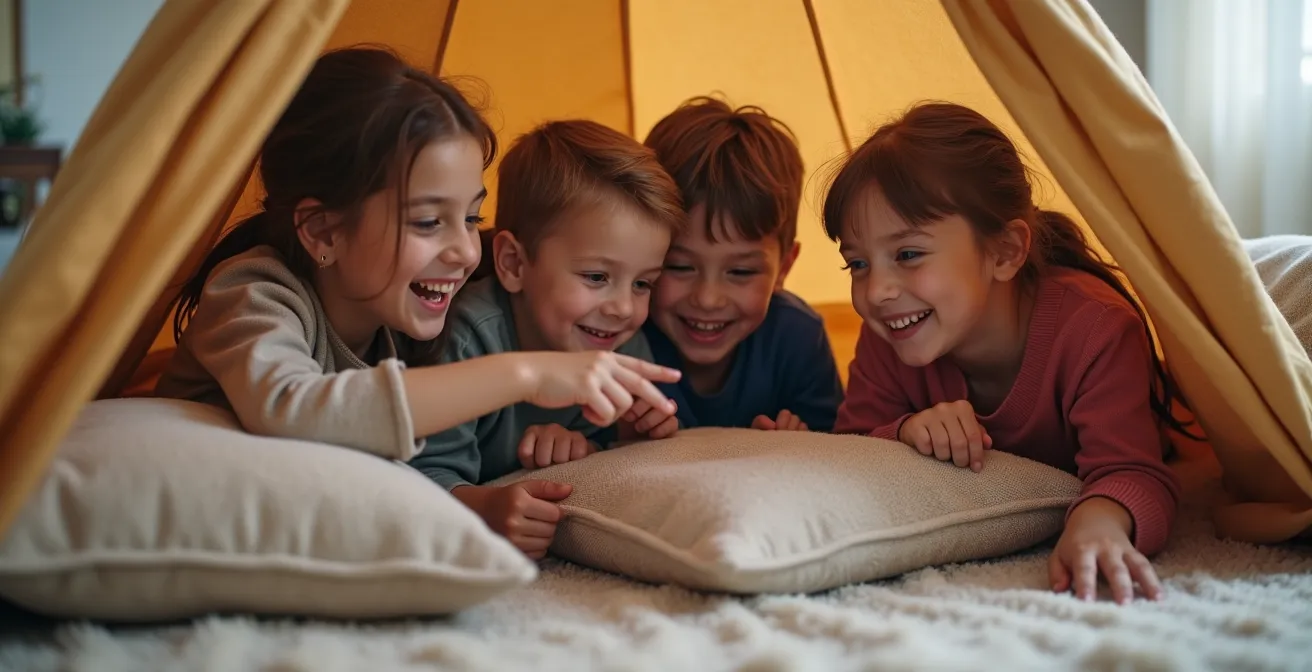
Experts in early childhood education emphasize the unique power of this shared dramatic play. As noted by the specialists at Penn Foster, this is where essential life skills are forged.
During dramatic play with each other, preschoolers are learning how to negotiate, cooperate, and navigate group dynamics. These are all valuable skills to have throughout your life.
– Penn Foster Early Childhood Education experts, The Impact of Dramatic Play in Early Childhood Education
In cooperative play, the “drama” is not about beating an opponent but about overcoming a shared obstacle. This collaborative struggle fosters a different, often deeper, kind of empathy. Children learn to celebrate the group’s triumphs and support each other through its setbacks, building a foundation for positive relationships that extends far beyond the game board.
Introducing cooperative games into a child’s life doesn’t mean eliminating competition. Instead, it offers a vital balance, providing a dedicated space where the primary goal is to work together, listen to others, and succeed as one.
How Blocks Become Cars, Phones, and Food in Imaginative Play?
A young child holding a wooden block to their ear and having a conversation is demonstrating one of the most significant leaps in cognitive development: object substitution. This is the ability to use one object to represent something else entirely. It might seem simple, but this act of symbolic thinking is a powerful workout for the brain, particularly the prefrontal cortex, which is responsible for abstract thought, planning, and Theory of Mind. The simple block becomes a tool for exercising the very parts of the brain that allow us to understand complex emotions and social situations.
This imaginative leap doesn’t happen in a vacuum; it’s tied to rapid brain development. Neurodevelopmental research confirms that most connections between brain neurons are formed between birth and age three, and object substitution play is a key activity that engages and strengthens these critical pathways. When a child decides a stack of blocks is a birthday cake, they are not just being creative; they are practicing the mental flexibility required to hold two realities in their mind at once—the physical reality of the blocks and the imagined reality of the cake. This is the same skill we use as adults to understand metaphors, grasp abstract concepts, and empathize with others.
The developmental specialists at Miracle Recreation explain the neurological importance of this process:
This ‘object substitution’ engages the prefrontal cortex, the brain region responsible for abstract thought, planning, and theory of mind. The simple block is a tool for exercising the very parts of the brain that allow us to understand complex emotions and social situations.
– Miracle Recreation developmental specialists, The Importance of Imagination in Child Development
The beauty of this type of play is its accessibility. It doesn’t require expensive, specific toys. In fact, the most open-ended objects—blocks, sticks, stones, cardboard boxes—are often the most powerful tools for building these cognitive skills. They place the creative burden entirely on the child, forcing them to build the meaning and the story from the ground up.
So, the next time you see a block being used as a car or a phone, recognize it for what it is: not just play, but the brain building its capacity for abstract thought and, ultimately, for empathy.
Key Takeaways
- Role-playing directly exercises empathy by activating the brain’s “mirror neuron” system, allowing children to simulate the feelings of others.
- Generic, open-ended props like capes and blocks foster more divergent creativity and abstract thinking than specific, pre-scripted character costumes.
- Cooperative play, where children work together against a common challenge, is a more direct path to building empathy than purely competitive activities.
How to Set Up a Self-Serve Craft Station That Minimizes Mess?
One of the biggest barriers for parents in encouraging dress-up and prop-making is the fear of chaos. A self-serve station can feel like an invitation for glitter explosions and paint spills. However, with thoughtful organization, you can create an empowering “Costume and Prop Lab” that fosters independence and creativity while keeping the mess contained. The key is to frame the station not as a free-for-all, but as an inventor’s workshop with its own system of organization and cleanup.
The design of the station is crucial. Use clear, labeled containers placed at the child’s height so they can see their options and access them independently. This teaches organizational skills and respect for materials. Designate a specific “messy zone,” perhaps covered with a wipeable mat or old sheet, and provide aprons or old shirts as “inventor coats.” This defines boundaries and makes protection part of the fun. Most importantly, the cleanup process should be integrated into the play itself. A child-sized broom and dustpan turns tidying up into another role—the diligent lab technician cleaning up after an experiment.
As one parent experienced, accessibility and novelty are key to sustained engagement. Keeping a basket of props readily available and rotating the items regularly prevents boredom and encourages new creative challenges. This approach not only supports play but also teaches responsibility.
Provide a basket or area specifically for dress-up clothes and props. Keep them easily accessible at all times. Change the items regularly to avoid boredom and keep it fun and challenging. This approach has helped families maintain creative play while teaching responsibility and organization skills.
– Parent experience
A well-organized station empowers children to bring their ideas to life without constant parental supervision, fostering a sense of autonomy and competence. Follow this plan to create a functional and inspiring space.
Your Action Plan: Creating a Costume and Prop Lab
- Frame the Space: Label the area as a “Costume Lab” or “Prop Workshop” to set a creative and purposeful tone.
- Organize Materials: Use clear, low-level containers with picture labels for materials like fabric scraps, cardboard tubes, markers, and tape. This helps children find what they need and put it back.
- Designate Zones: Lay down a wipeable mat or plastic sheeting to create a designated “messy zone” for paint or glue, and provide “inventor coats” (aprons) for protection.
- Integrate Cleanup: Make cleanup part of the play. Include a child-sized broom, sponges, and a wastebasket in the station, and model the “end-of-shift” tidying process.
- Rotate and Control: To maintain novelty and prevent overwhelm, rotate materials weekly. Only put out a manageable quantity of each item at a time.
By shifting your perspective from mess-manager to lab-facilitator, you provide the structure children need to safely explore their boundless imagination. The next step is to embrace your role not just as a cleaner of messes, but as an architect of an environment where emotional intelligence can flourish.
Frequently Asked Questions on Role-Playing and Costumes
Should children be allowed to wear costumes during meals?
Yes, with structure. Use the ‘Character Interview’ technique: have family members interview the character about their day. This builds communication skills and helps the child practice staying in-role while adhering to table manners, teaching cognitive flexibility.
How do we set boundaries without stifling imagination?
Frame rules as part of the character’s story. For example, saying “Even pirates need to use their indoor voice at the table” or “Superheroes help clean up their lairs” teaches code-switching and self-regulation without breaking the fantasy.
When should costumes come off?
Create a ‘de-roling’ ritual where removing the costume becomes a structured part of the play. This could be the doctor finishing their shift, the princess retiring for the evening, or the superhero going “off-duty.” This helps children transition and reinforces the boundary between play and reality.