
The key to managing your baby’s winter eczema isn’t just choosing soft fabrics, but systematically reducing their total “chemical load” from all sources.
- Conventional cotton and many “eco-friendly” fabrics hide pesticide residues and processing chemicals that directly trigger flare-ups.
- True safety comes from GOTS-certified organic cotton, which guarantees a clean production chain from seed to final garment.
Recommendation: Create a “Safe Skin Bubble” for your baby by focusing not only on certified organic clothing but also on fragrance-free detergents, proper washing techniques, and non-toxic feeding essentials.
Watching your baby struggle with the relentless itch of eczema, especially as dry winter air exacerbates their discomfort, is a deeply frustrating experience for any parent. You diligently apply creams and ointments, and you’ve likely been told to choose “soft, natural fabrics.” This advice, while well-intentioned, is dangerously incomplete. Many parents switch to standard cotton or bamboo, only to find the nighttime itching and raw, red patches persist, leaving them feeling helpless and confused.
The common approach focuses on fabric texture while overlooking a far more critical factor: the invisible chemical load. The problem often isn’t the fiber itself, but the pesticides, processing agents, synthetic dyes, and finishing chemicals that saturate non-organic textiles. Even items passed down with love, like vintage plastic plates, can harbor hormone-disrupting chemicals that contribute to the body’s overall inflammatory burden.
But what if the solution wasn’t just about avoiding obvious irritants, but about creating a holistic “safe skin bubble” around your child? This article shifts the focus from simply managing symptoms to proactively eliminating the hidden environmental triggers. We will move beyond the misleading “eco-friendly” labels to uncover the science behind why certain materials irritate and others heal. We’ll provide a clear, actionable roadmap to transform your baby’s immediate environment into a non-reactive sanctuary.
This guide will equip you with the knowledge to decode clothing labels, choose genuinely safe detergents, and understand the crucial differences between popular fabrics. By the end, you will be able to confidently select every item that touches your baby’s skin, offering them the profound relief they deserve.
Summary: A Parent’s Guide to Eczema-Safe Fabrics and Care
- Why do standard cotton pesticide residues trigger nighttime itching?
- How to verify GOTS certification on labels to avoid fake organics?
- Bamboo viscose or organic cotton: which breathes better for hot sleepers?
- The “eco-friendly” label scam that confuses 80% of parents
- Which detergents preserve organic fibers without irritating skin?
- Why do synthetic fragrances cause flare-ups in 60% of eczema cases?
- The BPA danger in vintage plastic plates passed down from grandma
- How to choose safe care essentials for sensitive skin without harsh chemicals?
Why do standard cotton pesticide residues trigger nighttime itching?
The advice to “choose 100% cotton” for sensitive skin is one of the most common yet misleading recommendations. It fails to distinguish between conventionally grown cotton and its certified organic counterpart. The real issue lies in the invisible chemical residues left behind by intensive farming practices. In fact, research shows that conventional cotton production accounts for 25% of the world’s pesticides, including insecticides, herbicides, and fungicides. These chemicals don’t just wash out in the factory; they can bind to the cotton fibers and remain in the final garment.
For a baby with eczema, whose skin barrier is already compromised, this is a critical problem. Their skin is more permeable, and a thinner stratum corneum, as confirmed by the National Institutes of Health, means these chemical irritants can penetrate more easily. During the long hours of sleep, a baby’s body heat and slight perspiration can effectively “leach” these residues from their pajamas directly onto their skin. This creates a state of constant, low-grade chemical exposure that triggers the immune system, leading to the inflammation, redness, and intense nighttime itching that disrupts sleep for both baby and parent. A Spanish study that analyzed infant garments found a staggering 303 different chemicals across the fabrics, from pesticides to prescription drugs, highlighting the hidden burden in everyday clothing.
Choosing certified organic cotton isn’t about a lifestyle trend; it’s a health strategy to remove this significant trigger. By eliminating the source of these chemical irritants, you give your baby’s skin a chance to calm down and heal, rather than constantly fighting off an invisible assault.
How to verify GOTS certification on labels to avoid fake organics?
In a market flooded with vague claims like “organic” or “natural,” the Global Organic Textile Standard (GOTS) is the single most important certification for parents of children with eczema. Unlike other labels that might only refer to the final product, GOTS is a “farm-to-finish” guarantee. It ensures not only that the cotton was grown without toxic pesticides and synthetic fertilizers but also that the entire processing chain—spinning, dyeing, and manufacturing—adhered to strict environmental and social criteria. This means no chlorine bleach, no formaldehyde, and no heavy metals in the dyes.
However, the popularity of the term “organic” has led to widespread misuse. A brand might label a product “made with organic cotton” when it legally contains as little as 5% organic fiber, with the rest being conventional, pesticide-laden cotton. To protect your child, you must become a savvy label detective. The key is to look for the official GOTS logo, which must be accompanied by a license number. This number is your tool for verification.
Don’t just trust the logo on the tag. True verification is a simple process you can do right in the store on your phone. This simple check is the only way to be certain you are buying a product that is genuinely safe and free from the chemical triggers that can torment your baby’s sensitive skin.
Your 4-Step GOTS Verification Plan
- Find the Logo & Number: Look for the official GOTS logo on the product label, which must include a license number.
- Visit the Database: Open your phone’s browser and go to the official GOTS public database.
- Enter the License Number: Type the number from the label into the database’s search field to verify the brand’s certification status.
- Check Product Category: Ensure that the specific product type you’re buying (e.g., “baby clothing”) is listed under their valid certification.
While GOTS is the gold standard for organic integrity, you may also see the OEKO-TEX 100 label. It’s important to understand the difference. OEKO-TEX tests the final product for a list of harmful substances, ensuring it’s safe for human contact. However, it does not certify the farming or production process as organic. For a baby with eczema, GOTS is superior because it guarantees purity from the very beginning.
This paragraph introduces the table below, which clarifies the distinction between two common certifications. The information is drawn from a helpful guide comparing fabric certifications.
| Certification | What It Covers | Testing Scope | Best For |
|---|---|---|---|
| GOTS | Entire production chain from seed to garment | Organic farming, processing, social responsibility | True organic guarantee |
| OEKO-TEX 100 | Final product only | Tests for 100+ harmful substances | Chemical safety verification |
Bamboo viscose or organic cotton: which breathes better for hot sleepers?
Bamboo is often marketed as a silky-soft, eco-friendly alternative to cotton, making it seem like an ideal choice for sensitive skin. However, for a baby prone to eczema, especially one who gets hot and sweaty during sleep, this choice can backfire. The term “bamboo” on a clothing label almost always refers to bamboo viscose or rayon. This is not a natural fiber in its final form; it’s a regenerated cellulose fiber created through a highly intensive chemical process using toxic solvents like carbon disulfide.
This paragraph introduces an illustration that helps visualize the structural difference between fibers. Understanding the hollow fiber structure is key to grasping breathability.
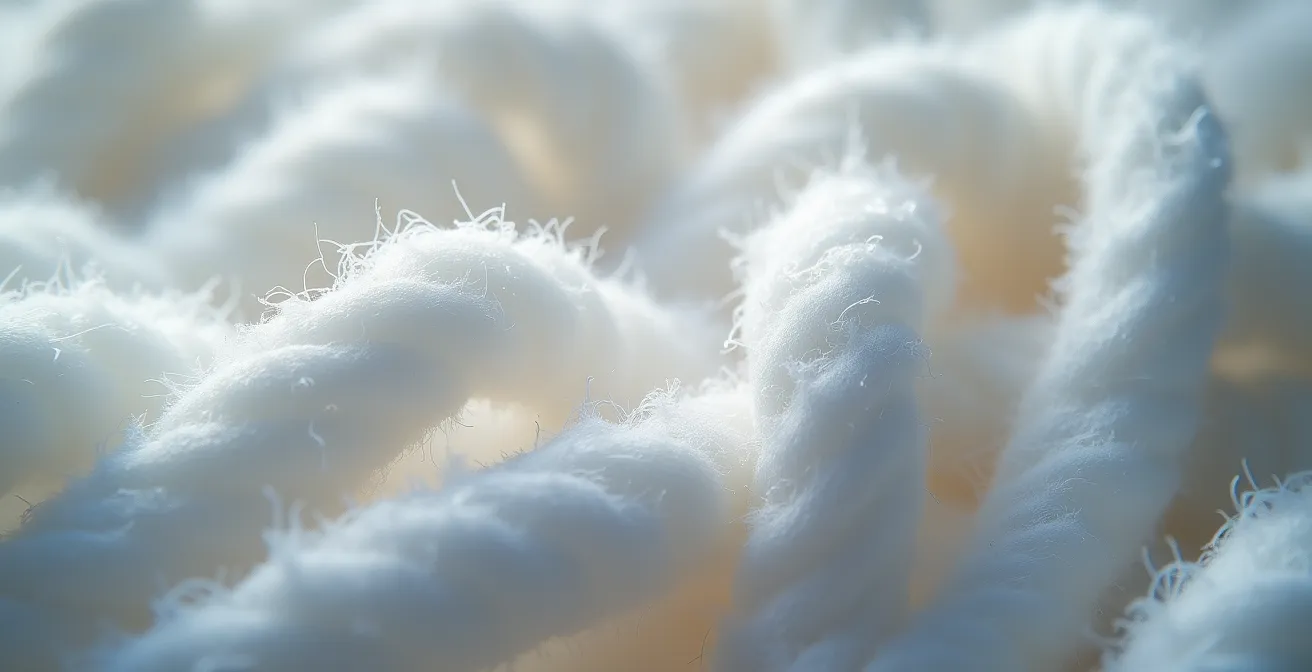
As the close-up image reveals, organic cotton fibers have a unique, hollow structure. This natural construction allows the fabric to breathe, absorbing moisture into the fibers and creating a stable, comfortable micro-climate against the skin. In contrast, while bamboo viscose is excellent at wicking moisture away for rapid evaporation, this very property can be problematic in dry, heated winter homes. It can pull moisture away from already-dry, eczema-prone skin, leading to further irritation. When the fabric becomes damp with sweat, it feels cold and clammy, failing to provide good insulation.
Bamboo rayon can feel soft but often involves heavy chemical processing that may irritate eczema-prone skin.
– Cuddle Sprouts Research Team, The Best Baby Clothes & Fabrics For Eczema
For winter layering and sleepwear, organic cotton’s ability to manage moisture while retaining warmth and loft makes it the superior choice. The minimal, chemical-free processing also ensures that no irritating residues are left behind to trigger a flare-up. The following table breaks down the key differences for winter performance.
The following data, presented to help you make an informed choice, is based on a comparative analysis of fabrics for eczema.
| Property | Bamboo Viscose | Organic Cotton |
|---|---|---|
| Processing | Heavy chemical processing with carbon disulfide | Minimal processing, no harsh chemicals |
| Moisture Management | Wicks moisture for rapid evaporation | Absorbs moisture into hollow fibers |
| Winter Performance | Can over-dry sensitive skin in heated homes | Maintains stable micro-climate |
| Under Layers | Feels cold and clammy when damp | Better insulation and loft retention |
The “eco-friendly” label scam that confuses 80% of parents
As a parent searching for safe products, you are the target of sophisticated marketing campaigns that use vague, unregulated terms to create a false sense of security. This practice, known as “greenwashing,” is rampant in the baby products industry. Words like “pure,” “natural,” “plant-based,” and even “hypoallergenic” have no legal definition and can be used on products that still contain significant irritants. A product can be “dermatologist-tested” without being “dermatologist-approved,” a subtle but critical distinction.
One of the most deceptive claims is “made with organic cotton.” As mentioned earlier, this can legally mean the garment contains only a small fraction of organic fiber, with the majority being conventional cotton grown with pesticides. Another hidden trap is a legal loophole that allows manufacturers to add 2-4% other fibers without disclosing them on the label. This is often done to cut costs, but those undisclosed synthetic fibers (like polyester or spandex) can trap heat and moisture, creating the perfect environment for an eczema flare-up.
To build your baby’s “safe skin bubble,” you must learn to see past these marketing terms and rely only on verifiable certifications like GOTS. Anything less is simply a gamble. Be skeptical of any brand that relies on flowery language instead of transparent, third-party proof. The following red flags are immediate signals that a product may not be as safe as it claims.
- ‘Made with organic cotton’: Can legally mean just 5% organic content.
- ‘Plant-based’: No regulation on percentage or processing methods.
- ‘Pure’: A meaningless marketing term with no legal definition.
- ‘Hypoallergenic’: Not regulated; the product can still contain known allergens.
- ‘Dermatologist-tested’: This does not mean it is dermatologist-approved or proven safe.
- ‘Natural’: A substance can be natural (like latex or poison ivy) and still be a major irritant or heavily processed with chemicals.
Which detergents preserve organic fibers without irritating skin?
You can invest in the highest quality GOTS-certified organic cotton, but all that effort is wasted if you wash it in the wrong detergent. Standard detergents are a primary source of skin irritation for two main reasons: leftover chemical residues and the very ingredients designed to “clean.” Fragrances, dyes, and optical brighteners are all known triggers. However, even some “eco-friendly” detergents pose a hidden risk.
Many eco-detergents use enzymes like protease and amylase to break down protein and starch stains. While effective, these enzymes can remain on fabric fibers after the wash. When they come into contact with skin, they can continue their job, breaking down the essential proteins that form the skin’s protective barrier. This can cause severe irritation and weaken skin that is already compromised by eczema. Fabric softeners are equally problematic, as they work by coating fibers in a waxy, often fragranced film that completely destroys the fabric’s natural breathability.
Case Study: The Hidden Damage from Enzyme Detergents
Research highlights a significant concern for eczema sufferers regarding detergent choice. Studies referenced by skin health experts show that enzyme residues, specifically from protease and amylase found in many “eco” detergents, can cling to fabric fibers even after a thorough wash. For individuals with a fragile skin barrier, like babies with eczema, these active enzymes continue their protein-degrading function upon contact with the skin. This enzymatic action can progressively break down the proteins in the skin’s outer layer, leading to significant irritation and exacerbating eczema symptoms long after the clothes are dry.
The safest approach is a “less is more” protocol. Choose a truly fragrance-free liquid detergent with a simple ingredient list. The term “unscented” can be misleading, as it may contain masking fragrances to cover chemical odors. “Fragrance-free” is the only reliable term. Always use the extra rinse cycle on your washing machine; this is arguably the single most important step in removing all traces of detergent. Finally, washing at a minimum of 60°C (140°F) is effective at eliminating dust mites, another common eczema trigger.
- Always use the ‘extra rinse’ cycle — the single most effective way to remove detergent residues.
- Avoid enzyme-based ‘eco’ detergents, as protease and amylase can degrade skin proteins.
- Never use fabric softeners; they coat fibers with a waxy film, destroying breathability.
- Choose ‘fragrance-free’ over ‘unscented,’ as the latter may contain masking fragrances.
- Wash at 60°C (140°F) when possible to eliminate dust mites and other allergens.
Why do synthetic fragrances cause flare-ups in 60% of eczema cases?
Fragrance is one of the most pervasive and potent triggers for eczema, yet it’s often overlooked because its impact isn’t always from direct contact. The term “fragrance” or “parfum” on an ingredient list is a legal black box. Under trade secret laws, a single ‘fragrance’ ingredient can legally hide hundreds of chemicals, including phthalates (known endocrine disruptors) and a host of potent allergens. Manufacturers are not required to disclose these individual components.
When these chemicals are in lotions, baby wipes, or your own personal care products, they are transferred directly to your baby’s skin. But the danger extends beyond touch. Volatile organic compounds (VOCs) released from scented candles, air fresheners, plug-ins, and even strong cleaning products create what can be called an “atmosphere of irritation.” These airborne chemicals can be inhaled and can also settle on surfaces and skin, creating a constant inflammatory stress on your baby’s system, even if the source never touches them directly.
This is why creating a “safe skin bubble” requires a strict fragrance-free policy for the entire home, not just for products that directly touch the baby. This includes your own laundry detergent, perfumes, and hand soaps. For a baby with eczema, there is no such thing as a “mild” or “natural” fragrance; any added scent is a potential trigger for a flare-up.
The BPA danger in vintage plastic plates passed down from grandma
The concept of a “safe skin bubble” extends beyond what your baby wears to what they touch and eat from. While fabrics are a major source of contact irritation, the total chemical load on a baby’s system also includes substances ingested or absorbed from other items in their environment. Cherished family heirlooms, like vintage plastic cups and plates from the 70s or 80s, can pose a significant and often unrecognized risk.
These older plastics were manufactured long before current safety regulations and often contain Bisphenol A (BPA) and phthalates. These chemicals are endocrine disruptors, meaning they can interfere with the body’s natural hormone systems, which can play a role in inflammatory conditions like eczema. The primary danger comes from leaching, where the chemicals migrate from the plastic into the food.
Case Study: How Heat and Fat Trigger Chemical Leaching
Scientific research confirms that the leaching of chemicals like BPA and phthalates from plastic is not constant; it is aggressively triggered by specific conditions. The two primary triggers are heat and fat. When a plastic plate is heated in a microwave or washed in a hot dishwasher, the chemical bonds weaken, causing significantly more leaching. Similarly, these chemicals are fat-soluble, meaning they migrate readily into fatty or oily foods, such as whole milk, yogurt, or pasta with an oil-based sauce. Vintage plastics are of particular concern because their chemical structure may have degraded over time, making them even more prone to leaching these harmful substances into a baby’s meal.
To reduce your baby’s overall chemical load, it is crucial to replace all food-contact plastics, especially older ones, with inert materials. Opting for safer alternatives is a simple but powerful step in protecting their developing system from unnecessary chemical exposure.
- Platinum-cured silicone: A completely inert material that does not leach chemicals, even at high temperatures.
- 304-grade stainless steel: Durable, non-reactive, and medical-grade material.
- Glass with protective silicone sleeves: Combines the purity of glass with much-needed break-resistance.
- Natural bamboo (uncoated): A good option for plates, as it is naturally antimicrobial without chemical treatments, but ensure it is not coated with a melamine-formaldehyde resin.
Key Takeaways
- The GOTS certification is the only reliable guarantee of a truly organic, chemical-free garment from farm to finish.
- Organic cotton’s breathable, hollow-fiber structure is superior to moisture-wicking bamboo viscose for maintaining a stable skin micro-climate in winter.
- A safe washing protocol (fragrance-free detergent, extra rinse cycle, no softeners) is as crucial as the fabric itself for preventing irritation.
How to choose safe care essentials for sensitive skin without harsh chemicals?
Creating a “safe skin bubble” is the ultimate goal in managing your baby’s eczema. It’s a holistic strategy that views your baby’s skin not as a problem to be solved, but as a delicate system to be protected. This involves carefully controlling their immediate environment to minimize all potential triggers, reducing their overall inflammatory load and giving their skin the peace it needs to heal. It’s about being the gatekeeper for everything that touches them, from the shirt you wear while cuddling them to the humidity in their nursery.
This strategy is built on a few core principles. First, “less is more.” This applies to bathing (2-3 times per week is often sufficient), using lukewarm water, and choosing an emollient or moisturizer with the fewest possible ingredients. Second is temperature and humidity control; overheating is a major sweat trigger, so keep the nursery cool (around 68-72°F or 20-22°C) and use a humidifier to maintain 40-50% humidity, which helps keep skin from drying out. Finally, think in layers, always starting with a GOTS-certified organic cotton base layer to act as a soft, chemical-free buffer against any other clothing.
Implementing this strategy requires a conscious audit of your home environment, but the payoff—a comfortable, calmer, and happier baby—is immeasurable. Here are the essential steps to building that protective bubble:
- Parent’s Wardrobe Audit: Keep dedicated “cuddle-safe” organic cotton t-shirts for holding your baby, ensuring your own clothes don’t transfer irritants.
- Control the Immediate Environment: Use a cool-mist humidifier in winter to keep the air from becoming too dry.
- Implement a ‘Less Is More’ Bathing Philosophy: Bathe only 2-3 times per week in lukewarm water and apply a thick, simple-ingredient emollient to damp skin immediately after.
- Layer Wisely: Always use an organic cotton base layer next to the skin, even under other sweaters or outfits.
- Regulate Temperature: Maintain the nursery at a cool 68-72°F (20-22°C) to prevent the overheating and sweating that triggers itching.
By shifting your focus from simply treating flare-ups to proactively creating a non-reactive environment, you empower yourself to provide lasting relief. Start today by choosing one area, like switching to a certified-safe detergent or auditing your baby’s sleepwear, and build from there to create the ultimate “safe skin bubble.”
Frequently asked questions about fabrics and eczema
What’s the difference between ‘unscented’ and ‘fragrance-free’?
‘Unscented’ products may contain masking fragrances to cover chemical odors, while ‘fragrance-free’ ensures no scent chemicals have been added at all. For sensitive skin, always choose ‘fragrance-free’.
Can fragrances trigger eczema without direct skin contact?
Yes, volatile organic compounds (VOCs) from air fresheners, candles, and cleaning sprays create an ‘atmosphere of irritation’ that can trigger flare-ups without ever touching the skin directly.
What hidden ingredients might be in ‘fragrance’ or ‘parfum’?
This single term can legally hide a proprietary mixture of hundreds of chemicals, including phthalates (which are endocrine disruptors) and other known allergens that manufacturers are not required to disclose individually.