In summary:
- The durability of toddler clothing is determined by fabric weight (GSM), not just the fiber type. Aim for 180-250 GSM for play clothes.
- Seam construction is a critical failure point. Look for flat-felled seams and bar-tacked reinforcement on high-stress areas like knees and pockets.
- For outdoor gear, understand the DWR (Durable Water Repellency) rating (e.g., 80/20) and wash it correctly to preserve its function.
- Shrinkage is often caused by mechanical stress (high-spin cycles) more than heat. Use a delicate cycle with cold water.
The cycle is infuriatingly predictable. You buy a new pair of pants for your toddler. They look great. After one afternoon of determined crawling, climbing, and tumbling, the knees are already showing wear. After three washes, they’ve either shrunk to an unusable size or a small tear has become a catastrophic hole. The common advice—”buy 100% cotton” or “look for good brands”—feels hollow when you’re staring at yet another piece of clothing destined for the rag pile.
Parents are understandably frustrated. The constant replacement of children’s clothing is not just a financial drain; it’s an environmental one. The truth is, the advice we’re often given is incomplete. It misses the underlying engineering principles that dictate a garment’s lifespan. Durability isn’t a magical quality possessed by expensive brands; it’s a measurable result of material science.
But what if you could approach the children’s section like a textile engineer? This guide moves beyond brand names and simple fiber labels. We will deconstruct toddler clothing into its core components: fabric weight (GSM), seam construction, fiber blends, and chemical coatings. By understanding these technical specifications, you can learn to visually inspect a garment for its true potential to withstand the rigorous testing of a highly active toddler, turning frustrating shopping trips into strategic investments in apparel that lasts.
This article provides a structured approach to selecting and maintaining durable children’s clothing. By examining the science behind fabric resilience, you’ll gain the tools to make informed decisions that save money and reduce waste.
Summary: The Ultimate Guide to Durable Toddler Fabrics
- Why Reinforced Knees Are Essential for Crawlers on Hardwood Floors?
- How to Wash Muddy Outdoor Gear Without Destroying Waterproof Coatings?
- 100% Cotton or Poly-Blend: Which Resists Playground Friction Better?
- The Washing Mistake That Shrinks Size 2T Down to Newborn Size
- When to Rotate Heavy Fabrics Out to Prevent Overheating in Spring?
- Why Stiff Jeans Hinder Climbing Skills on the Playground?
- Logs and Stumps: How to Create Natural Climbing Risks Safely?
- How to Find Soft Denim That Allows Full Movement for Active Preschoolers?
Why Reinforced Knees Are Essential for Crawlers on Hardwood Floors?
For a crawling toddler, the knees are the equivalent of tires on a vehicle—they are the primary point of contact and abrasion, especially on unforgiving surfaces like hardwood or concrete. Standard single-ply fabric is simply not engineered for this level of focused mechanical stress. The constant friction generates heat and physically wears down fibers, leading to the dreaded premature holes. This is a known pain point for parents, with research confirming that 34% of parents prioritize durability enhancement when shopping for their children’s clothes.
True “reinforced knees” are more than just a marketing term. From a technical standpoint, effective reinforcement involves one of two methods. The first is an external patch, often made from a tougher material like canvas or a high-denier synthetic. The second, more subtle method, involves an internal layer of fabric or interfacing fused to the inside of the pant leg before construction. This doubles the material at the critical wear zone without creating a bulky exterior patch.
When shopping, don’t just look for a decorative patch. Feel the knee area. Does it feel thicker or more substantial than the rest of the pant leg? Look closely at the stitching around patches or knee seams. The highest quality garments will use bar-tacked reinforcement—a series of dense, tight stitches—at the corners of these high-stress zones. This is a clear engineering sign that the manufacturer has actively designed the garment to resist failure at its weakest point.
How to Wash Muddy Outdoor Gear Without Destroying Waterproof Coatings?
For outdoor play, many parents invest in gear with a Durable Water Repellency (DWR) finish. This is a chemical coating applied to the fabric’s exterior that causes water to bead up and roll off, rather than soak in. It’s the first line of defense against rain and mud. However, this coating is not permanent and is incredibly sensitive to improper washing, which is a common reason why expensive “waterproof” gear fails after a few months.
The effectiveness of this coating can be compromised by dirt, oils from the skin, and, most critically, conventional detergents and fabric softeners. These substances leave behind residues that attract water, effectively masking the DWR and causing the fabric to “wet out.” To properly clean muddy gear, you must first brush off as much dry mud as possible. Then, wash the garment using a specialized technical wash designed for DWR fabrics, which cleans without leaving residue. Crucially, never use fabric softener, as it completely clogs the fabric’s pores and neutralizes the DWR finish.
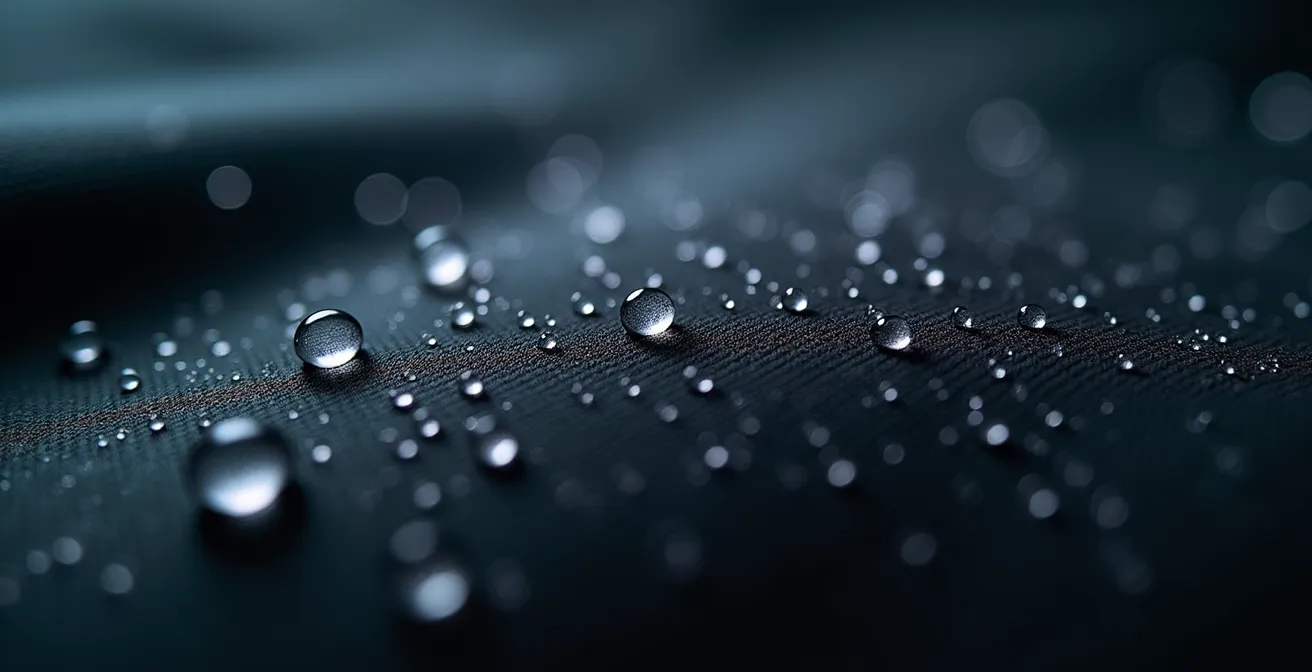
As shown in the image above, a functioning DWR coating makes water form distinct droplets. When this effect diminishes, it doesn’t necessarily mean the gear is ruined. It may just need to be reactivated. After washing with a technical cleaner, tumbling the garment on a low heat setting for about 20 minutes can often revive the DWR. The durability standard for most outdoor brands is an 80/20 rating, meaning the finish maintains 80% efficiency after 20 washes. However, scientific studies show that a combination of aging and washing affects the chemical release from these coatings, highlighting the importance of following proper care instructions to prolong the life and safety of the garment.
100% Cotton or Poly-Blend: Which Resists Playground Friction Better?
The “100% cotton is best” argument is rooted in comfort and breathability. However, when the primary enemy is playground friction—from plastic slides to rough-and-tumble play on asphalt—the answer becomes more complex. From a material science perspective, abrasion resistance is the key property, and this is where polyester-cotton blends often outperform pure cotton at a similar weight.
Polyester fibers are synthetic polymers that are inherently stronger and more resistant to friction and stretching than natural cotton fibers. When blended with cotton, you get the best of both worlds: the softness and moisture absorption of cotton, combined with the durability and shape retention of polyester. However, not all fabrics are created equal. The most reliable indicator of a fabric’s potential durability is its weight, measured in Grams per Square Meter (GSM). A higher GSM means more fiber is packed into the fabric, making it denser, thicker, and more robust.
The following table provides a technical breakdown of fabric weights and their ideal applications. For a parent looking for durable play clothes, the “Medium Weight Cotton” and “Poly-Cotton Blend” categories are the sweet spot.
| Fabric Type | GSM Range | Durability Rating | Best Use Case |
|---|---|---|---|
| Lightweight Cotton | 120-160 GSM | Low-Medium | Summer T-shirts, breathable tops |
| Medium Weight Cotton | 180-250 GSM | Medium-High | Everyday play clothes, school uniforms |
| Heavy Cotton Canvas | 280-320 GSM | Very High | Reinforced pants, outdoor gear |
| Poly-Cotton Blend | 150-200 GSM | High | Active wear, easy-care garments |
While many parents prefer cotton for its natural qualities, it’s important to be strategic. According to Cotton Incorporated, while 65 percent of parents say cotton lasts the longest, this perception may not always hold true for high-friction scenarios where a thoughtfully engineered blend might offer superior longevity. The key takeaway is to look beyond the fiber content and check the fabric’s density and weight.
The Washing Mistake That Shrinks Size 2T Down to Newborn Size
Every parent has experienced it: a favorite cotton outfit goes into the wash as a size 2T and comes out looking fit for a doll. The immediate culprit is assumed to be hot water. While heat does contribute to the shrinkage of natural fibers like cotton, a greater and often overlooked factor is mechanical stress. For cotton knits, like those used in t-shirts and leggings, the high-speed spin cycle of a washing machine can be more damaging than the water temperature.
The spinning process wrings water out through centrifugal force, but it also aggressively pulls and contorts the fabric. This mechanical agitation can cause the loops of the knit to tighten and lock into a more compact state, resulting in significant shrinkage. This frustration is so widespread that a study on Back-to-School apparel found that 72% of parents would spend more on clothes with shrink resistance, signaling a clear market need for more stable fabrics.
To minimize this laundry-room tragedy, the engineering-based solution is to reduce mechanical stress. This means opting for a ‘delicate’ or ‘hand wash’ cycle, even for sturdy-looking play clothes. This setting uses a slower spin speed and a gentler tumbling action. Pairing this with cold water is the ultimate combination for preserving the size and shape of cotton garments. While it seems counterintuitive to wash heavily soiled toddler clothes on a delicate cycle, a quality detergent and a proper pre-soak for stains are far more effective at cleaning than a punishing, high-spin cycle that damages the fabric’s structure.
When to Rotate Heavy Fabrics Out to Prevent Overheating in Spring?
As winter’s heavy-duty gear gives way to spring, parents face the challenge of dressing a child for fluctuating temperatures. Using fabric weight (GSM) as a guide becomes essential for thermal regulation. Heavy fabrics, such as a 300+ GSM canvas or thick fleece, are excellent for insulation but become a liability on a mild spring day. They trap heat and moisture, leading to a sweaty, uncomfortable, and cranky toddler who is at risk of overheating during active play.
The transition to spring calls for a strategy of layering with appropriate GSM fabrics. The goal is to create a modular system that can be adjusted as the day warms up. A lightweight base layer (around 140-160 GSM) made of a breathable material like cotton or a moisture-wicking blend is ideal. Over this, a medium-weight top layer, such as a hoodie or jacket in the 180-250 GSM range, provides warmth during cool mornings but can be easily removed as activity levels and temperatures rise.
For multipurpose spring apparel, fabric choice is key. Research suggests that for daily wear, a t-shirt in the 160-180 GSM range provides the best balance of durability for play and breathable comfort for a mild climate. This is slightly heavier than a standard cheap t-shirt (which might be 120-140 GSM) and will feel more substantial, hold its shape better, and withstand more wear and tear without being excessively hot. By thinking in terms of GSM, you can curate a seasonal wardrobe that is both durable and physiologically appropriate.
Why Stiff Jeans Hinder Climbing Skills on the Playground?
Denim is the go-to material for durable pants, but for a preschooler, there is a critical trade-off between durability and mobility. Heavy, rigid denim, while excellent at resisting tears, can actively hinder a child’s gross motor skill development. When a child attempts to climb a playground structure, they need unrestricted hip flexion and knee bend. Stiff jeans can act like a brace, limiting their range of motion, making climbing more difficult and potentially less safe.
The fabric restricts the very movements—squatting, high-stepping, lunging—that are fundamental to play and physical development. This is why many parents, despite valuing durability, express a strong preference for keeping natural, flexible fibers in their kids’ denim. In fact, 49% of parents prefer paying higher prices to keep cotton from being substituted with synthetic fibers that might compromise that natural flexibility.
The solution isn’t to abandon denim, but to select it with a focus on movement. Denim with a small percentage of elastane or spandex (e.g., 2-5%) offers a significant advantage. This introduces stretch without sacrificing too much of the classic denim feel. But how can you test this in the store?
Your Action Plan: The In-Store Squat Test
- Have your child perform a full, deep squat in the jeans while in the dressing room.
- Check for fabric pulling tightly or restricting movement at the hips and thighs.
- Ensure the fabric stretches adequately as the knee bends without pulling down from the waist.
- Verify the waistband doesn’t dig in or create a large gap at the back during the squat.
- Test a climbing motion by having your child lift one knee as high as they can towards their chest.
Logs and Stumps: How to Create Natural Climbing Risks Safely?
While the title suggests outdoor play, the most critical “logs and stumps” for a garment’s survival are the internal ones: the seams. A seam is a line where two or more pieces of fabric are held together with stitches. This is, by definition, a point of potential failure. Just as a toddler tests their balance on a log, every stretch, squat, and tumble tests the integrity of the seams on their clothing. The type of seam used is a direct indicator of the garment’s quality and durability.
In low-cost fast-fashion, you’ll often find a basic overlocked seam, where the edges are simply serged together. This is quick and cheap to produce, but the exposed threads are highly susceptible to snagging and abrasion, leading to unraveled seams. A truly durable garment designed for active play will feature more robust seam construction.
The table below outlines the seam types you should be looking for. Learning to identify these is like learning to spot quality engineering in a car. It’s a hidden detail that signals a long-term investment.
A deep dive into clothing construction reveals much about its intended lifespan, as shown in this analysis of seam types for active play. The most durable garments utilize techniques that protect the raw edges of the fabric from wear.
| Seam Type | Durability Rating | Best Application | Resistance to Snagging |
|---|---|---|---|
| Flat-felled seams | Excellent | High-quality jeans, outdoor pants | Very High – enclosed edges |
| Double-stitched seams | Good | Active wear, reinforced areas | High – added strength |
| Bar-tacked reinforcement | Excellent | Stress points, patch edges | Very High – concentrated strength |
| Basic overlocked seam | Fair | Light garments only | Low – exposed edges |
Next time you shop, turn a pair of pants inside out. Look for the flat-felled seam, common on the inseam of high-quality jeans, where all raw edges are folded and stitched away. Notice the small, dense stitches of bar-tacked reinforcement at the corners of pockets and belt loops. These are the hallmarks of a garment built to withstand the “natural risks” of play.
Key takeaways
- Check the GSM: Don’t just buy “cotton.” Look for a fabric weight of 180-250 GSM for durable, everyday play clothes.
- Inspect the Seams: Turn garments inside out. Look for flat-felled seams and bar-tacked reinforcements instead of simple overlocked edges.
- Understand the Tech: For outdoor gear, look for an 80/20 DWR rating and wash it with specialized detergent to maintain its function.
How to Find Soft Denim That Allows Full Movement for Active Preschoolers?
The ultimate goal for parents of active preschoolers is to find the “holy grail” garment: one that balances rugged durability with the softness and flexibility required for uninhibited play. You have learned to assess durability through GSM and seam construction, and mobility through the squat test. The final piece of the puzzle is achieving comfort without sacrificing all that hard-won resilience.
For denim, this balance is often found in fabric blends and finishing processes. Look for denim that incorporates 2-5% elastane (also known as Lycra or spandex). This small addition provides the crucial stretch for climbing and squatting. Furthermore, many manufacturers use washing and softening processes to break down the initial stiffness of the raw denim, making it comfortable from the very first wear. The fabric weight remains a key factor; a soft, stretchy denim in the 200-280 GSM range often represents the ideal intersection of durability and flexibility.
Ultimately, parents’ intuition about comfort is a valuable guide. As the editors of Sustainably Chic note, this focus on feel is paramount:
Organic cotton is one of my favorite materials when shopping for my children. They enjoy being comfortable, and nothing wears and washes as well as cotton
– Sustainably Chic Editorial, Top 10 Organic Kids Clothing Brands Guide
This highlights that while technical specifications are crucial, they must serve the end goal of a child’s comfort. By combining your new technical knowledge with a hands-on feel for softness and stretch, you can finally select garments that meet every requirement.
Armed with this engineering mindset, your next shopping trip will be different. Instead of being guided by price or brand alone, you now have the technical criteria to assess a garment’s true value and predict its lifespan. Start applying these principles today to build a durable, long-lasting wardrobe for your little adventurer.