In summary:
- The best shoe mimics being barefoot, with a flat, flexible sole that allows for natural muscle development.
- Proper fit is more critical than brand; you must learn to check for length, width, and depth to avoid developmental issues.
- Rigid arch support and stiff ankle collars can weaken a child’s foot by preventing essential muscles from activating and strengthening.
- Regularly inspecting shoes for specific wear patterns and checking the feet for red marks are key diagnostic skills for parents.
That first wobbly step is a monumental milestone, and it’s immediately followed by a parental panic: what shoes should they wear? The market is a confusing whirlwind of conflicting advice. You’ll hear that shoes must be supportive, then that they must be soft. Some advocate for high-tops, others for minimalist slippers. This confusion is understandable, as parents are rightly concerned with setting a foundation for a lifetime of healthy movement. Most advice centers on finding “soft and flexible” shoes, which is a good starting point but far from the whole story.
As a pediatric podiatrist, I encourage parents to shift their mindset from simply buying features to becoming diagnosticians of their child’s needs. The goal isn’t just to protect their feet, but to select footwear that allows for, and even encourages, healthy neuromuscular development. This means understanding *why* certain features matter and learning to spot the subtle signs of a poor fit before they become a problem. It’s about nurturing the foot’s natural architecture, not forcing it into a preconceived shape.
This guide moves beyond the generic advice. We will dissect the myths around arch support, provide a clinical method for measuring feet at home, and compare fastening systems for stability. More importantly, you will learn to read the story told by worn-out shoes and identify the critical red flags on your child’s feet that signal it’s time for a change. Let’s empower you to make confident, informed choices that truly support your child’s developmental journey from the ground up.
Summary: A Podiatrist’s Framework for First Walker Footwear
- Why Rigid Arch Support Can Weaken Muscles in Early Walkers?
- How to Measure Toddler Feet at Home Without a Brannock Device?
- Velcro vs. Laces: Which Provides Better Ankle Stability for Running?
- The Hidden Wear Pattern in Used Shoes That Affects Gait
- When to Size Up: 3 Red Marks That Indicate Immediate Replacement
- Why Kegels Might Be Making Your Pelvic Floor Worse, Not Better?
- Why Floor-Length Dresses Are Dangerous for Walkers Under 3 Years?
- 3-Wheel or 2-Wheel Scooter: When to Make the Switch?
Why Rigid Arch Support Can Weaken Muscles in Early Walkers?
One of the most persistent myths in children’s footwear is the need for aggressive arch support from day one. It seems intuitive: if adults with flat feet need support, shouldn’t we build a child’s arch early? The answer, grounded in pediatric science, is a firm no. A baby’s foot is not a miniature adult foot. It’s a cartilaginous structure, naturally flat due to a fatty pad, and its arch develops over years of use. Forcing it into a pre-formed, rigid arch support is like putting a cast on a healthy muscle; it prevents the muscle from doing the work it needs to grow strong.
The development of a healthy arch relies on the activation of small, intrinsic foot muscles. These muscles are stimulated when the foot has to adapt to different surfaces and balance the body. This is why barefoot time is so crucial. In fact, research shows children spending more time barefoot develop stronger intrinsic foot muscles, which are fundamental to forming a robust arch and stable gait. A rigid arch support effectively outsources the job of these muscles, telling them they don’t need to work. Over time, this can lead to weaker feet that become dependent on artificial support.
Wearing overly supportive or rigid footwear at this early age can affect the natural strengthening process that occurs during normal development.
– Straits Podiatry Research Team, The Complete Guide to Choosing Podiatrist-Recommended Kids Footwear
Instead of looking for support, parents should look for shoes that allow for developmental proprioception—the foot’s ability to feel and react to the ground. This means a flat, flexible, and non-intrusive insole is the superior choice for a first walker. The shoe’s job is protection from hazards, not architectural intervention.
How to Measure Toddler Feet at Home Without a Brannock Device?
Getting an accurate measurement of a squirming toddler’s foot can feel like an impossible task, but it’s one of the most critical steps in ensuring healthy foot development. A shoe that’s too small can restrict growth and cause discomfort, while one that’s too big can cause tripping and an unnatural gait as their toes grip to keep the shoe on. While a professional fitting is always ideal, you can get a reliable measurement at home with the right technique, focusing on length, width, and depth.
The most reliable method involves tracing your child’s foot. Have them stand on a piece of paper (it’s important they are weight-bearing for an accurate shape) and trace around their foot with a pen held vertically. Do this for both feet, as they are often slightly different sizes. Then, measure the distance from the heel to the tip of the longest toe. Add about a half-inch (or a thumb’s width) to this measurement to allow for growth and movement. This total length is your target shoe size. This simple check gives you a solid baseline for assessing any shoe you consider.
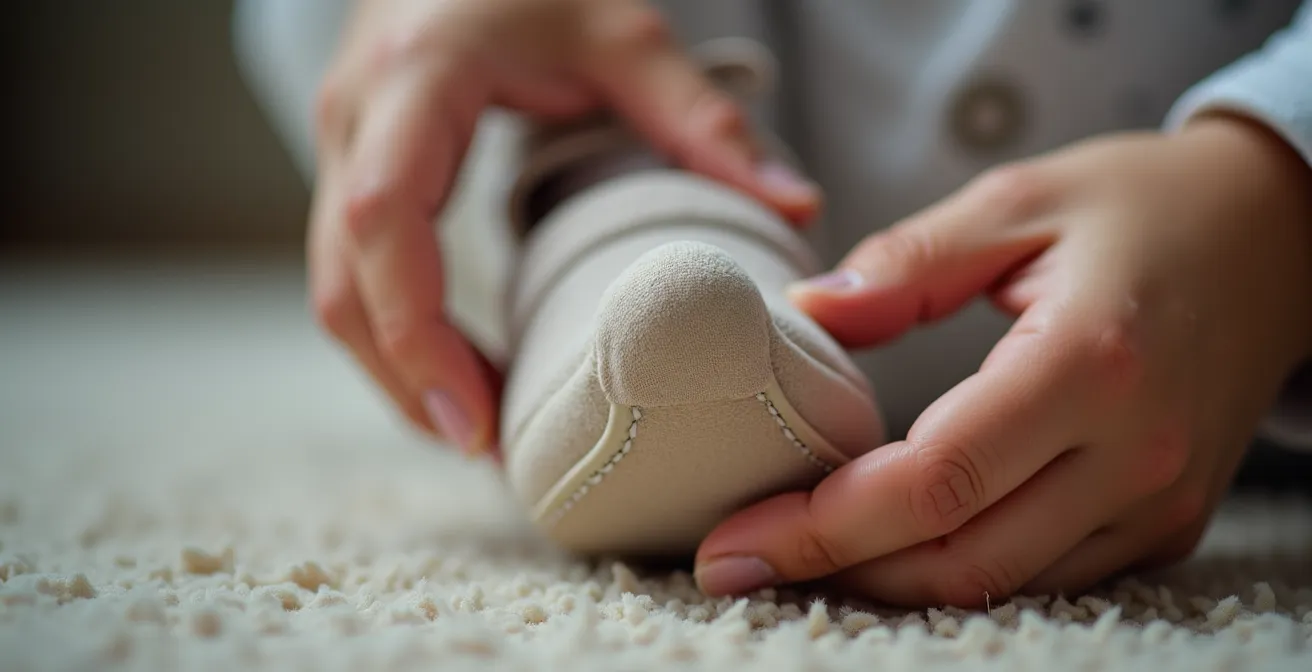
Beyond the tracing, a hands-on check inside the shoe is essential. Once the shoe is on, you should be able to comfortably press your thumb between the end of your child’s longest toe and the end of the shoe. Also, feel along the sides to ensure there’s no excessive pressure on the widest part of the foot. These manual checks are your best tool for confirming a good fit in real-time.
Your Action Plan: Professional Foot Measuring at Home
- Measure in the late afternoon or evening, as feet naturally swell throughout the day. This helps you avoid buying shoes that become too tight.
- With the shoe on and your child standing, press on the tip of the shoe. You should feel a thumb’s width of space from their longest toe to the end of the shoe for growth room.
- Have the child walk around the room. Watch for any signs of discomfort or toe curling, which can be an anticipatory response to a poor fit or instability.
Velcro vs. Laces: Which Provides Better Ankle Stability for Running?
The debate between Velcro and laces is about more than just convenience; it’s a matter of fit, security, and developmental appropriateness. For the earliest walkers, the primary goal is a secure fit that is easy to achieve. As they transition to more active running and climbing, the need for what I call dynamic ankle containment becomes more pronounced. Both fastening systems have their merits, and the best choice often depends on the child’s age, activity level, and the specific shape of their foot.
Velcro (or hook-and-loop) fasteners are fantastic for promoting independence. Toddlers can learn to put on and take off their own shoes, which is a significant fine motor and self-care milestone. For children with high-volume or wide feet, the adjustability of a Velcro strap is invaluable. However, a single strap may not provide enough security across the instep for a very active child. A double-strap strategy often offers a much better and more secure fit. Laces, on the other hand, offer unparalleled micro-adjustment. You can customize the tightness across the entire top of the foot, providing superior hold and stability, which is especially beneficial for children with narrow feet or those engaging in a lot of running and quick direction changes.
Case Study: A Pediatric PT’s Experience with Velcro
The Movement Mama, a pediatric physical therapist, notes that Velcro straps are crucial for adapting to the changing volume of a toddler’s foot as it loses baby fat. Her experience showed that children master Velcro shoes earlier, which boosts confidence. She does, however, add a practical warning: this newfound independence often leads to shoes being enthusiastically removed during car rides, a familiar scenario for many parents.
The following table breaks down the key differences to help you decide which is best for your child’s current stage of development. Remember, the “best” fastener is the one that provides the most secure and customized fit for your child’s unique foot and activity level.
| Feature | Velcro Straps | Laces |
|---|---|---|
| Adjustability | Easy quick adjustment for varying foot shapes | Micro-adjustment possible for customized fit |
| Independence | Promotes toddler independence and fine motor skills | Requires adult assistance initially |
| Security | Best with double-strap strategy for secure fit | Superior hold across entire top of foot |
| Best For | Early walkers developing self-care skills | Active toddlers needing maximum stability |
The Hidden Wear Pattern in Used Shoes That Affects Gait
The temptation to use hand-me-down shoes is strong, especially given how quickly children outgrow them. However, from a podiatric perspective, this is one of the riskiest things you can do for a developing foot. A shoe is not just a protective covering; it’s a piece of equipment that molds to its wearer’s foot and gait pattern. The problem is shockingly common, as research suggests 2 out of 3 kids are wearing the wrong shoe size, and inheriting a shoe with a pre-formed “gait imprint” only compounds the issue.
When a child wears a shoe, their foot, body weight, and unique way of walking create specific compression patterns in the footbed and outsole. This is the shoe’s gait imprint. If the first owner had a tendency to pronate (roll their foot inward), the inner edge of the shoe’s sole and midsole will be more compressed. When a new child with a neutral gait wears this shoe, the pre-existing wear pattern forces their foot to follow that same inward-rolling path, effectively teaching their foot an incorrect walking pattern. This can lead to issues with alignment not just in the feet, but up through the ankles, knees, and hips.
Before ever considering a used shoe, you must become a detective and inspect it for these hidden signs of wear. A visual and tactile inspection can reveal the story of the previous wearer and help you avoid passing on their gait issues to your child. Here are the key areas to check:
- Outsole Wear: Look for uneven wear on the bottom. Heavy wear on the inner edge can indicate pronation, while heavy outer edge wear can indicate supination.
- Footbed Compression: Remove the insole if possible. Can you see a deep impression of another child’s toes or heel? Memory foam is especially problematic as it molds permanently.
- Heel Counter Breakdown: The heel counter is the stiff cup at the back of the shoe. Check if it’s leaning to one side or feels collapsed, which shows it has been molded by a previous gait pattern.
- Midsole Creases: Look at the foam midsole from the side. Are the compression lines even, or are they deeper on one side, indicating an unbalanced gait?
When to Size Up: 3 Red Marks That Indicate Immediate Replacement
Children’s feet grow in unpredictable spurts, and because their nerve endings are still developing, they often won’t complain about a shoe that’s become too tight. This is why parents must be vigilant, acting as the primary detectors of fit issues. The “thumb’s width” rule is a great proactive measure, but another powerful diagnostic tool is the daily foot check. Taking off your child’s shoes and socks at the end of the day and looking for specific red marks can tell you exactly how and where a shoe is failing.
These fit-related red flags are not just random irritations; they are a diagnostic map. The location of a persistent red mark (one that doesn’t fade after 15-20 minutes) points to a specific fit problem. Learning to read this map is essential for preventing discomfort, blisters, and even ingrown toenails. It’s the most definitive sign that a shoe needs to be replaced immediately, even if you just bought it a month ago.
A Podiatrist’s Diagnostic Map of Red Marks
Podiatrists at Parkview Health have a clear system for interpreting these marks. They explain that checking at the end of the day, when feet are at their largest, is key. Red marks on the tips of the toes mean the shoe is too short. Red marks on the widest part of the foot (the sides of the forefoot) indicate the shoe is too narrow. Finally, red marks on the instep or top of the foot show the shoe is too shallow and pressing down on their foot’s structure.
Sometimes, the signs are behavioral before they are physical. A child who suddenly fights having their shoes put on, or who is quick to take them off the moment they get a chance, may be communicating discomfort that they can’t yet verbalize.
The soft soles were a priority since my mother in law is a pediatric nurse and she recommended them. My 9-month-old showed signs of discomfort before any visible marks appeared – she would fight putting the shoes on every morning, which was our first warning sign.
– Teresita, parent surveyed by The Bump
Why Kegels Might Be Making Your Pelvic Floor Worse, Not Better?
As a pediatric podiatrist, my world is feet. But often, the most powerful lessons come from looking at parallel principles in other areas of the body. A common concern I hear from new parents in my practice relates to their own physical recovery, particularly regarding pelvic floor health. The default advice is often “do your Kegels,” but this can be a perfect example of a well-intentioned intervention that misses the underlying problem, offering a powerful metaphor for what we must avoid with our children’s feet.
The issue with a blanket “Kegel” prescription is that it assumes the pelvic floor is simply weak and needs strengthening. For many, however, the problem is not weakness but hypertonicity (too much tension) or poor coordination. In these cases, repeatedly contracting an already tight muscle can worsen the problem, leading to pain and dysfunction. The real solution is often learning to first *relax* and release the muscle, then reintegrate it into a coordinated system with the core and diaphragm. It’s about function, not just brute strength.
This is a perfect analogy for rigid arch support in children’s shoes. A stiff, “supportive” shoe is like performing a constant, isometric contraction on the foot. It prevents the small intrinsic muscles from learning to relax, contract, and coordinate in response to the ground. It assumes a “weakness” that needs a crutch, when in reality the foot needs freedom to develop its own functional strength and coordination. Just as the goal for the pelvic floor is balanced function, the goal for the foot is not to be passively propped up, but to be an active, responsive, and intelligent structure. The best “exercise” is natural movement in an unrestrictive environment.
Why Floor-Length Dresses Are Dangerous for Walkers Under 3 Years?
When we consider healthy foot development, we must look beyond the shoe itself and assess the child’s entire “gait environment.” This includes the surfaces they walk on and, just as importantly, the clothes they wear. While seemingly harmless and often quite adorable, certain clothing items can pose a significant risk to a new walker’s safety and interfere with the development of a natural, efficient gait. Floor-length dresses and oversized trousers are primary culprits.
For a child learning to walk, the process is one of constant feedback and refinement. Their brain is learning to coordinate limb movement, balance, and process sensory information from the soles of their feet. A floor-length dress introduces an unpredictable external variable. The hem can get caught under their feet or between their legs, leading to a high risk of tripping and falling. More subtly, to avoid tripping, a child might adopt an unnatural gait modification, such as taking higher, more deliberate steps or walking with a wider stance. This altered pattern prevents them from developing the smooth, heel-to-toe rhythm of a mature gait.
This interference is not just physical; it’s neurological. It disrupts the clean loop of developmental proprioception. The child’s feet are trying to send clear signals to the brain about the ground beneath them, but the constant snagging of fabric creates “noise” in that signal. It’s the equivalent of trying to learn piano while wearing thick, clumsy mittens. To allow for the most natural development, clothing for new walkers should be well-fitting and end well above the ankle, giving their feet and legs complete freedom of movement. The environment, including their clothing, should be as unrestrictive as possible to support, not hinder, their motor learning journey.
Key takeaways
- Prioritize a flat, flexible sole to encourage the natural strengthening of your child’s intrinsic foot muscles, mimicking barefoot walking.
- Become a “fit diagnostician” by checking for a thumb’s width of space at the toe and identifying the three key red marks (toes, width, instep) that signal a poor fit.
- Never use hand-me-down shoes, as the “gait imprint” from the previous owner can force your child’s foot into an unhealthy walking pattern.
3-Wheel or 2-Wheel Scooter: When to Make the Switch?
The journey of motor development that begins with those first wobbly steps continues through a series of increasingly complex milestones. The transition from a 3-wheel to a 2-wheel scooter is a perfect illustration of this progression, and it connects directly back to the foundational work done in their earliest years. This decision isn’t just about age; it’s a reflection of your child’s developing balance, coordination, and confidence, all of which are rooted in healthy foot and ankle function.
A 3-wheel scooter provides a stable platform. The child can focus primarily on the mechanics of pushing off and steering without having to simultaneously manage side-to-side balance. It’s the equivalent of an early walking shoe with a slightly wider base—it provides confidence and allows the basic skill to be learned in a secure environment. The switch to a 2-wheel scooter represents a significant leap in motor complexity. It requires dynamic balance, meaning the child must constantly make micro-adjustments with their core, hips, and, most critically, their feet and ankles to stay upright.
This is where the importance of early footwear choices becomes clear. A child whose feet have been allowed to develop strong intrinsic muscles and sharp developmental proprioception will have a much easier time mastering a 2-wheel scooter. Their feet are not passive platforms; they are active, sensory organs that can feel the tilt of the board and signal the ankle to stabilize. The readiness for a 2-wheel scooter is a sign that this system is well-developed. Look for their ability to balance on one foot for a few seconds or to walk along a curb without falling. These are indicators that their foot-to-brain communication is fast and effective, ready for the next challenge.
Empowered with this diagnostic knowledge, you are now equipped to move beyond marketing claims and confidently select footwear that nurtures your child’s natural development, supporting them securely on their journey from their first steps to their first scooter ride and beyond.