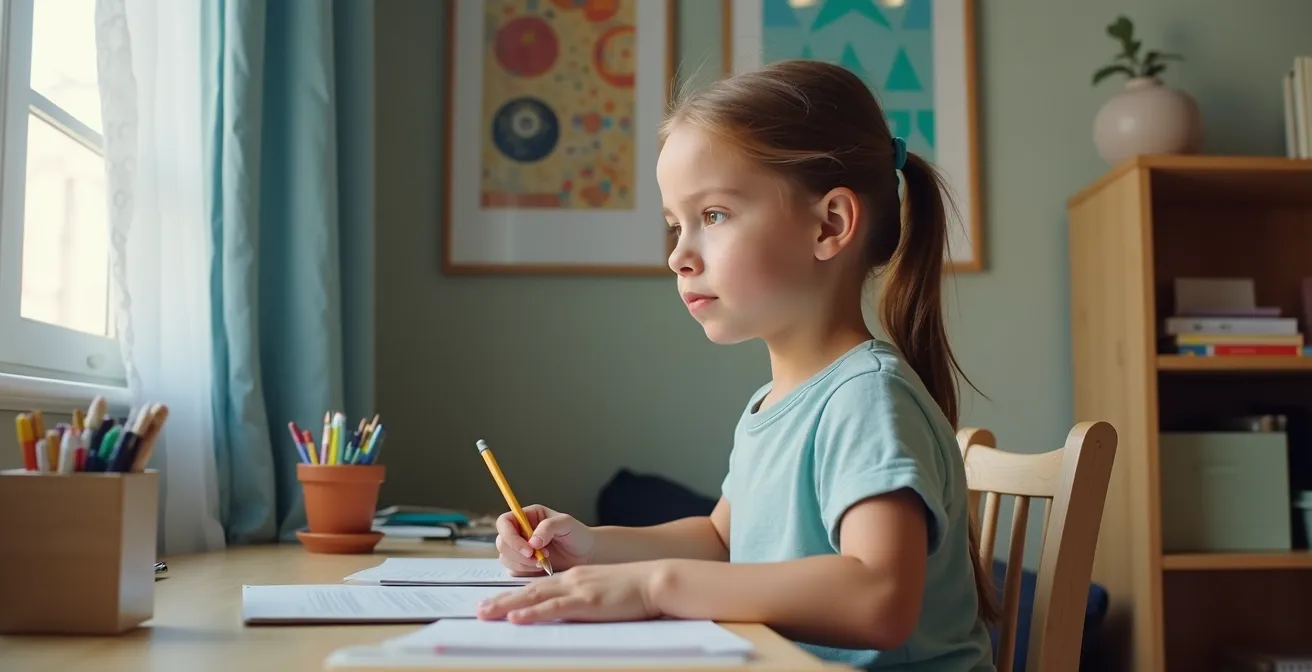
In summary:
- Preventing slouching requires an entire ergonomic system, not just a single chair.
- Proper support for the feet is non-negotiable as it stabilizes the pelvis and the entire spinal column.
- Environmental factors like lighting and even clothing waistbands provide sensory feedback that directly impacts posture.
- Regular, short movement breaks are clinically proven to be more effective than maintaining a single “perfect” posture.
Observing your school-aged child collapse into a C-shape over their homework is a deeply familiar and concerning sight for many parents. The immediate instinct is to blame the chair, leading to a frustrating search for that one perfect piece of furniture. While a supportive chair is a component, the common advice often misses the fundamental clinical picture. The belief that a single product can “fix” slouching is a significant oversimplification of pediatric ergonomics.
From an occupational therapy perspective, a child’s posture is the functional outcome of their entire sensory environment. It’s a complex interplay between their body and their surroundings. The real cause of chronic slouching is rarely just a bad chair; it’s a systemic failure of the entire workspace to provide the correct anatomical support and sensory feedback. The problem isn’t just the lumbar spine; it begins with dangling feet, is exacerbated by eye strain from poor lighting, and is even influenced by the restrictive pressure of their clothing.
This guide moves beyond the generic advice. Instead of focusing on a single piece of furniture, we will deconstruct the child’s entire homework ecosystem. We will adopt a corrective, anatomical lens to understand *why* slouching occurs and how to engineer a dynamic environment that promotes spinal health. This is about building a system where good posture becomes the path of least resistance for your child’s developing body.
This comprehensive overview will examine each critical component of your child’s study area. From the desk and foot support to lighting, seating choices, and even the clothes they wear, you will gain a clinical understanding of how each element contributes to—or detracts from—spinal alignment and focus.
Summary: The Anatomical Guide to a Slouch-Free Homework Station
- Why “Growing With You” Desks Save Backs and Money Over 5 Years?
- The Dangling Feet Issue: Why Footrests Are Essential for Focus?
- Warm or Cool Light: What Is Best for Reading Without Headaches?
- Bean Bag vs. Chair: Why Soft Seating Ruins Posture for Writing Tasks?
- When to Force a Standing Break: The 20-Minute Rule for Spines
- Why Poor Weight Distribution Leads to Chronic Slouching in 8-Year-Olds?
- The Rigid Waistband Mistake That Makes Boys Refuse to Sit Down
- How to Select an Ergonomic School Bag to Prevent Back Pain in Primary School?
Why “Growing With You” Desks Save Backs and Money Over 5 Years?
A child’s body is in a constant state of flux, with growth spurts rapidly altering limb length and torso height. A standard, fixed-height desk forces a child to adapt their body to the furniture, rather than the other way around. For a smaller child, a desk that is too high forces them to elevate their shoulders and abduct their arms, creating tension in the neck and upper back. As they grow, that same desk becomes too low, encouraging them to hunch forward and flex their spine to reach the work surface. This constant biomechanical compromise is a primary driver of postural dysfunction.
An adjustable desk, or a “growing desk,” is a critical investment in proactive spinal care. It is the only way to maintain the single most important ergonomic principle for seated work: ensuring the elbows are at a 90-degree angle with the wrists in a neutral position when typing or writing. This alignment minimizes strain on the entire upper body. High-quality adjustable desks are designed to accommodate this growth; in fact, a good quality height-adjustable desk can often keep up with a child’s growth for 4-5 years or more, making it a sound long-term investment.
When selecting such a desk, prioritize models with intuitive, safe adjustment mechanisms like locking rotary knobs or turn-handles. These allow for precise, controlled changes. Furthermore, features like a tiltable desktop provide another layer of ergonomic benefit, allowing a slight upward angle for reading (reducing neck flexion) and a flat surface for writing. This adaptability makes the desk a dynamic tool that serves the child’s body, not a static obstacle they must contort around.
The Dangling Feet Issue: Why Footrests Are Essential for Focus?
From a clinical standpoint, the feet are the foundation of seated posture. When a child’s feet dangle without firm contact with a surface, a predictable and damaging biomechanical cascade, or “postural chain” reaction, is initiated. Without a stable base, the pelvis lacks an anchor. To find stability, the child will often slide forward in their chair, causing the pelvis to tilt backward (posterior pelvic tilt). This immediately flattens the natural lordotic curve of the lumbar spine, forcing it into a flexed, or C-shaped, position.
This spinal flexion travels up the kinetic chain. The thoracic spine rounds into an exaggerated kyphosis (a hunchback posture), and to compensate for the downward gaze, the head juts forward, placing immense strain on the cervical spine and neck musculature. This entire “slouched” posture originates from the lack of foot support. Furthermore, dangling feet create pressure points on the back of the thighs, which can compress nerves and reduce blood flow, leading to fidgeting, discomfort, and a significant decrease in the ability to sustain attention on a task.
The non-negotiable solution is to ensure the child’s feet are firmly planted on a stable surface, with their knees bent at approximately 90 degrees. If the chair is adjusted to the correct height relative to the desk and their feet do not reach the floor, an adjustable footrest is not optional; it is essential. It provides the stable base needed to maintain a neutral pelvic position and support the natural curves of the spine.
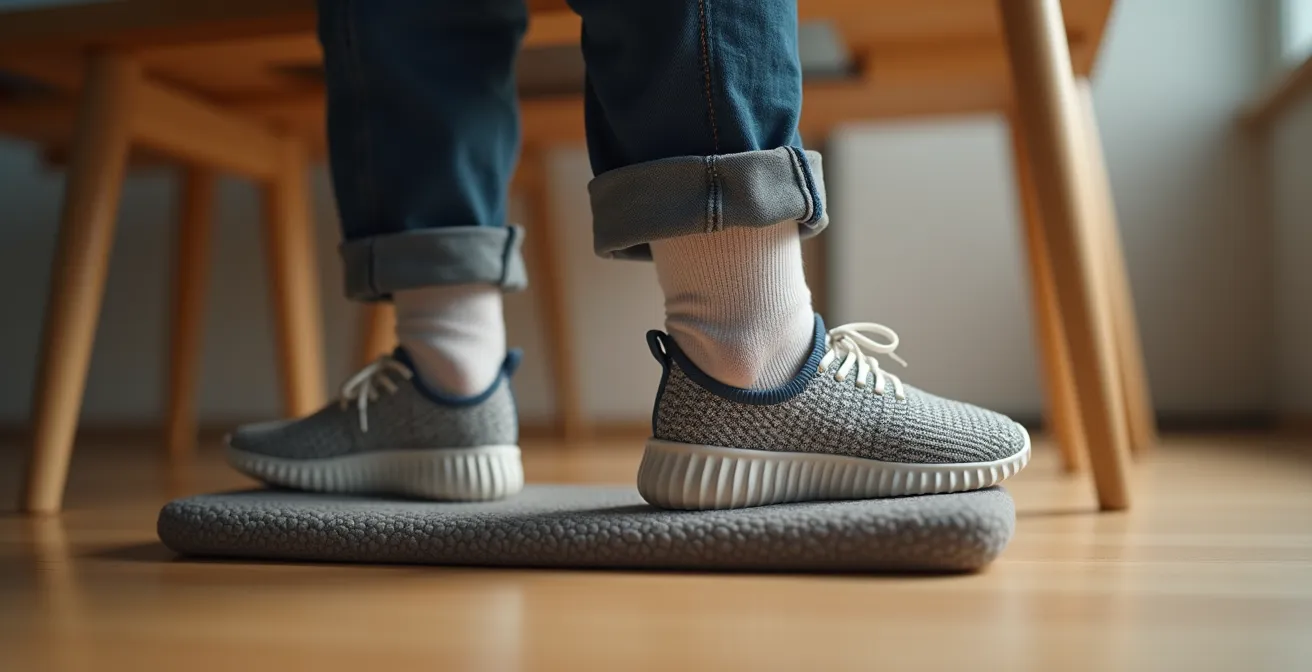
As you can see, firm contact with the footrest provides the stability required for the rest of the body to align correctly. This simple intervention is often the most impactful change a parent can make to immediately improve their child’s seated posture and concentration.
Warm or Cool Light: What Is Best for Reading Without Headaches?
Lighting is a frequently overlooked component of the ergonomic ecosystem, yet it has a direct impact on posture through its effect on the visual system. When lighting is too dim, too harsh, or creates glare on the work surface, a child will instinctively move their body to compensate. They will lean forward, crane their neck, and hunch their shoulders simply to get their eyes closer to the page or to angle their head to avoid a reflection. This sustained forward posture, driven by eye strain, reinforces the very slouching patterns parents are trying to prevent.
Headaches during or after homework are a classic symptom of poor lighting ergonomics. The solution is not just about brightness, but about the temperature and timing of the light. The sensory environment should adapt to the time of day to support both focus and the child’s natural circadian rhythm. Cool, bright light mimics daylight and is excellent for promoting alertness during afternoon study sessions. However, using this same light in the evening can disrupt melatonin production and make it harder for a child to wind down for sleep.
A strategic approach to task lighting is necessary. By adjusting the color temperature and brightness throughout the day, you can create an optimal sensory environment that supports vision without forcing postural compromises. This approach reduces eye strain, minimizes headaches, and helps keep the child’s spine in a neutral, upright position. The following table provides a clinically-informed strategy for task lighting.
| Time of Day | Light Temperature | Brightness Level | Purpose |
|---|---|---|---|
| Afternoon (2-5pm) | Cool (5000K-6500K) | Bright (400-500 lux) | Simulates daylight for focus |
| Evening (5-8pm) | Warm (2700K-3000K) | Dimmer (250-350 lux) | Protects circadian rhythm |
| Late Evening (8pm+) | Very Warm (2200K-2700K) | Low (150-250 lux) | Prepares for sleep |
Implementing such a strategy, as suggested by data found in guides like one from Eureka Ergonomic on setting up kids’ desks, can significantly reduce the physical stress associated with reading and studying.
Bean Bag vs. Chair: Why Soft Seating Ruins Posture for Writing Tasks?
It is crucial to differentiate between seating for passive activities (like watching a movie) and active, task-oriented seating (like writing or problem-solving). A bean bag, sofa, or bed falls squarely into the category of passive seating. While comfortable for relaxation, it is anatomically destructive for focused work. These soft surfaces provide zero pelvic or lumbar support. When a child attempts to write while sitting on a bean bag, their pelvis sinks and tilts backward, forcing their entire spine into a deep, unsupported C-curve.
To perform a task like writing, they must then hyper-flex their neck and hunch their shoulders forward to get their eyes and hands over their work. This position puts enormous strain on spinal ligaments and back muscles. An ergonomic task chair, by contrast, is designed for active support. Its key features are a firm seat pan that promotes a neutral pelvic position and a contoured backrest. Indeed, research on ergonomic seating shows that features like curved or winged backrests provide essential feedback to a child’s spine, actively encouraging the maintenance of healthy posture.
The solution is not to banish soft seating, but to clearly delineate its function. Parents must create a clear physical and mental separation between “relaxation zones” and “workstation zones.” The transition from one to the other acts as a powerful cue to the brain, signaling a shift in postural and cognitive demands.
Your Action Plan: The Transition Ritual Strategy
- Designate the bean bag or soft seating as a “relaxation zone” for passive activities like listening to music or reading for pleasure only.
- Create a clear physical separation in the room between the relaxation zone and the dedicated homework workstation.
- Establish a consistent verbal cue to signal the change, such as: “Okay, it’s focus time. Let’s move to your workstation.”
- Have the child physically stand up and move from the soft seating to their ergonomic chair and desk.
- Use this physical act of transitioning as a powerful brain signal to activate “focus mode” and adopt a task-ready posture.
When to Force a Standing Break: The 20-Minute Rule for Spines
No matter how “perfect” a seated posture is, the human body is not designed to remain static. Prolonged sitting leads to a phenomenon known as “postural creep,” where spinal ligaments slowly deform under constant load, and postural muscles fatigue and switch off. This fatigue is precisely why a child who starts their homework sitting perfectly upright is often slumped over 25 minutes later. The instruction to “sit up straight” is ineffective against muscle fatigue. The only clinical solution is frequent postural change and movement.
The idea of forcing a child to sit still for an hour is an outdated and anatomically harmful concept. A dynamic approach is far more effective for both spinal health and sustained focus. To combat postural fatigue, we must integrate short, regular movement breaks. In fact, ergonomics experts at Cornell University suggest a pattern similar to the “20-8-2” rule: for every 20 minutes of sitting, one should stand for 8 minutes and move for 2 minutes. For children, a simplified version is highly effective: sit for 20-25 minutes, then take a 2-5 minute standing or movement break.
These breaks don’t need to be disruptive. They can be simple “movement snacks” performed right at the desk. Encourage your child to stand up and stretch towards the ceiling, perform a few gentle spinal twists in their chair, do 10 push-ups against a wall to counteract the forward hunch, or simply walk to the kitchen for a glass of water. The goal is to unload the spine, reactivate dormant muscles, and reset their postural awareness. A timer can be a helpful, non-confrontational tool to enforce this essential rule.
Why Poor Weight Distribution Leads to Chronic Slouching in 8-Year-Olds?
Slouching is not just a forward-and-back issue; it also has a side-to-side, or lateral, component. Asymmetrical posture, where a child consistently leans or shifts their weight to one side, is a significant concern. This often happens when a chair’s seat pan is too wide or too deep for the child’s frame. To feel stable or to get closer to the armrest, the child will shift their pelvis to one side. This causes a lateral tilt in the pelvis, which the spine must then compensate for by curving to the opposite side (a functional scoliosis) to keep the head level.
This subtle, habitual leaning can lead to muscle imbalances, with muscles on one side of the trunk becoming chronically tight and shortened, while those on the other become overstretched and weak. An 8-year-old, with their developing musculoskeletal system, is particularly vulnerable to these patterns becoming ingrained. The chair must fit the child like a glove, not a cavernous armchair. The seat depth should allow for 2-3 fingers of space between the back of the child’s knee and the edge of the seat, and the width should be just enough to be comfortable without encouraging leaning.
Parents can perform a simple diagnostic check at home to look for these asymmetries. This “Mirror Test” can quickly reveal subtle imbalances:
- Have your child sit in their usual homework position, as if you were not there.
- Stand directly behind them, holding a smartphone or camera at their shoulder height.
- Take a photograph, ensuring it is perfectly level.
- Analyze the photo: Are their shoulders at the same height? Is one ear lower than the other? Do you see a curve in their spine or a noticeable head tilt?
- If you detect any asymmetry, the first step is to re-evaluate the fit of the chair and ensure their feet are fully and evenly supported.
Key Takeaways
- An ergonomic chair is only one part of a complete system; the desk, footrest, and lighting are equally critical for preventing slouching.
- Good posture is dynamic, not static. The goal is to facilitate frequent movement and postural changes, not to enforce a single rigid position.
- The child’s environment sends constant sensory signals (light, pressure from clothing) that directly influence their ability to maintain spinal alignment.
The Rigid Waistband Mistake That Makes Boys Refuse to Sit Down
A child’s refusal to sit still is often interpreted as a behavioral issue, but it can frequently be rooted in sensory discomfort. The body’s sense of self-movement and body position is called proprioception. Clothing that is too tight, especially around the waist, can provide a constant, noxious proprioceptive input. A rigid, non-stretch waistband from jeans or formal trousers digs into the abdomen when a child is seated, creating a focal point of pressure and discomfort. This is particularly noticeable in boys due to anatomical differences.
This persistent, irritating signal from the waistband can overload a child’s sensory system. To escape the discomfort, they may fidget, squirm, perch on the edge of their chair, or refuse to sit down altogether. They are not being “disruptive”; their body is instinctively trying to solve a sensory problem. This is a crucial, often-missed piece of the ergonomic puzzle. As experts in sensory processing note, this discomfort can have a direct effect on a child’s ability to focus and participate in tasks.
One study found that proprioceptive difficulties among children may contribute to decreased motor planning and postural control leading to disruptive behaviors that negatively affect their participation in daily tasks.
– Brain Balance Centers, Proprioception and Sensory Processing Research
The solution is simple but profound: ensure that clothing worn during homework allows for unrestricted movement and provides no negative sensory feedback. As soon as a child gets home from school, they should change out of restrictive uniforms or jeans and into “homework clothes”—soft, breathable garments with elastic waistbands like joggers or leggings. Removing this source of sensory irritation can dramatically improve a child’s ability and willingness to sit comfortably and maintain a proper posture.
How to Select an Ergonomic School Bag to Prevent Back Pain in Primary School?
The ergonomic battle is often lost before a child even sits down at their desk. A heavy, poorly-fitted school bag acts as a “pre-fatiguing” force on the very postural muscles required for sitting upright. A bag that is too heavy or hangs too low forces a child to lean their trunk forward from the hips and jut their head forward to counterbalance the load. They essentially walk to and from school in a slouched position. By the time they arrive home, their spinal erector muscles are already exhausted, making it nearly impossible to maintain good posture during homework.
Selecting and packing a school bag is a critical ergonomic intervention. The total weight of the packed bag should never exceed 10-15% of the child’s body weight. The bag itself should be lightweight and have two wide, padded shoulder straps that are adjusted so the bag sits high on the back. The bottom of the bag must never hang below the child’s waist; it should rest in the contour of their lower back. A chest strap and a waist belt are excellent features that help distribute the load more evenly across the torso, taking pressure off the shoulders and spine.
How the bag is packed is just as important as the bag itself. Follow these clinical guidelines for fitting and packing:
- Heaviest Items Closest: Pack the heaviest items, like textbooks and laptops, in the compartment closest to the child’s spine.
- Even Distribution: Use all compartments to distribute the weight evenly and prevent items from shifting.
- Symmetrical Straps: Always use both shoulder straps and ensure they are adjusted to equal lengths. Carrying a heavy bag on one shoulder is a primary cause of postural asymmetry.
- Waist-Level Rule: Regularly check that the bottom of the bag sits at or above the child’s waist level.
Begin today by observing your child’s entire homework environment, not just their chair. A systematic assessment of this complete ergonomic ecosystem is the first, most critical step toward building lasting postural health and focus.