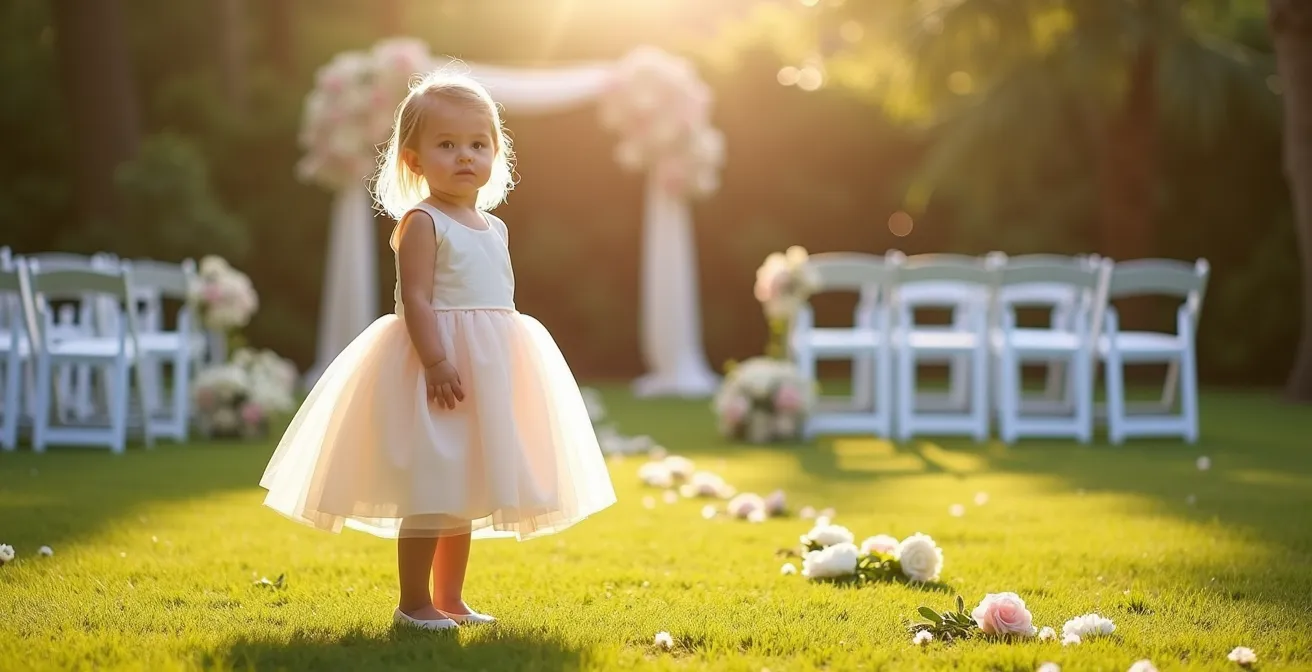
The secret to a perfect flower girl experience lies in treating the dress not as a fragile garment, but as a piece of high-performance engineered apparel.
- Prioritize safety and mobility over aesthetics, especially for toddlers, by choosing tea-length or shorter hemlines.
- Select fabrics strategically: multi-layered tulle for its wrinkle-hiding volume, and breathable cottons for comfort during long events.
Recommendation: Adopt a “two-outfit” strategy—a formal dress for the ceremony and photos, and a comfortable, dedicated reception outfit to ensure happiness and prevent meltdowns.
The vision is always enchanting: a little one, angelic in white, gliding down the aisle scattering petals. For mothers, however, this magical image is often shadowed by practical anxieties. Will she trip? Will the fabric be itchy? Will this beautiful, expensive dress survive a ten-hour marathon of running, dancing, and potential cake-related incidents? The pressure to find a dress that is both fairy-tale perfect and child-proof is immense. Many parents focus on matching the bridal theme or finding the most voluminous ball gown, believing that aesthetics are paramount.
While a beautiful dress is essential, the conventional approach often overlooks the most critical factor: the child’s experience. This guide reframes the selection process. The key isn’t simply to find a miniature wedding dress; it’s to apply a form of child-centric engineering to formalwear. We will move beyond the common advice to explore the technical ‘why’ behind each choice—from the physics of fabric wrinkles to the ergonomics of a non-slip headband. It’s about making strategic decisions that ensure the dress has all-day endurance.
By understanding the failure points of formal children’s wear, you can proactively choose a dress that not only looks breathtaking in photos but also supports a happy, comfortable, and safe experience for your flower girl. We will dissect everything from hemline safety for toddlers to the science of long-term fabric preservation, transforming you from a worried shopper into an expert bridal consultant for your own child.
This guide provides a complete roadmap for selecting an all-day flower girl dress. We will cover the critical aspects of safety, fabric performance, accurate measurements, accessory choices, and long-term care to ensure both a magical day and a lasting memento.
Summary: The All-Day Flower Girl Dress: A Survival Guide to Magical and Meltdown-Proof Attire
- Why Floor-Length Dresses Are Dangerous for Walkers Under 3 Years?
- How to Store a Satin Dress so It Does Not Yellow Over 10 Years?
- Tulle or Silk: Which Fabric Hides Wrinkles Better in Photos?
- The Measurement Error That Makes Online Dress Orders Fail 40% of the Time
- How to Choose Headbands That Don’t Slip During the Ceremony?
- Renting vs. Buying: Which Makes Sense for a Ring Bearer Outfit?
- How to Disassemble Box Costumes to Store Them Flat?
- How to Dress Kids for Summer Weddings Without Causing Meltdowns?
Why Floor-Length Dresses Are Dangerous for Walkers Under 3 Years?
For a toddler who has recently mastered walking, a floor-length dress presents a significant and often underestimated safety hazard. At this developmental stage, children have a higher center of gravity and a wider, less stable gait. They frequently look up or around, not at their feet, making them prone to tripping over their own clothing. A hemline that brushes the floor can easily get caught under a small foot or shoe, especially during a moment of excitement or a quick turn, leading to a fall that could cause serious injury and certainly distress during a major event.
Beyond the immediate trip hazard, overly long or restrictive dresses can impede crucial motor skill development. According to insights on child development, it’s vital that clothing allows for a full range of motion for movements like crawling, climbing, and sitting. A long, cumbersome skirt can prevent a child from navigating stairs, getting up from the floor, or even sitting comfortably. The “cruising” phase, where toddlers pull themselves up on furniture, is particularly risky, as excess fabric can snag on table corners or chair legs.
For this reason, tea-length (falling mid-calf) or even shorter hemlines are the safest and most practical choice for flower girls under the age of three. This length provides the formal, elegant look desired for a wedding while ensuring the child’s feet are completely clear and their movement is unrestricted. While a floor-length gown might be tempting for a single, static photograph, the risk it poses throughout a long and active day is simply not worth it. Prioritizing freedom of movement is the first rule of child-centric dress engineering.
Ultimately, a comfortable and safe child is a happy child, which is the true goal for any family member participating in a wedding.
How to Store a Satin Dress so It Does Not Yellow Over 10 Years?
A flower girl’s satin dress is more than an outfit; it’s a cherished keepsake. Yet, many of these precious garments are pulled from storage years later only to be found discolored with a distinct yellow tinge. This yellowing is not a sign of poor quality but a chemical reaction. It’s primarily caused by the oxidation of leftover residues, such as soaps, starches, or even invisible spills, and is accelerated by improper storage materials and environments.
The single biggest mistake is storing the dress in a plastic garment bag. Plastic traps moisture and emits chemical fumes that can cause fabric to break down and yellow over time. The gold standard for textile preservation, as recommended by archival experts, is to use materials that are both chemically stable and breathable. According to a guide on archival storage of textiles, this means opting for acid-free boxes lined with acid-free tissue paper or using garment bags made from unbleached cotton muslin or Tyvek. These materials protect the dress from dust and light while allowing air to circulate, preventing moisture buildup.
Before storage, the dress must be impeccably clean. It’s crucial to have it professionally cleaned or to wash it yourself using a pure detergent—not a soap, which can leave an alkaline residue that causes yellowing—and distilled water to avoid mineral deposits. Once clean, store the garment in a stable, cool, and dark environment with moderate humidity. Attics and basements are the worst locations due to their extreme temperature and humidity fluctuations. A closet in the main living area of your home is a much safer choice for long-term preservation.
By investing in the right materials and environment, you can ensure the dress remains as beautiful as the day it was worn for decades to come.
Tulle or Silk: Which Fabric Hides Wrinkles Better in Photos?
In the world of wedding photography, wrinkles are the enemy. A sharply creased dress can catch the light in unflattering ways, creating distracting lines that detract from the moment’s magic. When choosing a flower girl dress, the fabric’s propensity to wrinkle—and its ability to hide those wrinkles—is a major factor in the aesthetic-comfort matrix. The two classic choices, silk/satin and tulle, perform in dramatically different ways.
Silk and satin are known for their luxurious sheen and smooth drape. However, this same lustrous surface is what makes them unforgiving. Any crease or fold creates a sharp edge that catches the light, making wrinkles highly visible in photographs. These fabrics have poor “crush recovery,” meaning once a wrinkle is set (from sitting in a car, for example), it requires immediate attention, usually with a steamer, to be removed. For a child who will be sitting, playing, and being carried throughout the day, a satin dress is almost guaranteed to show signs of wear in photos taken later in the event.
Tulle, on the other hand, is a photographer’s best friend. Because tulle dresses are almost always constructed with multiple, lightweight layers, the fabric creates volume and softness rather than a flat, reflective surface. When tulle rumples, it creates soft, diffused shadows that blend into the dress’s overall texture. It doesn’t form the sharp, light-catching creases that satin does. This structural advantage gives it excellent “bounce-back” and wrinkle recovery. This comparative analysis highlights the practical differences for a long event.
| Fabric Type | Wrinkle Visibility | Recovery After Compression | Photo Performance |
|---|---|---|---|
| Tulle (Multi-layered) | Low – soft rumples blend into volume | Excellent bounce-back | Forgiving in all lighting |
While a silk or satin dress can look impeccable at the start of the ceremony, a multi-layered tulle gown is the superior choice for maintaining a flawless look from the first photo to the last. It offers a level of “wrinkle camouflage” that is simply unmatched, ensuring the flower girl looks ethereal and picture-perfect all day long.
For parents prioritizing photo-readiness throughout the entire event, the forgiving nature of tulle is the most strategic choice.
The Measurement Error That Makes Online Dress Orders Fail 40% of the Time
Ordering a flower girl dress online offers convenience and a world of choice, but it comes with a significant risk: a poor fit. While no official statistic claims a 40% failure rate, the anecdotal evidence from bridal forums and alteration shops is overwhelming. The single most common and critical measurement error parents make is measuring for the present instead of the future. Children grow, and their growth is unpredictable. Measuring for a perfect fit today for a wedding three months away is a recipe for a dress that is too tight and uncomfortable on the big day.
A successful online order depends on anticipating growth and prioritizing “wiggle room.” Bridal experts universally recommend ordering the dress just 2-3 months before the wedding, as this strikes a balance between securing the dress in time and minimizing the impact of a sudden growth spurt. However, even within that window, you must measure correctly and build in a buffer. The most critical failure point is often the torso length and waist. A common mistake is measuring a child while they are standing tall, but forgetting that the dress needs to be comfortable when they sit. A torso that fits perfectly while standing can become constricting when seated for a long dinner.
To avoid this, you must adopt a professional measurement protocol. It’s not just about the numbers; it’s about how you take them and what you account for. This checklist provides a framework for getting it right.
Your Pre-Order Measurement Checklist: Ensuring a Perfect Fit
- Account for growth: If the wedding is more than two months away, consider ordering one size up and planning for minor alterations.
- Prioritize comfort: Choose dresses with some “wiggle room” or features like a sash that can cinch the waist for a better fit, rather than a perfectly tailored size.
- Consider the diaper factor: For toddlers, always allow for diaper bulk when measuring the waist and hips, as this can add a full inch or more.
- Measure for sitting comfort: After taking standing measurements, have the child sit down and measure the torso length again to ensure there is no pulling or tightness.
- Think about length: For young children, tea-length is always a safer bet to prevent tripping, even if floor-length is an option.
This strategic approach to measurement is the best insurance against the disappointment and last-minute stress of a dress that simply doesn’t fit.
How to Choose Headbands That Don’t Slip During the Ceremony?
A floral crown or a delicate headband is often the finishing touch that elevates a flower girl’s look from sweet to truly angelic. However, this charming accessory can quickly become a source of frustration if it constantly slips, tips forward, or causes discomfort. A child fussing with her headband during the ceremony is a distraction for everyone. The key to a successful hair accessory is not just its beauty, but its ergonomic design and stability on a child’s head.
The primary reasons headbands fail are poor grip, excessive weight, and pressure points. Children, especially toddlers, have finer, softer hair that offers less traction than adult hair. A smooth plastic or metal band has very little to grip onto and will inevitably slide out of place. Furthermore, a headband that is too heavy, perhaps adorned with large, oversized flowers, will naturally want to tip forward with every movement. Finally, a band that is too tight will create painful red marks behind the ears, leading to a meltdown and the accessory being ripped off within minutes.
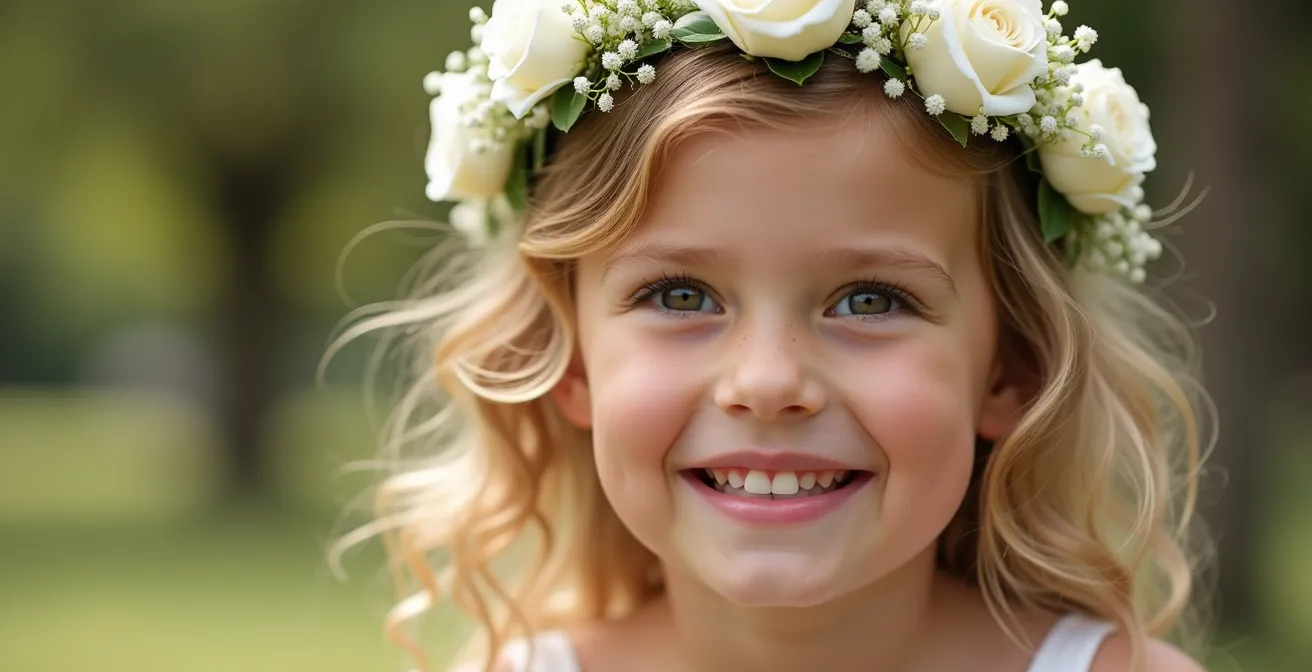
The solution is to choose an accessory with built-in stability features. According to expert styling guides, it’s essential to look for headbands with features designed for hold and comfort. Search for bands with a soft inner lining made of felt or velvet, or those that incorporate subtle micro-grip materials on the inside. For very fine hair, a full elastic band that goes all the way around the head often provides a much better and more comfortable grip than a hard, C-shaped band. Before the wedding day, a “test wear” is non-negotiable. Have the child wear the accessory for at least five minutes of active play. Afterwards, check for any red marks and see if it stayed in place. As a final pro tip, always have a backup plan, like a few simple, decorative hair clips, ready for a quick and easy switch if the primary accessory fails.
This thoughtful approach ensures the accessory enhances the magic of the moment, rather than becoming a distraction from it.
Renting vs. Buying: Which Makes Sense for a Ring Bearer Outfit?
While this guide focuses on flower girls, the principles of child-centric formalwear apply equally to ring bearers. One of the biggest logistical questions for parents is whether to rent or buy the outfit. Unlike a flower girl dress, which is often kept as a keepsake, a boy’s suit or tuxedo is less likely to hold the same sentimental value and is more easily outgrown. The decision hinges on a practical evaluation of cost, fit, and convenience.
Renting offers two major advantages: lower initial cost and built-in flexibility. A rental typically costs a fraction of the purchase price, which is a significant benefit for an outfit that will likely be worn only once. More importantly, rental companies are built to handle growth spurts. It’s a well-known fact that unpredictable growth spurts in children aged 3-8 make buying formalwear months in advance a gamble. With a rental, you can submit final measurements much closer to the event date and often have access to last-minute size exchanges, providing invaluable peace of mind. Furthermore, the rental fee usually includes damage waivers and cleaning, removing the post-wedding hassle and liability.
Buying, on the other hand, offers ownership and the potential for reuse if you have other formal events or younger children. However, it comes with higher upfront costs and the full risk of the child outgrowing the outfit before the wedding. The owner also bears all responsibility for cleaning, storage, and any damage that occurs. This table breaks down the core considerations to help you make an informed choice.
| Factor | Renting | Buying |
|---|---|---|
| Initial Cost | Lower (30-50% of purchase price) | Higher upfront investment |
| Size Changes | Last-minute exchanges available | Risk of poor fit if bought early |
| Damage Liability | Often covered by rental company | Owner bears all risk |
| Storage/Cleaning | Not required | Professional cleaning and archival storage needed |
For most one-off events like a wedding, the flexibility and cost-effectiveness of renting make it the most logical and stress-free option for ring bearer outfits.
How to Disassemble Box Costumes to Store Them Flat?
Sometimes, the little ones in a wedding party are given more theatrical roles that come with novelty costumes, such as a ring bearer dressed as a little car or a flower girl in a large, boxy flower pot outfit. While charming on the day, these bulky, three-dimensional costumes present a significant storage nightmare. Unlike a dress that can be hung or folded, these items take up immense space. The secret to long-term storage is careful disassembly with the goal of storing all components flat.
Before you begin, take photos from every angle. This visual record will be your instruction manual when you need to reassemble the costume in the future. Next, carefully examine how the costume is constructed. Most box costumes are held together with a few common methods: hot glue, Velcro, fabric ties, or staples. Your disassembly strategy will depend on the fastener.
Here’s a step-by-step approach to breaking down a typical box costume:
- Identify the Seams: Look for the primary connection points where the large panels of the box are joined. These are your targets.
- Deconstruct Gently: If it’s held by Velcro or fabric ties, simply undo them. If hot glue was used, you can often gently warm the seam with a hairdryer on a low setting to soften the glue, then carefully pull the panels apart. For staples, use a staple remover to extract them without tearing the cardboard or fabric.
- Remove Appendages: Carefully detach any decorative elements like wheels, headlights, or petals. Place all small hardware (screws, clips, etc.) into a labeled zip-top bag and tape it securely to one of the main panels.
- Stack and Store: Once all components are separated and flat, stack them neatly. To prevent color transfer or sticking, place a sheet of acid-free tissue paper between each decorated piece. Slide the entire flat-packed costume into a large, sturdy portfolio or between two large pieces of cardboard to keep it protected and flat in storage.
This approach not only saves precious storage space but also preserves the costume for future use or as a fun childhood memento.
Key Takeaways
- Safety Over Style: For toddlers, a tea-length dress is non-negotiable to prevent trips and allow for natural movement.
- Fabric is Functional: Choose multi-layered tulle for a wrinkle-proof look in photos and breathable cotton blends for all-day comfort, especially in warm weather.
- Plan for the Future: Whether buying a dress (anticipate growth spurts) or storing it (use archival materials), a preservation-minded approach prevents future problems.
How to Dress Kids for Summer Weddings Without Causing Meltdowns?
A summer wedding presents a specific challenge: heat. For a child, being hot and uncomfortable is the fastest path to a full-blown meltdown, regardless of how beautiful their outfit is. The key to success is a strategy built around breathability and adaptability. Aesthetics must work in harmony with thermal comfort. Forcing a child into a heavy, multi-layered satin ball gown for an outdoor ceremony in July is setting them up for misery.
The most effective strategy is the “two-outfit” approach. This involves planning for two distinct garments: one for the formal part of the day and one for the reception. The ceremony outfit can be the more formal, photo-ready dress, but it should still be chosen with the weather in mind. Look for dresses made from natural, breathable fabrics like cotton, linen, or lightweight silk blends. Even with a formal dress, you can enhance comfort by choosing moisture-wicking undergarments and ensuring all tags and itchy seams are removed well in advance.
Once the ceremony and main photos are complete, it’s time for the switch. The reception outfit should be all about comfort. A simple, breathable cotton sundress or a comfortable romper allows the child to run, play, and dance without being constrained by heavy or delicate fabrics. This not only makes the child happier but also protects the more expensive ceremony dress from the inevitable wear and tear of a reception. Don’t forget the footwear; have a pair of comfortable sandals or flats ready to replace the formal ceremony shoes. This simple switch can completely transform a child’s experience of the day.
Armed with this knowledge, you are now ready to choose a dress that ensures your flower girl feels as magical as she looks, from the first photo to the last dance.