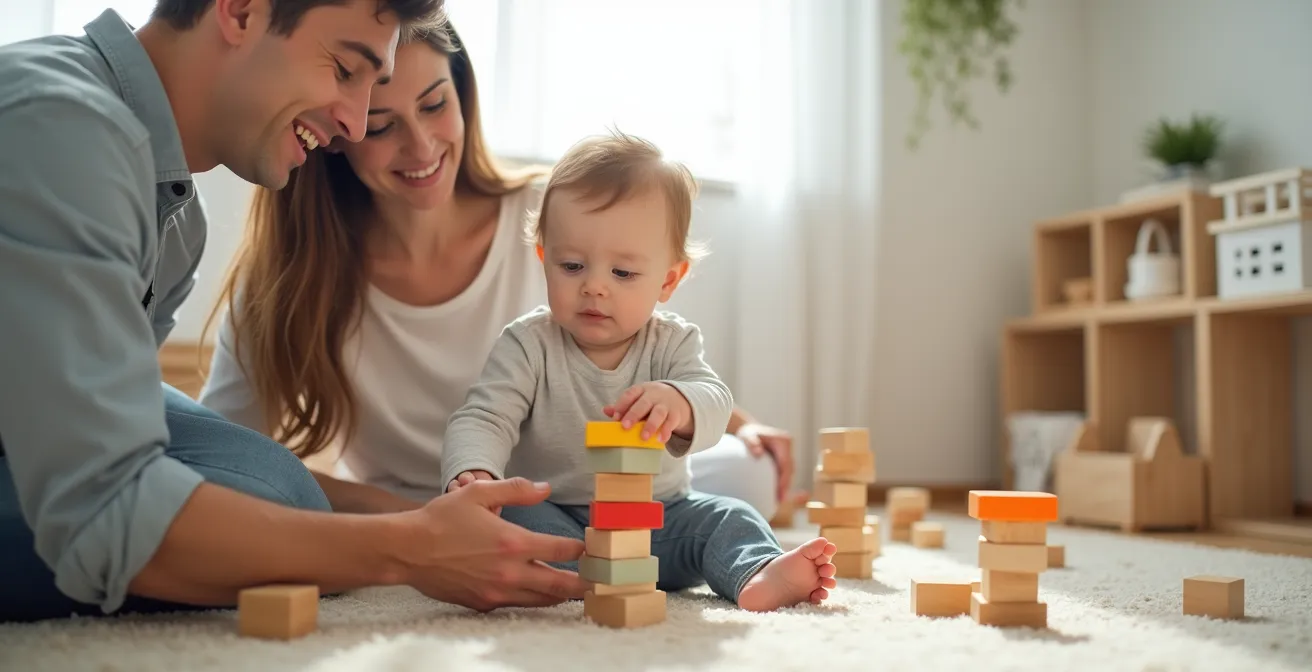
The constant pressure to track developmental milestones is creating more parental anxiety than it solves. The key isn’t to track harder, but to observe better.
- Cognitive growth is not a linear race; skills often appear, disappear, and re-emerge as the brain reorganizes itself for more complex tasks.
- Foundational social skills, like sharing attention with you, are far better predictors of future learning than rote abilities like counting.
Recommendation: Shift your focus from a checklist of “what” your child can do to observing “how” they explore, connect, and solve problems within their environment.
As a developmental pediatrician, I see a common thread of anxiety weaving through modern parenting: the milestone checklist. Parents arrive at appointments armed with apps and charts, their voices tight with concern. “He’s 14 months and not walking,” or “She only has five words, is she behind?” This hyper-focus on hitting discrete, average-based targets turns the beautiful, messy process of development into a high-stakes performance review for both child and parent. The internet is saturated with lists of what your child *should* be doing, fueling a cycle of comparison and worry.
The standard advice to “not worry” and that “every child is different” often falls flat because it lacks actionable guidance. But what if the entire framework of a developmental race is flawed? What if the key to understanding your child’s cognitive journey wasn’t about checking boxes, but about learning to see the intricate patterns of their unique growth? The truth is, a child’s brain development is not a straight line. It’s a dynamic, complex dance of progress, temporary plateaus, and even regressions, all of which are normal and necessary parts of building a sophisticated mind.
This guide is designed to shift your perspective from that of an anxious auditor to a confident, curious observer. We will move beyond the “what” and delve into the “how” and “why” of cognitive growth. You will learn to recognize the powerful, underlying processes at play, from the science behind developmental leaps to the profound importance of shared experiences. By the end, you’ll have a new set of tools—not for tracking, but for truly seeing and supporting the brilliant, one-of-a-kind development happening in your child every day.
To help you navigate this new perspective, this article explores the essential shifts in mindset and observation. We will cover why developmental ranges are so wide, how to foster foundational skills, and what to do with the information you gather.
Summary: Observing Your Child’s Growth: A Pediatrician’s Guide to Less Anxiety
- Wide Normal Ranges: Why Walking at 10 Months or 15 Months Is Both Fine?
- The Marshmallow Test at Home: Can You Teach Delayed Gratification?
- Why Skills Disappear Before a Major Developmental Leap?
- App vs. Notebook: The Best Way to Keep Records for Check-Ups?
- Why Noticing “Joint Attention” Is More Important Than Counting to 10?
- How to Ask “Is This Normal” Without Being Dismissed as Anxious?
- Why Repeating the Same Yearly Rituals Reduces Anxiety in Children?
- How Does Your Home Environment Impact Cognitive Growth in Toddlers?
Wide Normal Ranges: Why Walking at 10 Months or 15 Months Is Both Fine?
One of the greatest sources of parental anxiety is the idea of a fixed “due date” for milestones like walking. The reality is that child development operates within wide windows of normalcy, not on a rigid timeline. A child’s brain is not programmed to master skills in a predetermined order. Instead, it prioritizes. Some toddlers focus their immense neural energy on mastering language, becoming highly verbal early on while their gross motor skills take a backseat. Others are single-minded in their quest for mobility, climbing and cruising long before they string two words together. This is not a deficit; it’s a developmental pathway—your child’s unique neurological wiring at work.
These individual differences are why the “normal” range for walking is so broad, typically from 10 to 18 months. Data from the Centers for Disease Control and Prevention confirms this variability, showing that while many children walk earlier, 75% of children walk by 15 months, implying a significant and perfectly normal portion develops this skill later. Focusing on a single, average date ignores the holistic picture of your child’s progress. Are they an expert problem-solver, figuring out how to retrieve a toy from under the couch? Are they a keen observer, studying faces and interactions? These are all powerful indicators of cognitive growth, even if they aren’t as easily checked off a list as “takes first steps.”
Your role is not to push your child toward an arbitrary average but to observe and support their chosen area of focus. By celebrating what they *are* mastering, you recognize and nurture their individual strengths. This shift in perspective transforms anxiety about a “delayed” skill into fascination with a developing specialization.
The Marshmallow Test at Home: Can You Teach Delayed Gratification?
The famous “marshmallow test,” where children are tested on their ability to wait for a better reward, has become a cultural touchstone for self-control. Parents often wonder how they can “teach” this skill, sometimes creating high-pressure situations at home. However, decades of follow-up research have revealed a crucial insight: a child’s ability to delay gratification is less about innate willpower and far more about trust in their environment. Children who experience consistent, reliable caregiving—who trust that the promised second marshmallow will actually appear—are much better at waiting.
Rather than staging formal tests, you can build this foundational trust and patience through playful, everyday routines. This is a form of qualitative observation where you focus on building a skill through connection, not measurement. As one study on cognitive development highlights, incorporating small moments of waiting into positive contexts is highly effective. This might look like waiting for a specific song to start before a dance party, finishing a puzzle piece together before turning the page of a book, or waiting for the toast to pop before getting a snack. These low-stakes, predictable “waiting games” build the neural pathways for self-regulation without the pressure of performance.
The goal is to create an environment where waiting is a normal and even enjoyable part of a shared activity, not a test of character. By doing so, you’re not just teaching patience; you’re building a secure attachment and a regulated nervous system, which is the true foundation of executive function skills like self-control.

This image captures the essence of the concept: a moment of shared, calm waiting that is relational, not transactional. The focus is on the connection and the process, which is far more beneficial for a toddler’s developing brain than a formal test.
Why Skills Disappear Before a Major Developmental Leap?
One of the most perplexing and often frightening experiences for a parent is developmental regression. Your toddler, who was babbling a handful of words, suddenly goes quiet. Your child, who was sleeping soundly, begins waking multiple times a night. The immediate fear is that something is wrong. However, in a typically developing child, this temporary “disappearance” of a skill is often a hallmark of an impending developmental leap. This process is known as cognitive reorganization, and it’s akin to a computer system shutting down to install a major software upgrade.
The brain is dedicating immense resources to building a new, more complex neural framework. To do this, it temporarily diverts energy away from maintaining older, less-established skills. As one parent anecdotally shared, it’s common for toddlers to experience sleep disruptions just before a major milestone emerges, like a burst in language or motor ability. This isn’t a failure; it’s the brain doing intensive, behind-the-scenes work. In fact, developmental research indicates that regression occurs in up to 70% of toddlers before they make significant developmental progress. This temporary “downtime” is a sign of intense growth, not loss.
Observing these patterns can be incredibly reassuring. When you notice a skill go offline, instead of panicking, you can shift your mindset to one of curious anticipation. Ask yourself, “What new, amazing skill might be just around the corner?” This reframes a period of anxiety into an exciting preview of your child’s next stage of development, allowing you to see the bigger picture of their non-linear growth.
App vs. Notebook: The Best Way to Keep Records for Check-Ups?
In an age of data, the impulse to track every milestone is strong. Many parents feel pressured to use a digital app, while others prefer a simple notebook. As a pediatrician, my advice is to choose the method that best helps you shift from a “tracker” to an “observer.” The goal is not to amass a spreadsheet of data points, but to collect rich, qualitative observations that provide context for your child’s development. A 10-second video of your child attempting to stack blocks tells me more about their motor skills, frustration tolerance, and problem-solving abilities than a simple checkmark next to “stacks two blocks.”
The best method is the one that captures the *story* of your child’s development, not just the data. Your pediatrician doesn’t need a complete log of every single thing your child does. They need focused, relevant information that helps them assess your child’s overall trajectory. The following table compares different methods, framing them as tools for observation rather than tracking.
| Method | Best For | Key Features | Pediatrician Value |
|---|---|---|---|
| CDC Milestone Tracker App | Structured tracking | Illustrated checklists, automatic reminders, PDF summaries | Standardized data easily shareable |
| Aha! Moments Journal | Qualitative observations | Weekly surprising moments, story-based entries | Rich context for development discussion |
| Video Clips (10 seconds) | Accurate skill capture | Visual proof of skills, eliminates recall bias | Most accurate for assessment |
| Minimum Viable Tracking | Essential milestones only | Key firsts, persistent concerns, screener answers | Focused on clinically relevant data |
Consider an “Aha! Moments Journal” where you jot down one surprising or funny thing your child did each week. Or, create a small, private album of short video clips capturing new skills. This approach, which focuses on noteworthy progress and genuine concerns, is far more valuable for a pediatric check-up—and far less stressful for you—than a daily log of pass/fail milestones.
Why Noticing “Joint Attention” Is More Important Than Counting to 10?
In our achievement-oriented culture, parents often fixate on academic-style milestones: Can my child count? Do they know their colors? While these skills are wonderful, they are not the primary drivers of early cognitive development. A far more critical and predictive skill is joint attention. This is the simple, profound ability to share an experience with another person. When your toddler points at a dog and then looks back at you to see if you’re looking too, they are demonstrating this foundational skill. They are making what we call an “emotional bid” to connect and share a moment of interest.
This skill is the very bedrock of all future social, emotional, and even academic learning. As experts at the Virtual Lab School state in their work on early cognitive development:
Joint attention is the bedrock upon which all future learning (social, emotional, academic) is built. When a child points at a bird and looks back at you, they are making a ‘bid’ to share an experience.
– Virtual Lab School, Cognitive Development: Infants and Toddlers
Unlike counting, joint attention cannot be taught through flashcards. It is nurtured through responsive interaction. It’s about you noticing their bid for connection and responding to it. “Wow, you see that big dog! He has floppy ears!” This back-and-forth “emotional transaction” builds the neural architecture for communication, empathy, and learning from others. Instead of quizzing your child, focus on noticing and documenting these moments of shared connection. They are the truest indicators of a healthy, developing social brain.
How to Ask “Is This Normal” Without Being Dismissed as Anxious?
One of the most frustrating experiences for a concerned parent is feeling dismissed by a healthcare provider. Voicing a worry only to be told “don’t be anxious” or “let’s wait and see” can be invalidating and unproductive. The key to a more effective conversation is to shift from expressing generalized anxiety to presenting specific, observation-based data. This approach positions you not as an anxious parent, but as a competent, collaborative partner in your child’s care. Instead of asking a vague question like, “Should I be worried about his speech?” you can lead with your observations.
When you present concrete examples, you give your pediatrician clear information to work with. This moves the conversation from reassuring your emotions to assessing your child’s development. It invites a professional opinion on specific behaviors rather than a general judgment on your level of worry. The goal is to ask for a framework for your own observation, empowering you to know what to look for and when to be genuinely concerned. This is about turning your parental vigilance into a powerful tool for advocacy and understanding.
Action plan: Communicating with your pediatrician
- Lead with data: “I’ve observed he uses about 5 words and primarily communicates by pointing. Can you help me understand where that fits developmentally?”
- Request a framework: “I’m not seeking a diagnosis today, but rather a framework for observation. What are the 1-2 most important things to watch in his social play over the next three months?”
- Ask for specifics: Don’t settle for vague reassurance. Ask direct questions like, “What else could explain this pattern?” or “At what point should this become a clinical concern?”
- Document observations: Bring your “Aha! Moments Journal” or video clips. “Based on my tracking, he’s meeting these milestones but not this one. What’s your assessment of this specific skill?”
- Seek actionable guidance: Walk away with a clear plan. Ask, “What specific red flags should prompt me to schedule an earlier follow-up appointment?”
Why Repeating the Same Yearly Rituals Reduces Anxiety in Children?
In our quest to track daily progress, we often overlook a powerful, low-stress tool for observing growth: family rituals. Maintaining consistent yearly traditions—like visiting the same pumpkin patch each autumn, decorating the house for a holiday in the same way, or taking a photo in the same spot on their birthday—serves as a powerful qualitative measure of development. These rituals act as developmental anchors, providing a stable backdrop against which your child’s growth becomes strikingly visible.
As highlighted in one case study, parents notice dramatic year-over-year changes during these events without the pressure of daily tracking. A comment like, “Last year you could barely lift a small pumpkin, and this year you ran right to the biggest one!” is a joyful, organic observation of growth in strength, confidence, and motor planning. These rituals also build a child’s prospective memory. When a child can anticipate a known sequence of events (“After summer comes my birthday, and then we go to the apple orchard”), they are demonstrating a sophisticated cognitive ability that is a precursor to future planning skills. This sense of predictability creates a feeling of safety and control, which is essential for reducing anxiety in young children.
Furthermore, these shared experiences strengthen family bonds and create a positive emotional context for development. In fact, cognitive development research reveals that children with consistent family rituals show 40% better emotional regulation and social skills. By focusing on these meaningful, repeated experiences, you are not only creating cherished memories but also providing the exact kind of predictable, secure environment that fosters robust cognitive and emotional growth.
Key takeaways
- Your child’s development is not a race. Wide ranges for milestones are normal, reflecting unique developmental priorities.
- A child’s ability to self-regulate is built on a foundation of trust and security, not by testing their willpower.
- Social-emotional skills like joint attention are the true bedrock of future learning, more critical than early academic skills.
How Does Your Home Environment Impact Cognitive Growth in Toddlers?
After exploring the nuances of developmental timelines and observational techniques, the final and most important piece of the puzzle is the environment you create. You can put away the flashcards and educational toys, because extensive research points to a simpler, more powerful truth: the single most critical environmental factor for a toddler’s cognitive growth is the parent’s regulated nervous system. As experts from First Things First aptly state, “A parent who is calm and present creates the psychological safety a child needs for their brain to explore and learn optimally.” Your calm presence is the “safe harbor” from which your child feels confident enough to venture out and explore the world.
This principle extends to the physical space. Over-cluttered, over-stimulating rooms can overwhelm a developing brain, leading to fragmented attention and stress. Research on toddler cognition has shown that simplified play spaces with fewer, open-ended toys foster deeper focus and more complex imaginative play. One study noted that families who curated a responsive environment—where parents noticed and supported the child’s interest in simple objects like a wooden spoon and a pot—saw more sustained engagement than in rooms full of “educational” electronics. The learning comes not from the toy, but from the child’s freedom to explore and the parent’s gentle support of that exploration.
Ultimately, fostering cognitive growth is less about what you buy and more about who you are. By focusing on your own well-being and creating a calm, responsive, and connected environment, you are providing the ideal conditions for your child’s brain to thrive. You are the curriculum.
By letting go of the milestone race and embracing your role as a calm, curious observer, you give both your child and yourself the greatest gift: the freedom to enjoy the beautiful, unique journey of their development.