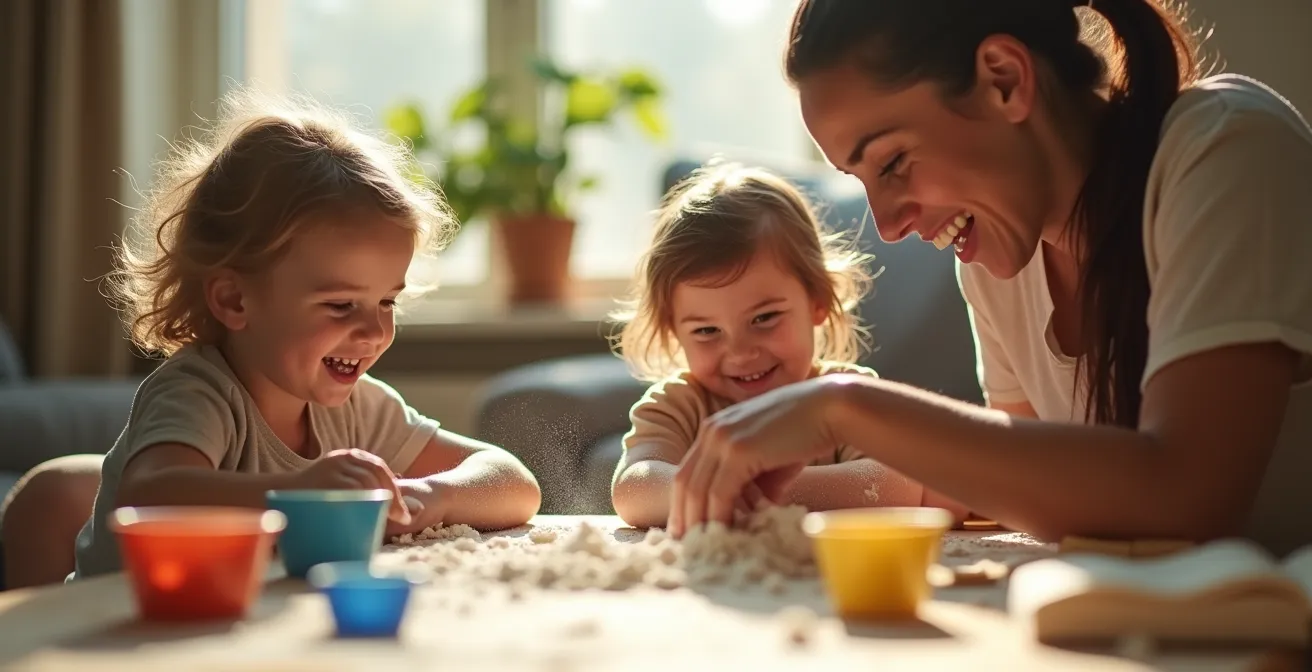
Many parents believe structured learning, like flashcards or educational apps, is the key to a child’s success. The truth is, this high-pressure approach often stifles the very curiosity it aims to build. This guide reveals how to reframe everyday activities—from baking to bathtime—into powerful, child-led “invisible labs.” You’ll discover how to become a curious collaborator rather than a teacher, fostering deep cognitive skills like critical thinking and problem-solving, all through the natural magic of play.
Does the thought of “teaching” your toddler feel like a second job? You see the flashcards, the educational apps, the STEM-certified toys, and feel a wave of pressure. You want your child to thrive, but the push to formalize learning at home can feel exhausting, turning joyful moments into mini-tests. You’re not alone in this feeling. The modern parenting landscape often suggests that every minute must be optimized for academic advantage, a concept that sits uneasily with the beautiful chaos of childhood.
The common advice is to buy more, schedule more, and drill more. We’re told that structured activities are the path to a smarter kid. But what if this entire premise is flawed? What if the most profound learning doesn’t happen in front of a screen or with a worksheet, but in the messy, joyful, and seemingly ordinary moments of your day? This isn’t about ignoring development; it’s about understanding the powerful science behind genuine play.
The true key isn’t to become an undercover teacher, but to transform into a curious collaborator. It’s about seeing your kitchen, your bathtub, and your daily walk not as chores, but as rich, “invisible labs” for discovery. This article will shift your perspective from product-focused drills to process-oriented exploration. You will learn not just *what* to do, but *why* these simple, pressure-free interactions build a stronger, more resilient cognitive architecture for lifelong learning.
This guide will walk you through practical, real-world examples of how to integrate profound learning concepts into your daily routine. From fractions in the kitchen to scientific inquiry in the bath, you’ll see how to unlock your child’s natural curiosity without a single flashcard in sight.
Summary: Unlocking Learning in Everyday Moments
- Why Baking Is Better Than Flashcards for Teaching Fractions?
- Audiobooks or Reading Aloud: Which Builds Better Vocabulary?
- Floating and Sinking: How Bathtime Becomes a Science Lab?
- The Worksheet Trap: Why Formal Drills Kill Love of Learning in Toddlers?
- How to Play “I Spy” to Teach Colors and Categories on the Go?
- How to Turn a Supermarket Cake Into a Custom Masterpiece for $5?
- Why Solving Riddles for Treats Boosts Critical Thinking Skills?
- Do STEM Toys Actually Teach Coding to Preschoolers?
Why Baking Is Better Than Flashcards for Teaching Fractions?
Flashcards present fractions as abstract, disconnected symbols on a card. Baking makes them real. When a child holds a 1/2 cup measure and sees it takes two of them to fill the 1 cup measure, they aren’t just memorizing a rule; they are experiencing a physical truth. This is the heart of multi-sensory learning, where concepts are touched, seen, and even tasted. The kitchen becomes a delicious laboratory for applied mathematics, a place where “one-quarter,” “one-third,” and “one-half” are not just numbers, but tangible amounts of flour, sugar, and chocolate chips.
The learning deepens when you start manipulating the recipe. Ask a simple, curiosity-driven question: “What if we wanted to make a double batch of cookies for grandma?” Suddenly, your child is faced with a real-world problem. How do you double 3/4 of a cup of brown sugar? This isn’t a test; it’s a collaborative challenge. You can explore it together, using the measuring cups to physically add 3/4 and another 3/4, then discovering it’s a cup and a half. As described in a lesson plan from the University of Toronto, this hands-on process helps children intuitively grasp complex ideas like fraction equivalence and addition long before they face them in a formal classroom setting.
This method works because it’s meaningful. The goal isn’t to get the right answer on a worksheet; it’s to bake delicious cookies. The math is a tool, not the final product. This context removes the pressure and anxiety often associated with mathematics, framing it instead as a creative and useful skill. It’s the difference between learning about a hammer and actually using one to build something. The former is academic; the latter is empowering and memorable.
Ultimately, baking together transforms abstract math into a shared, joyful experience, building not only an understanding of fractions but also positive memories around learning itself.
Audiobooks or Reading Aloud: Which Builds Better Vocabulary?
Both audiobooks and reading aloud expose a child to a rich world of words, far beyond what they encounter in daily conversation. An audiobook can be a fantastic tool, especially during car rides or quiet time, offering exposure to fluent storytelling and diverse vocabulary. However, when it comes to building a deep, functional vocabulary and fostering comprehension skills, the active engagement of reading *with* a child is significantly more powerful. An audiobook is a broadcast; a shared reading session is a conversation.
The key difference lies in a practice called dialogic reading. This is where you, the parent, act as a collaborator in the story. You don’t just read the words on the page; you pause, ask questions, and connect the story to your child’s own life. You might ask, “The character feels frustrated. Do you remember feeling frustrated yesterday when your tower fell?” This interaction transforms your child from a passive listener into an active participant. They are not just hearing the word “frustrated”; they are linking it to an emotion, a memory, and a context, which cements its meaning.
This shared experience is what builds true language architecture. When you read aloud, you can change your voice for different characters, use your hands to show what “enormous” looks like, and watch your child’s face for cues of understanding or confusion. You can pause and ask, “What do you think will happen next?” This simple question encourages prediction, a foundational critical thinking skill. An audiobook, for all its convenience, cannot replicate this dynamic, responsive, and deeply human connection.

As this image suggests, the magic happens in the shared gaze and mutual expression, a space where stories come alive through interaction. This is where vocabulary moves from being simply heard to being truly understood and owned. The warmth of a shared lap and a pointed finger at an illustration provides a rich, multi-sensory context that audio alone cannot match.
While audiobooks have their place as a supplement, the interactive, conversational nature of reading aloud is unparalleled for building a robust and deeply integrated vocabulary in a young mind.
Floating and Sinking: How Bathtime Becomes a Science Lab?
For a young child, the bathtub is a premier physics laboratory. With a few simple toys and a spirit of inquiry, bathtime can transform from a daily chore into a thrilling exploration of buoyancy, density, and displacement. The best part? It requires zero setup and uses materials you already have. A rubber duck, a plastic cup, a bar of soap, a washcloth—each one is a piece of scientific equipment waiting to be tested. The core of this learning isn’t a lecture on Archimedes’ principle, but a simple, repeated question: “Will it float or will it sink?”
This question is the gateway to the scientific method. When you ask, “What do you think will happen to the soap?” you are prompting a hypothesis. When you say, “Let’s try it!” you are conducting an experiment. When you observe the result and ask, “What happened? Did it float?” you are encouraging observation and data collection. This cycle is the very foundation of scientific thinking. You can then introduce variables: “What if we put the small floating toy inside the big sinking cup? Will the cup float now?”
The beauty of this “bathtime lab” is that it is entirely child-led. Your role is not to provide answers but to ask curious questions and share in the wonder of discovery. There are no “wrong” experiments. If your child wants to see if water floats on water, let them try! The process of exploration is far more valuable than the outcome. This pressure-free environment encourages risk-taking and fosters a mindset where curiosity is rewarded, laying the groundwork for a lifelong love of science.
Your Bathtime Scientific Method Checklist
- Hypothesis Phase: Start by asking, “What do you THINK will happen to this toy when we put it in the water?”
- Experiment Phase: Use an enthusiastic, “Let’s try it and see!” to put the object in the tub.
- Observation Phase: Prompt your child to describe the result: “What did you notice? Did it float or sink?”
- Variable Testing: Introduce a change. Ask, “What if we fill the cup with water first? Will it still float?”
- Data Collection: For older toddlers, make it more concrete. “Let’s make two piles on the side of the tub: a float pile and a sink pile.”
- Communication Phase: Encourage explanation, even if it’s imaginative. “Tell me why you think that happened!”
By embracing your role as a fellow scientist, you turn a simple bath into a powerful lesson in physics and critical inquiry, all while getting your child clean.
The Worksheet Trap: Why Formal Drills Kill Love of Learning in Toddlers?
In our eagerness to give our children a head start, it’s tempting to reach for tools that look like “real” learning: worksheets, tracing letters, and math drills. This is the Worksheet Trap. While these tools feel productive to adults, for a toddler, they can be profoundly counterproductive. A young child’s brain is wired for learning through movement, exploration, and multi-sensory experience. A worksheet, by its very nature, is static, two-dimensional, and often has only one right answer. It prioritizes the result (a correctly traced ‘A’) over the rich, messy process of discovery.
This approach can inadvertently teach a child several negative lessons. First, it can teach them that learning is a passive activity where they must sit still and follow instructions. Second, it can create a fear of being wrong, as the focus is on correctness rather than experimentation. Most importantly, it can extinguish the very flame of intrinsic motivation. When learning is presented as a chore to be completed, it’s no wonder a child begins to resist it. The joy of discovery is replaced by the pressure to perform, a shift that can have long-lasting effects on their relationship with education.

Contrast the worksheet with a set of simple wooden blocks. The blocks offer infinite possibilities. They can be a tower, a car, a fence for toy animals, or an abstract sculpture. They teach balance, gravity, spatial reasoning, and problem-solving. There is no right or wrong way to play with them. This kind of open-ended play allows the child to be the architect of their own learning, fostering creativity and resilience. In fact, research shows that play is critical for emotional well-being; a study during the COVID-19 lockdowns found that children who engaged in adventurous play showed fewer symptoms of anxiety and depression.
By avoiding the Worksheet Trap and embracing open-ended, process-oriented play, you are not just teaching your child facts; you are nurturing a curious, confident, and resilient lifelong learner.
How to Play “I Spy” to Teach Colors and Categories on the Go?
Some of the most powerful learning moments require zero preparation and no equipment at all. “I Spy with my little eye…” is a classic for a reason. It’s a versatile, engaging game that can be played anywhere—in the car, at the grocery store, or waiting in line. At its simplest, it’s a fun way to pass the time. But with a little intention, it becomes a dynamic tool for building crucial cognitive skills, from visual discrimination to abstract thinking. It perfectly embodies the principle of turning any environment into an “invisible lab.”
The game’s brilliance lies in its scalability. You can adjust the complexity in real-time to match your child’s developmental stage. A young toddler can start with simple, concrete attributes. “I spy something… blue!” This teaches color recognition and hones their ability to scan their environment for a specific feature. As they master this, you can move on to more complex ideas. The key is to see the game not as a single activity, but as a ladder of cognitive challenges that you can climb together.
As your child grows, the prompts can evolve to target increasingly sophisticated thinking skills. This progression moves them from simple observation to classification and, eventually, to abstract reasoning. The American Academy of Pediatrics powerfully states the importance of this kind of activity in their clinical report on play-based learning. As they note:
The research is clear: play is not a time-filler or a fun add-on. It’s an essential early childhood practice to build the cognitive architecture they’ll need for lifelong learning and success. Play is not frivolous: it enhances brain structure and function and promotes executive function.
– American Academy of Pediatrics, Clinical Report on Play-Based Learning
The following table, based on principles of play-based learning, shows how you can adapt the game to build that cognitive architecture step-by-step. It illustrates a clear path from recognizing a color to understanding an abstract concept like emotion.
| Level | Focus | Example Prompt | Skills Developed |
|---|---|---|---|
| Level 1 | Colors | ‘I spy something blue’ | Visual discrimination, color recognition |
| Level 2 | Categories | ‘I spy something you can eat’ | Classification, vocabulary expansion |
| Level 3 | Functions | ‘I spy something that helps us stop’ (e.g., a stop sign) | Critical thinking, cause-effect understanding |
| Level 4 | Abstract Concepts | ‘I spy something that looks happy’ (e.g., a smiley face on a sign) | Emotional intelligence, abstract thinking |
By strategically leveling up your “I Spy” prompts, you’re not just spotting objects; you’re building your child’s ability to categorize, analyze, and think abstractly, all disguised as a simple, fun game.
How to Turn a Supermarket Cake Into a Custom Masterpiece for $5?
The pressure to create a “Pinterest-perfect” birthday party can be immense, but creativity and meaningful learning have nothing to do with a big budget. Taking a plain, inexpensive supermarket cake and transforming it with your child is a powerful lesson in resourcefulness, fine motor skills, and the value of process over perfection. The goal isn’t to create a flawless masterpiece, but to engage in a collaborative design project that costs next to nothing.
This activity is a fantastic “invisible lab” for developing fine motor skills. Using tweezers to place individual sprinkles, a fork to create patterns in the frosting, or even a plastic bag with the corner snipped off as a makeshift piping bag are all excellent exercises for strengthening the small muscles in a child’s hands. These are the same muscles they will later use to hold a pencil and write. But unlike a tedious tracing exercise, this is a joyful and motivated task. The prize at the end is a delicious, personalized cake!
More than that, it’s a lesson in design thinking. You can start by brainstorming a theme together (“What colors should we use for your dinosaur cake?”). Then, you can analyze your constraints (the $5 budget). This process teaches planning and problem-solving. Research from TCU’s Karyn Purvis Institute highlights how play helps with cognitive development, and as their work shows, play removes barriers like fear and stress. This low-stakes, high-fun activity is a perfect example. There is no fear of “ruining” an expensive cake; there is only the joy of creating together.
Ultimately, this project teaches a profound lesson: that effort, creativity, and collaboration are more valuable than money. The lopsided, sprinkle-covered cake you make together will be more cherished than any store-bought confection because your child will see their own ideas and hard work reflected in it.
Why Solving Riddles for Treats Boosts Critical Thinking Skills?
Riddles are like gym equipment for a child’s brain. They are playful, engaging, and specifically designed to exercise the muscles of logic, inference, and creative problem-solving. A simple riddle like, “I have cities, but no houses; forests, but no trees; and water, but no fish. What am I?” forces a child to think outside the box. They must inhibit their literal interpretation and engage in lateral thinking to arrive at the answer: a map. This mental flexibility is a cornerstone of advanced critical thinking.
The act of solving a riddle is a full cognitive workout. It enhances language skills by playing with double meanings and metaphors. Studies show a clear link between this kind of symbolic play and language development. For example, research on symbolic tasks demonstrated that children who performed well had significantly better receptive and expressive language skills. Riddles are a perfect, portable form of this symbolic play. They require a child to hold multiple ideas in their mind, evaluate possibilities, and discard those that don’t fit—all key components of executive function.
Pairing this brain-boosting activity with a small, tangible reward—like a single piece of fruit, a sticker, or the answer to “what’s for snack?”—can further enhance the experience. The anticipation of the reward can release a small amount of dopamine, a neurotransmitter associated with motivation and memory. This doesn’t mean every riddle needs a prize, but a “riddle treasure hunt” to find a snack can turn a mundane moment into an exciting challenge. This playful approach has tangible benefits; the latest 2024 research indicates that just 20 minutes of play can increase a child’s attention span by up to 30%, making it a smart activity before a task that requires focus.
By weaving riddles into your day, you are not just entertaining your child; you are giving them a fun, low-pressure way to practice the complex art of thinking about thinking.
Key Takeaways
- True learning is child-led and process-oriented, not a result of high-pressure drills or expensive tools.
- Everyday routines like baking, bathing, and grocery shopping are rich, “invisible labs” for science, math, and literacy.
- The parent’s role is to be a “curious collaborator” who asks good questions, rather than a teacher who provides all the answers.
Do STEM Toys Actually Teach Coding to Preschoolers?
The market is flooded with expensive “STEM toys” that promise to turn your preschooler into a coding prodigy. While the intention is good, many of these toys fall into the same trap as worksheets: they are often rigid, product-focused, and offer a limited range of “correct” solutions. A toy that teaches a child to follow a specific sequence to make a robot move is teaching them to follow instructions, not necessarily the foundational logic of coding, which is about creative problem-solving.
The core of computational thinking isn’t about learning a specific programming language; it’s about developing skills like decomposition (breaking a big problem into smaller parts), pattern recognition, and algorithmic thinking (creating a step-by-step plan). These skills are often better developed through simple, open-ended materials. A set of wooden blocks, for example, is a far more powerful tool for learning these concepts than a prescriptive robot. A child building a bridge with blocks must consider balance, structure, and sequence. If the bridge collapses, they must debug their design and try again—a perfect analogy for the coding process.
The long-term benefits of this kind of foundational play are significant. For example, educational statistics show that children who play with blocks have 15% better math skills in high school. This is because the open-ended nature of the play builds a flexible, problem-solving mind. Commercial STEM toys often have a high price tag and a short shelf-life, as a child loses interest once they’ve “solved” the toy’s limited puzzles. A simple box of cardboard, on the other hand, can be a car, a castle, or a computer, growing with the child’s imagination and developmental stage.
This table highlights the crucial differences between many commercial STEM toys and the power of simple, open-ended materials. The real value lies not in the toy’s features, but in the child’s freedom to create.
| Aspect | Commercial STEM Toys | Open-Ended Materials (e.g., Blocks, Cardboard) |
|---|---|---|
| Cost | $30-200+ | $0-20 |
| Flexibility | Limited paths/solutions | Infinite possibilities |
| Child Agency | 10% child, 90% toy design | 90% child, 10% material |
| Longevity | Interest wanes after solving | Grows with child’s development |
| Skills Taught | Specific sequences | Problem-solving, creativity, logic |
Before investing in an expensive electronic toy, consider the infinite learning potential of a simple set of blocks. The most powerful STEM tool is not the one with the most batteries, but the one that best unleashes your child’s own creativity and problem-solving abilities.