
Contrary to popular belief, leadership isn’t a trait reserved for the most assertive children; it’s a set of skills that inclusive games can teach everyone.
- Effective games replace elimination with “re-engagement loops” to ensure continuous participation and learning.
- True cooperation is built when the game’s challenge is the opponent, not the other players.
- Adapting rules for different abilities doesn’t dilute the game; it creates new roles and leadership opportunities.
Recommendation: Focus on facilitating games with shared goals and interdependent roles to cultivate emergent leadership in every child.
As parents and educators, we often watch group games unfold with a familiar pattern: the fastest, most assertive children dominate, while quieter or less coordinated kids end up on the sidelines. The conventional wisdom is to encourage “taking turns” or to simply find games labeled “cooperative.” But this often misses the point. We see activities that are meant to build leaders inadvertently reinforce hierarchies, leaving many children feeling excluded rather than empowered. What if the goal wasn’t just to make sure everyone plays, but to design play itself as a tool for universal skill-building?
The common approach to teaching leadership often focuses on designating a “leader” for an activity. This can put undue pressure on some and overshadow the potential of others. The real magic happens not in appointing leaders, but in creating an environment where leadership qualities can emerge organically from anyone. These are the crucial micro-skills: negotiating a rule, helping a teammate, communicating an idea without words, or finding a fair way to resolve a dispute. These are the true foundations of leadership that every child can develop.
This guide moves beyond simple lists of games. As a recreational therapist, the focus here is on the *mechanisms* within the games. We will deconstruct simple, fun activities to reveal how they build foundational leadership qualities in an inclusive way. We’ll explore how to keep everyone engaged, how to use games to solve arguments, and how to adapt activities for every child. The key isn’t finding a “perfect” game, but learning to facilitate any game with an inclusive, skill-building mindset. By shifting our perspective, we can transform playtime from a simple pastime into a powerful workshop for developing confident, empathetic, and collaborative individuals.
text
This article provides a structured approach to understanding and implementing these inclusive games. Below is a summary of the key areas we will explore, each designed to give you practical tools and a new perspective on child’s play.
Summary: A Therapist’s Guide to Inclusive Leadership Games
- How “Toilet Tag” Keeps Everyone in the Game Longer?
- Rock-Paper-Scissors: Teaching Kids to Solve Arguments Without Adults?
- The “Line Up by Birthday” Method: How to Mix Teams Randomly?
- How to Modify Rules for Asthmatic or Less Mobile Children?
- The “Peak End” Rule: Why You Should Stop While They Still Want More?
- Why 8-Year-Olds Find 90% of Eggs Before Toddlers Take One Step?
- Online Course or Local Class: Which Offers Better Community Support?
- How to Choose Interactive Games That Teach Cooperation Instead of Competition?
How “Toilet Tag” Keeps Everyone in the Game Longer?
The single greatest flaw in many classic childhood games like tag or dodgeball is elimination. The moment a child is “out,” their opportunity for participation, practice, and fun ends. This often means the least coordinated or slowest children get the least amount of playtime, creating a cycle of disengagement. The solution is to design games with re-engagement loops—mechanics that bring players back into the game instead of casting them out. The impact of this approach is significant, as a meta-analysis found a significant effect on social development (g = 0.38) from game-based learning that prioritizes engagement.
“Toilet Tag” is a perfect example. When a player is tagged, they aren’t out. Instead, they freeze in place, squatting down with one arm out like a toilet flusher. They are “stuck in the mud,” but not removed from the game. Any other active player can “unfreeze” them by “flushing” their arm. This simple modification achieves several therapeutic goals at once. It eliminates the feeling of failure associated with being “out” and keeps every child physically present and part of the group. More importantly, it creates a cooperative dynamic within a competitive game; players must balance evading the “it” person with the strategic need to help their frozen teammates.
This introduces a form of emergent leadership. A child who might not be the fastest runner can become a crucial “rescuer,” valued for their awareness and willingness to help others. You can add layers to this by establishing clear “unfreezing” mechanics, such as requiring a player to crawl under the frozen person’s legs, which adds a fun physical challenge and further promotes teamwork. The core principle is continuous involvement, ensuring that every child, regardless of athletic ability, remains an active and valuable part of the game until the very end.
Rock-Paper-Scissors: Teaching Kids to Solve Arguments Without Adults?
Conflict is an inevitable part of group play. “Who goes first?” “Which team gets the ball?” “You’re not playing fair!” As facilitators, our first instinct is often to step in and mediate. However, this robs children of a critical opportunity to develop one of the most important leadership micro-skills: peer-led conflict resolution. A simple, universally understood tool like Rock-Paper-Scissors can be a powerful first step in empowering children to solve their own minor disputes, fostering autonomy and mutual respect. It provides a structured, fair, and quick process that removes adult bias from the equation.
Instead of imposing a solution, we can teach children to use this game as their default mechanism for simple decisions. The beauty of this approach lies in its simplicity and the immediate transfer of power to the children themselves. It teaches them that a fair process, not the loudest voice or the threat of adult intervention, can lead to a resolution. This builds a foundation for more complex negotiations later on. The goal is to make “Let’s do Rock-Paper-Scissors for it” a common refrain on the playground, a sign of a group that is learning to self-govern.

By observing these interactions, we can also spot emergent leadership qualities. A child who suggests using the game to solve a dispute is demonstrating proactive problem-solving. A child who ensures both parties understand and accept the outcome is practicing fairness and mediation. It shifts the focus from winning the argument to agreeing on a process, a subtle but profound lesson in collaborative decision-making. This simple game becomes a miniature civics lesson, teaching that even in disagreement, there are fair ways to move forward together.
The “Line Up by Birthday” Method: How to Mix Teams Randomly?
One of the quickest ways for exclusion to creep into group activities is during team selection. Children often gravitate towards their friends, creating the same cliques time and again. The classic “captains picking teams” method is notoriously anxiety-inducing for those picked last. A simple, non-verbal activity like the “Birthday Line-up” is a brilliant way to randomize groups, break up social patterns, and build new skills simultaneously. The instruction is simple: “Line up in order of your birthdays, from January 1st to December 31st, without talking.”
This task immediately presents a challenge that cannot be solved by the most athletic or loudest child. It requires a different kind of skill set. Children must invent ways to communicate complex information (the month and day of their birth) using only gestures, pantomime, and observation. This is where non-verbal communication skills flourish. You’ll see children holding up fingers for their birth month, showing a number for the day, or physically positioning each other based on their understanding. Research on inclusive games highlights how activities like these silent line-ups are particularly effective for developing non-verbal communication and emergent leadership, as different children find different ways to contribute to the shared goal.
Once the line is formed (perfectly or imperfectly), you have a beautifully randomized group. You can then easily split them into teams by counting off (“1, 2, 1, 2…”) or splitting the line in the middle. This method is not only fair but also a valuable activity in itself. It’s a low-pressure icebreaker for shy kids, who can participate fully without needing to speak. There are many variations to this that build different skills:
- Shoe Size Version: Line up by shoe size, which develops observation skills.
- Height Version (Eyes Closed): Line up by height with eyes closed, which builds trust and tactile cooperation.
- Siblings Version: Line up by number of siblings, which encourages children to learn more about each other.
How to Modify Rules for Asthmatic or Less Mobile Children?
True inclusion means designing activities where every child can participate meaningfully, not just watch from the sidelines. For children with asthma, mobility challenges, or other physical limitations, high-energy running games can feel like a barrier. However, this doesn’t mean they need to be excluded. The key is adaptive facilitation—the art of modifying a game’s rules to fit the players, not forcing players to fit the game. This proactive approach ensures that participation is possible for everyone, often creating new, interesting roles in the process.
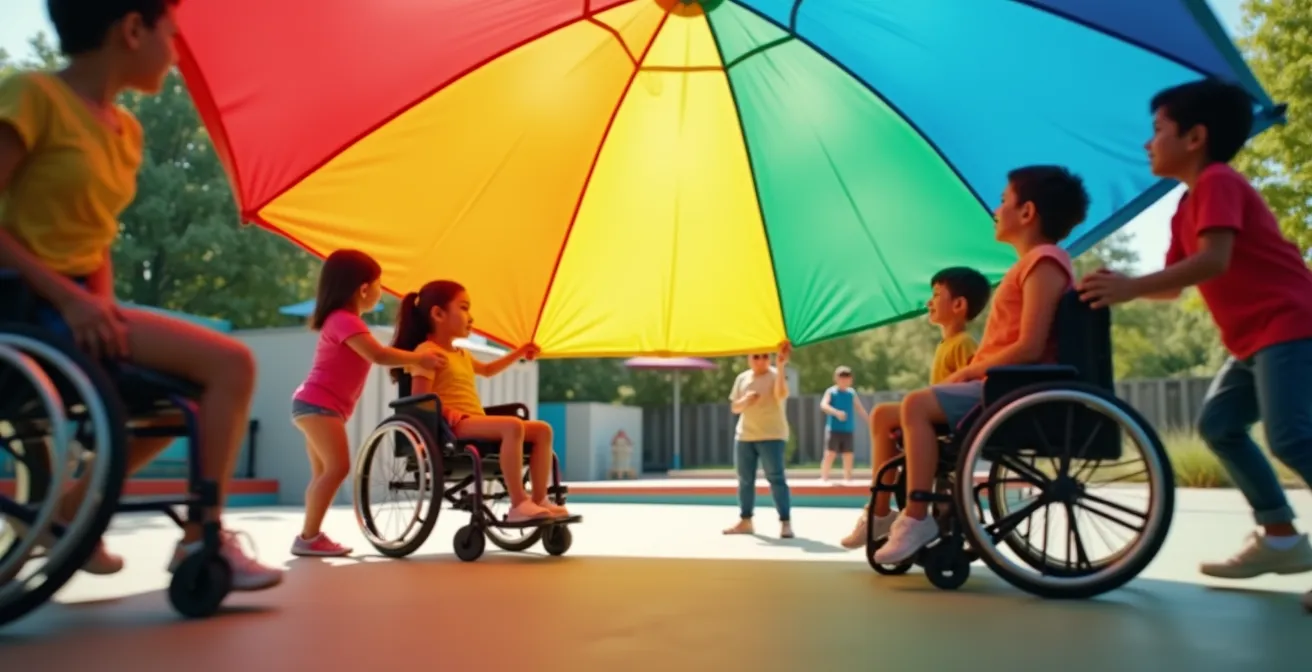
A useful tool for this is the A.R.I.A. framework, which provides a simple structure for thinking about adaptations. It encourages us to look at four key areas of any game. As outlined in resources for creating inclusive play environments, small changes can have a huge impact.
| Adaptation Type | Example Modification | Benefits |
|---|---|---|
| Area (A) | Reduce playing field size | Less distance to cover, maintains participation |
| Role (R) | Create stationary ‘base defender’ position | Strategic involvement without running |
| Instruments (I) | Use foam balls instead of hard balls | Safer, less intimidating |
| Assistance (A) | Allow buddy system or pairs | Shared responsibility, peer support |
By applying this framework, a game of tag can be transformed. You can reduce the playing area (Area), create a “safe zone” that a less mobile child defends (Role), or allow a child to use a pool noodle to increase their reach (Instrument). These modifications aren’t “dumbing down” the game; they are enriching it. They introduce strategic elements and create interdependent roles where a child’s thinking and positioning become just as valuable as their running speed. This is how we ensure that a child’s physical ability doesn’t dictate their ability to play, lead, and belong.
The “Peak End” Rule: Why You Should Stop While They Still Want More?
How a child remembers an activity is just as important as the activity itself. A positive memory makes them eager to participate next time, while a negative one can lead to future resistance. This is where understanding a simple psychological heuristic can transform your facilitation. As a recreational therapist, one of the most powerful tools I use is the “Peak-End Rule.” This principle suggests that our memory of an experience isn’t an average of how we felt throughout, but is instead dominated by how we felt at its most intense moment (the “peak”) and at its very end.
As Nobel laureate Daniel Kahneman and his colleagues established through extensive research:
The peak–end rule is a psychological heuristic in which people judge an experience largely based on how they felt at its peak (i.e., its most intense point) and at its end.
– Daniel Kahneman & Barbara Fredrickson, Peak-End Rule psychological research
What does this mean for group games? It means we should almost never play a game until the children are exhausted and begging to stop. By that point, the “end” of their memory is one of boredom or fatigue. Instead, we should aim to stop the game right after a “peak” moment—a hilarious chase, a great team play, a moment of collective success—while the energy is still high and the children are laughing. Ending on this high note solidifies the entire experience in their memory as positive and fun. The classic example from Kahneman’s 1993 study on uncomfortable experiences showed that subjects preferred a longer trial that had a slightly less unpleasant ending, proving the immense power of how an experience concludes.
Hearing “Aw, can we play one more time?” is the signal of a perfectly timed ending. You have left them wanting more. That feeling of “I can’t wait to do that again” is the goal. It ensures enthusiasm for future activities and builds a positive association with group play, which is especially important for children who may have had negative experiences in the past. Mastering the art of the positive ending is a subtle but profound leadership skill for any facilitator.
Why 8-Year-Olds Find 90% of Eggs Before Toddlers Take One Step?
Activities involving mixed-age groups, like a family picnic or a school-wide event, present a unique inclusion challenge. A classic Easter egg hunt is a perfect case study. The older, faster, and more cognitively developed children will almost always dominate, finding the majority of the eggs before the toddlers have even figured out the game. This can lead to frustration for the little ones and a lack of meaningful challenge for the older kids. The solution isn’t to separate them, but to reframe the activity from a competition into a collaboration.
The simplest and most effective adaptation is to create cross-age partnerships. Pair an older child (e.g., an 8-year-old) with a younger child (e.g., a 3-year-old). Their shared goal is no longer “I need to find the most eggs,” but “We need to fill our basket together.” This immediately changes the dynamic. The older child’s role shifts from competitor to mentor, guide, and helper. Their leadership skills are activated in a nurturing way: they might spot an egg and, instead of grabbing it, point it out to their younger partner, helping them with the fine motor skills needed to pick it up.

This structure provides benefits for everyone. The younger child gets to be successful and feels supported and included. The older child practices empathy, patience, and communication—essential leadership qualities that a purely competitive environment would not foster. They learn to adapt their own pace and perspective to help someone else succeed. You can also structure the environment itself, for example, by hiding brightly colored eggs in obvious places for the toddlers and more camouflaged eggs in trickier spots that require the older kids’ problem-solving skills. By designing the game with interdependence in mind, you transform a potentially exclusionary race into a heartwarming lesson in teamwork and mentorship.
Online Course or Local Class: Which Offers Better Community Support?
For parents and teachers committed to becoming better facilitators of inclusive play, the journey of learning doesn’t end with a single article. Continuous development is key, and the question often arises: is it better to take an online course or attend a local, in-person class? Both avenues offer distinct advantages, and the best choice depends on your specific needs for community, practice, and flexibility.
Online courses offer unparalleled access to global experts and cutting-edge theories on child development, play therapy, and inclusive education. They provide incredible flexibility, allowing you to learn at your own pace and on your own schedule. This format is often more affordable and connects you with a diverse, global community of fellow learners through forums and social media groups. However, the primary drawback is the limited opportunity for hands-on, real-time practice. You learn the theory, but applying it in a dynamic group of children is a different challenge.
Conversely, local classes or workshops provide an invaluable, tangible experience. They offer immediate feedback from instructors who can observe you in action. The hands-on practice with real group dynamics is irreplaceable. Furthermore, local classes help you build a strong, regional peer network—other parents, teachers, and therapists in your area whom you can call on for advice, share resources with, and collaborate with in the future. While they are typically more expensive and require adherence to a fixed schedule, the community support and practical application can be more direct and lasting. Ultimately, the ideal path may be a hybrid, using online resources for theoretical knowledge and seeking local opportunities to put that knowledge into practice.
Key Takeaways
- Inclusion is not just about participation; it’s about designing games where every child has a meaningful role and opportunity to develop skills.
- Focus on teaching micro-skills like conflict resolution, non-verbal communication, and empathy, as these are the true building blocks of leadership.
- The facilitator’s most important role is to adapt—modifying rules, environments, and goals to ensure the game serves the children, not the other way around.
How to Choose Interactive Games That Teach Cooperation Instead of Competition?
The fundamental shift required for inclusive play is moving from a competitive mindset to a cooperative one. In a competitive game, one person’s success requires another’s failure. In a cooperative game, success is shared or not achieved at all. But how can you tell if a game is truly cooperative? The “SCORE” framework is a simple yet powerful tool for evaluating any activity to see if it promotes genuine teamwork.
When you’re choosing a new game or adapting an old one, run it through this mental checklist. The more “yes” answers you get, the more likely the game is to foster the collaborative and interdependent skills we want to build. A truly cooperative game is one where the challenge comes from the task itself—like building the tallest tower together or moving a ball across a field without it touching the ground—rather than from trying to beat the other players. This reframes the entire dynamic of play, making teammates allies rather than rivals.
This approach naturally creates opportunities for emergent leadership. When players are interdependent, they need communicators, strategists, motivators, and observers. A child who is good at seeing the big picture can help direct the group’s efforts, while another who is particularly encouraging can keep morale high. It allows different children to lead in different ways, based on their unique strengths. Using a clear framework helps you be more intentional in your game selection, ensuring playtime is consistently building a culture of cooperation.
Your Checklist for Choosing Truly Cooperative Games: The SCORE Framework
- Shared Goal: Does the game have a common objective that all players are working towards together?
- Collective Success/Failure: Do all players either win as a team or lose as a team?
- Opponent: Is the primary challenge posed by the game’s rules or environment, rather than other players?
- Role Interdependence: Do players need to rely on each other’s different skills or actions to succeed?
- Empowerment: Does the game structure allow different children to take the lead or make key contributions at different times?
By focusing on these principles of inclusion, adaptation, and cooperation, you can transform simple group games into powerful learning experiences. The next step is to start applying these frameworks to your own context, whether in a classroom, on a sports team, or in your own backyard.