
The most meaningful Christmas traditions are not about picture-perfect moments, but about building a predictable framework of contribution and connection that acts as an emotional anchor for your children.
- Repetitive, predictable rituals are scientifically shown to reduce anxiety and build a profound sense of security in children.
- Shared experiences, like collaborative holiday prep or activity-based advent calendars, create stronger, more lasting positive memories (“memory residue”) than passive, material gifts.
Recommendation: Shift your focus from managing holiday tasks to designing family rituals where every member, no matter how small, has a valued and evolving role.
For new parents, the pressure to create magical Christmas memories can feel overwhelming. You scroll through images of perfect gingerbread houses and matching family pajamas, feeling a mix of inspiration and anxiety. The desire to establish your own family culture, distinct from the one you grew up with, is powerful. You want to give your children more than just presents; you want to give them a sense of belonging, of story, of home. Many families fall back on a checklist of common activities—baking cookies, visiting Santa, watching holiday movies—which are lovely but can sometimes feel hollow if the “why” behind them is missing.
But what if the true magic of tradition isn’t in the activity itself, but in its architecture? What if the key to building deep, lasting connection lies not in what you do, but in how you do it, and the roles you create for your children within that structure? The most powerful traditions are not static events but living rituals that serve as emotional anchors. They provide predictability in a chaotic world and give children a tangible sense of their importance within the family unit. This isn’t about adding more to your holiday to-do list; it’s about infusing your existing activities with intention.
This guide will walk you through the process of designing—or redesigning—your family’s Christmas traditions through the lens of emotional connection and child development. We will explore why repetition is so calming for children, how to transform them from holiday “guests” to “contributors,” and how to navigate the complex dynamics with extended family and within your own partnership. The goal is to build a set of traditions that not only create joy today but also grow with your family, becoming a bedrock of security for years to come.
To help you craft these enduring family rituals, we will explore the core principles and practical steps in the sections below. This framework is designed to empower you to build a holiday culture that is uniquely and meaningfully yours.
Summary: A Guide to Crafting Traditions That Build Family Connection
- Why Repeating the Same Yearly Rituals Reduces Anxiety in Children?
- How to Delegate Holiday Prep So Kids Feel Like Contributors, Not Guests?
- Chocolate vs. Activity Calendars: Which Builds More Anticipation?
- The 4-Gift Rule: How to Explain It to Grandparents Without Offense?
- How to Schedule “Immediate Family Only” Time During Chaotic Holidays?
- The ‘Blow Out the Candles’ Alternative That Keeps the Cake Germ-Free
- Why the ‘Manager vs. Executor’ Dynamic Destroys Intimacy?
- How to Balance Parenting Roles Without Resentment Building Up?
Why Repeating the Same Yearly Rituals Reduces Anxiety in Children?
For a child, the world can often feel large, unpredictable, and overwhelming. Rituals, especially yearly holiday traditions, serve as powerful emotional anchors in the flow of time. When a child knows that every year, on the first weekend of December, the family will get hot chocolate and pick out a tree, they are not just looking forward to a fun activity. They are internalizing a sense of order, safety, and predictability. This repetition creates a psychological safety net. It silently communicates: “The world keeps changing, but this, right here, stays the same. We are safe. We are a family.”
This sense of predictability is crucial for reducing anxiety. The brain is a pattern-seeking machine, and for a developing mind, familiar patterns are calming. Knowing what comes next frees up mental and emotional energy that would otherwise be spent on navigating uncertainty. Instead of worrying about the unknown, a child can fully immerse themselves in the joy of the moment. These rituals become landmarks in their childhood, creating a narrative of stability that they carry with them. They are the building blocks of a secure attachment to the family unit, a feeling of being part of something solid and enduring.
Furthermore, these traditions are often multi-sensory experiences—the smell of pine, the taste of a specific cookie, the sound of a particular song. These sensory details become deeply encoded with feelings of love and security. As children grow, encountering these same smells, tastes, and sounds can instantly trigger those foundational feelings of safety, acting as a resource for resilience throughout their lives. The ritual is not just an event; it’s a deposit into a child’s emotional bank account.
Ultimately, the consistency of these traditions helps build a strong family identity. It’s the story your family tells itself about who you are, reinforcing the message that “this is what we do,” and by extension, “this is who we are.”
How to Delegate Holiday Prep So Kids Feel Like Contributors, Not Guests?
One of the most profound shifts you can make in your family’s holiday culture is moving children from being passive recipients of magic to active co-creators of it. When children are given genuine responsibility, they develop a sense of competence, purpose, and true belonging. The goal is to foster a contribution culture, where everyone’s effort is valued. This isn’t about adding chores to their plate; it’s about bestowing a title, a role that is theirs to own. This simple change in framing can transform a task from a burden into an honor.
The key is to match the responsibility to their developmental stage. A toddler can’t manage the holiday menu, but they can be the “Chief Tinsel Placer,” in charge of decorating the lower branches of the tree with non-breakable ornaments. An older child can become the “Holiday Music DJ” or the “Gift Wrap Manager.” By giving their role a special name, you elevate its importance. This sense of ownership is incredibly empowering and teaches them vital life skills about collaboration and responsibility, all within a context of joy and celebration.
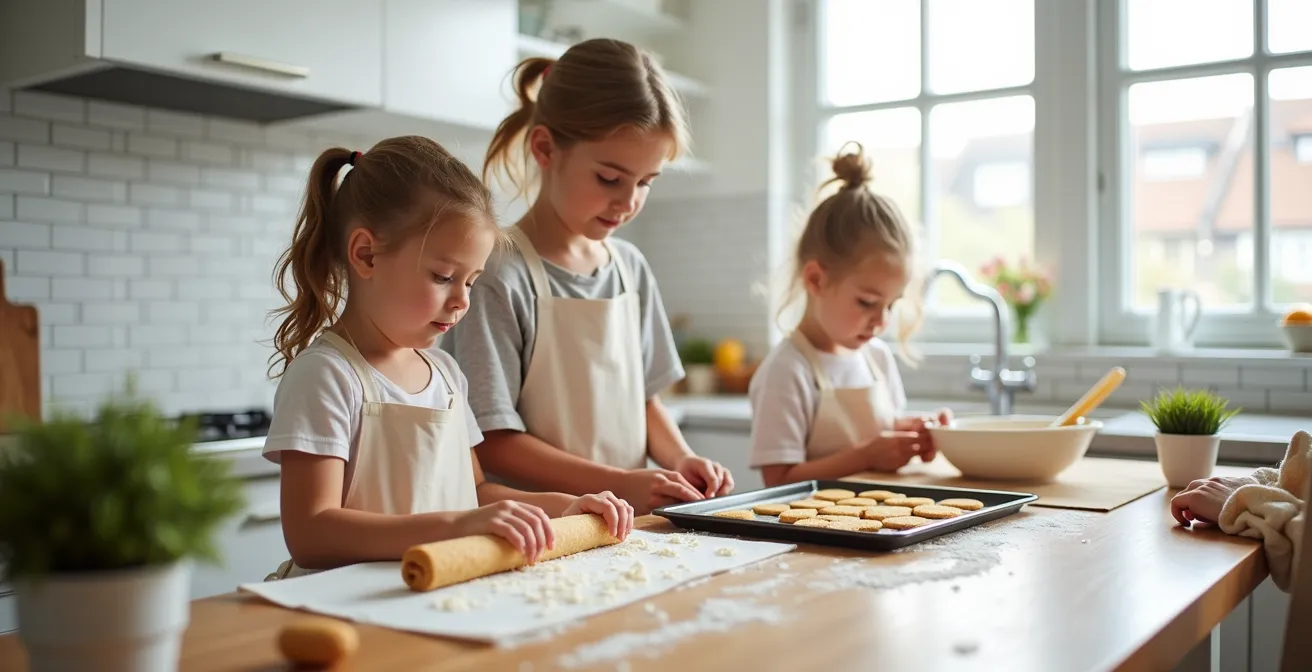
As the image above beautifully illustrates, a kitchen filled with children of different ages engaged in various tasks is a perfect example of a contribution culture in action. To implement this, consider creating a “Holiday Contribution Ladder.” This is a list of roles that grow in complexity as your children age. An effective approach, as detailed in guides on family activities and traditions, is to give each child a clear ‘jurisdiction’. For example:
- Ages 3-4: “Ornament Inspector” or “Napkin Folder-in-Chief.”
- Ages 5-7: “Hot Chocolate Station Captain,” responsible for arranging mugs and toppings.
- Ages 8-10: “Official Cookie Taste-Tester” or “Holiday Card Stamper.”
- Ages 11-13: “Gift Wrap Manager,” in charge of organizing supplies and helping younger siblings.
- Ages 14+: “Tradition Documentation Leader,” tasked with taking photos or videos to create a yearly family album.
By thoughtfully delegating, you are not just getting help; you are teaching your children that their presence and effort are integral to the family’s joy. They are not just guests at the holiday show; they are essential members of the cast and crew.
Chocolate vs. Activity Calendars: Which Builds More Anticipation?
The daily ritual of the advent calendar is a cornerstone of holiday anticipation for many children. But not all calendars are created equal when it comes to building meaningful memories. The choice between a simple chocolate calendar and a more involved activity calendar represents a fundamental difference in philosophy: passive consumption versus active participation. While a daily piece of chocolate provides a moment of fleeting pleasure, it is an individual and often forgettable experience.
The Power of Experiential Memory
The concept of “memory residue” helps explain the difference in impact. Scientific studies have shown that experiences tend to provide more lasting happiness and satisfaction than material goods. When families implement activity-based advent calendars—with daily prompts like “build a fort and read a Christmas story” or “make a card for a neighbor”—they are creating shared experiences. These moments leave a significant memory residue. Years later, a child is unlikely to recall the taste of a specific chocolate, but they will vividly remember the night the whole family wore silly hats and drank hot chocolate in a blanket fort. This is because experiences that strengthen family bonds are more deeply encoded in our long-term memory.
An activity calendar is a tool for ritual architecture. It’s a pre-planned structure for connection. Each day offers a small, manageable prompt for togetherness, transforming the countdown to Christmas into a season of bonding. This actively builds anticipation not just for a gift, but for a shared moment. The following table breaks down the differing impacts:
| Factor | Chocolate Calendar | Activity Calendar | Hybrid Approach |
|---|---|---|---|
| Immediate Gratification | High (daily treat) | Low-Medium | High (both elements) |
| Memory Formation | Low (fleeting pleasure) | High (shared experiences) | Highest (habit-stacking) |
| Family Bonding | Individual experience | Collective participation | Structured togetherness |
| Anticipation Type | Passive receiving | Active participation | Balanced engagement |
| Long-term Impact | Minimal lasting value | Creates traditions | Reinforced memories |
For parents looking to create their own culture, the activity calendar is a powerful tool. It allows you to intentionally design 24 small rituals that reflect your family’s unique values, whether that’s creativity, service to others, or simply unstructured fun.
The 4-Gift Rule: How to Explain It to Grandparents Without Offense?
As new parents establish their family culture, one of the most common points of friction is managing the well-intentioned generosity of grandparents. The desire to simplify gift-giving, often through systems like the “4-Gift Rule” (something they want, something they need, something to wear, and something to read), can be misinterpreted as a rejection of love. Successfully communicating this boundary is an exercise in diplomacy and empathy, and it’s a critical part of protecting your family’s values from holiday consumerism.
The key is to frame the conversation not as a restriction, but as a shared mission. You are not telling them “don’t buy gifts”; you are inviting them to participate in a more meaningful approach to giving. Start the conversation early, well before the holiday shopping season begins, and always lead with appreciation for their generosity. Explain the “why” behind your decision: you are trying to teach your children to value things more deeply, to appreciate experiences over excess, and to avoid being overwhelmed. This approach is gaining traction, and as research on minimalist parenting suggests, it aligns with a broader cultural shift towards sustainability and intentionality.
Providing clear, positive alternatives is crucial. Grandparents’ love language is often giving, so you need to provide a new dialect for them to speak it. Here are some scripts and strategies to guide the conversation:
- Frame it as a partnership: “We are really trying to teach the kids to value experiences and needs over just having a mountain of toys. We would absolutely love for you to be a part of that with us.”
- Offer specific, high-value alternatives: “Instead of several smaller toys, what would you think about being their official ‘Experience Gifter’? A membership to the zoo or tickets to a children’s theater show from you would be so special and create lasting memories.”
- Suggest a contribution to a larger goal: “We’re saving up for a ‘big’ family gift this year, like a bicycle or a play structure. If you’d like, contributing to that would be an amazing and incredibly helpful gift.”
- Use collaborative tools: “We’ve created a shared digital wishlist that shows the ‘want, need, wear, read’ categories. It would help us stay organized and ensure your gift is something truly cherished.”
Remember, the goal is not to “win” an argument but to bring your extended family into alignment with your values. By acknowledging their love and channeling their generosity, you can turn a potential conflict into a moment of deeper connection.
How to Schedule “Immediate Family Only” Time During Chaotic Holidays?
The holidays often pull families in a dozen different directions, with obligations to extended family and friends. For a young family trying to establish its own identity, protecting a sacred space for just the immediate unit is not selfish; it is essential. This “immediate family only” time is when your unique rituals can truly take root, free from the observation or influence of others. It’s the quiet morning, the lazy afternoon, the specific moment that belongs only to you and your children. Without it, your traditions can become performative rather than connective.
The challenge is carving out this time without causing offense. Proactive and clear communication is your greatest tool. Don’t wait for the week of Christmas to announce your plans. Mention it in November, framing it positively and as a cherished, non-negotiable part of your family’s rhythm. Instead of saying, “We’re not coming over on Christmas morning,” try, “We are so excited for the big family dinner on the 24th! We’re reserving Christmas morning for our little pajama-and-pancake tradition at home, and then we’d love to see everyone in the afternoon.”
Giving your private time a specific, branded name can also help. It transforms it from a vague absence into a concrete event. “The Annual Christmas Morning Pajama Fort” or “The Boxing Day Pancake Championship” sounds official and special. It’s a tradition, not an exclusion. Here are some strategies for protecting this sacred time:
- Brand Your Ritual: Give your private family time a fun, official-sounding name.
- Communicate Proactively: Let extended family know your plans in November, focusing on when you *will* be together.
- Create ‘Active Stillness’: Plan a specific, low-key activity (like watching the same movie every year or working on a puzzle) rather than just having undefined “downtime.” This creates a clear structure.
- Treat It as Immovable: Schedule it in the calendar like a doctor’s appointment. It is a non-negotiable commitment to your family’s well-being.
- Offer Alternative Connections: Propose hosting a different event, like a New Year’s brunch, to show you still value wider family connection.
By setting this boundary with kindness and foresight, you create a calm center in the holiday storm. This protected space allows your family to breathe, connect, and build the intimate memories that form the heart of your unique story.
The ‘Blow Out the Candles’ Alternative That Keeps the Cake Germ-Free
Many beloved traditions, when viewed through a modern lens, can be adapted to be more inclusive, meaningful, or even hygienic. The classic act of blowing out birthday candles, a ritual often transferred to a “Happy Birthday, Jesus” cake at Christmas, is a perfect example. While steeped in nostalgia, the awareness of spreading germs has led many families to seek alternatives that preserve the celebratory spirit without the aerosolized spray of saliva. This presents a beautiful opportunity not just to replace a tradition, but to elevate it.

Instead of an act of extinguishing, you can create a ritual of illuminating. This shifts the focus from a single person’s wish to a collective expression of hope and gratitude. It’s a powerful metaphor for a young family: you are building your light together. This can be adapted in several beautiful ways, preserving the magic of fire and wishes in a new form.
Case Study: The ‘Christmas Wish’ Lighting Ceremony
A growing number of families have adopted a “Christmas Wish” ceremony as a beautiful alternative. The process is simple yet profound. Instead of one person blowing out candles, each family member takes a turn lighting a candle on the cake or a separate candelabra. As they light their candle, they share a hope for the family in the coming year, a positive memory from the past year, or something they are grateful for. This simple pivot transforms the moment from a brief, individual act into a longer, deeply connective family ritual. It fosters reflection, gratitude, and verbal affirmation—all cornerstones of a strong family culture. Some families do this while singing a carol or “Happy Birthday,” keeping the celebratory feel while adding a layer of spiritual or emotional significance.
By being willing to thoughtfully examine and adapt traditions, you model flexibility and intentionality for your children. You show them that traditions are not rigid rules to be followed, but living expressions of a family’s love and values, capable of evolving as the family itself grows and changes.
Why the ‘Manager vs. Executor’ Dynamic Destroys Intimacy?
The holiday season has a way of magnifying the invisible labor within a partnership. Often, one partner (historically, the woman) becomes the “Chief Magic Officer,” holding the entire mental load of the holidays. They are the manager—researching gifts, tracking addresses for cards, planning menus, and scheduling events. The other partner becomes the executor, willingly helping when asked (“Just tell me what to do!”) but not carrying the cognitive burden of planning and anticipating. While this may seem like teamwork on the surface, this “manager vs. executor” dynamic is a silent killer of intimacy and a potent source of resentment.
The manager feels isolated and exhausted, their efforts unseen. The executor feels like a helpful employee rather than an equal partner, disconnected from the “why” behind the tasks. This dynamic is not just detrimental to the couple; it’s also a powerful form of partnership modeling for children. Children are astute observers. They see who holds the list. They see who initiates the holiday tasks and who waits for instructions. They internalize this as a model for what a partnership looks like, potentially carrying this inequitable pattern into their own future relationships.
Applying the ‘Fair Play’ Method to Holiday Tasks
To combat this, couples can apply principles from systems like Eve Rodsky’s “Fair Play.” The goal is to distribute not just the tasks, but the full “Conception, Planning, and Execution” (CPE) of each holiday domain. For instance, as described by families who have successfully implemented minimalist holiday approaches, one partner might take full ownership of “Gifts for Extended Family.” This means they are responsible from start to finish: conceptualizing what to get, researching options, purchasing, wrapping, and ensuring delivery. The other partner might own “Holiday Meals” in its entirety. This transfer of complete ownership eliminates the manager/executor trap, fosters true partnership, and dramatically reduces resentment. It models a healthy, balanced relationship for the children, which is one of the most meaningful gifts you can give them.
Breaking this cycle requires a conscious and explicit conversation between partners. It’s about transforming the holiday workload from a source of division into an opportunity for genuine collaboration, strengthening both your partnership and the emotional foundation of your family.
Key Takeaways
- Intentional Rituals vs. Activities: Focus on designing predictable rituals that give children a sense of security and a role, rather than just checking off a list of festive activities.
- Contribution Over Consumption: Empower children by giving them age-appropriate responsibilities in holiday preparations. This builds their sense of competence and belonging.
- Balanced Partnership is Key: The way parents collaborate (or don’t) on holiday tasks is a powerful lesson for children. Aim for shared ownership, not a manager/helper dynamic, to model a healthy relationship.
How to Balance Parenting Roles Without Resentment Building Up?
Achieving a truly balanced partnership during the holidays is not a one-time fix; it’s an ongoing process of communication, evaluation, and adjustment. Resentment often builds not from the work itself, but from feeling unseen, unappreciated, or stuck with the tasks no one else wants. The solution is to make this invisible work visible and to approach the division of labor with curiosity and flexibility. As research on family dynamics shows, children’s sense of security is directly affected by the emotional climate between parents during the holidays. A partnership rooted in fairness and mutual support creates a more joyful and secure environment for everyone.
A powerful way to foster this balance is to create a new tradition: the “Post-Holiday Joy Audit.” In January, when the dust has settled, sit down together as partners. This isn’t a time for blame, but for honest reflection. Each partner can rate the holiday tasks they were responsible for on a simple “dread to joy” scale. You might discover that one person genuinely enjoys wrapping gifts, while the other finds it meditative to do the holiday grocery shopping. You might also identify tasks that neither of you enjoys, which can then be automated, outsourced, or simplified for the following year.
This process also allows you to strategically delegate to the children. As you review the tasks, ask: “Is there a piece of this that one of the kids is ready to take on next year?” This ensures that the “Contribution Ladder” evolves as your children grow. Documenting these decisions in a shared “Holiday Playbook” (a simple digital note or physical binder) prevents you from having the same stressful conversations year after year. It turns the division of labor into a collaborative, evolving strategy.
Your Action Plan: The Post-Holiday Joy Audit
- Schedule a Debrief: Make it a new tradition to have a “Holiday Playbook” meeting in early January. Put it on the calendar.
- Rate the Tasks: Each partner independently rates their assigned holiday tasks on a “dread to joy” scale from 1 to 10.
- Identify Highs and Lows: Discuss which tasks brought unexpected satisfaction and which caused the most stress. Look for patterns.
- Redistribute Based on Joy: Reassign tasks for next year based on enjoyment and strengths, not just old habits or perceived competence.
- Plan for Delegation: Consciously identify one or two new, age-appropriate responsibilities to delegate to the children next year and add them to the playbook.
By making the management of the holidays a transparent and collaborative process, you transform a potential source of conflict into a powerful tool for connection. You model for your children that a strong family is a team, one that works together to create its own joy, year after year.