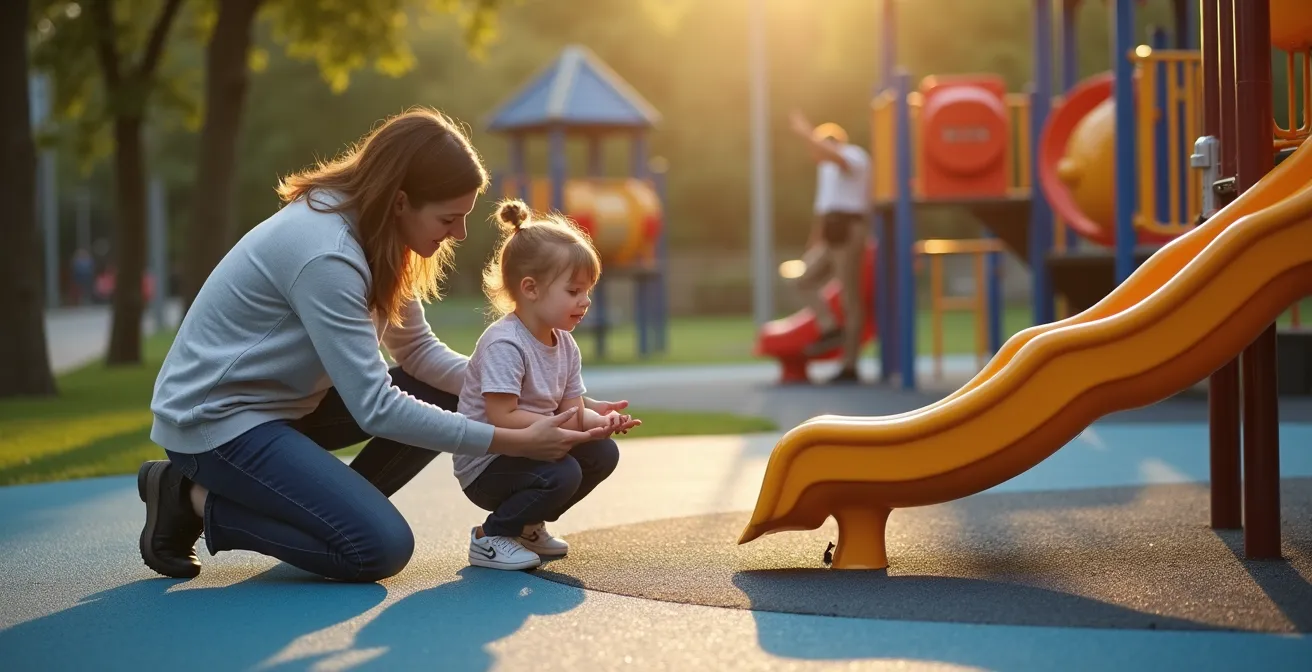
That new playground looks fun, but hidden dangers can turn a day of play into a trip to the ER. Standard advice to “be careful” is too vague. This guide provides a certified inspector’s 60-second safety sweep, a practical method to quickly assess surfaces, equipment, and structural integrity. You will learn not just what to look for, but how to test for hazards, empowering you to make an informed decision before your child ever takes their first step on the equipment.
The moment you arrive at a new park, there’s a familiar mix of excitement and anxiety. Your child is already running towards the tallest slide, but your mind is racing through a checklist of potential dangers. We’re told to supervise our children, but what does that truly mean? Simply watching from a bench isn’t enough when hazards are often invisible to the untrained eye. The common advice—look for broken equipment or make sure the ground is soft—lacks the practical detail needed to prevent the most serious injuries.
The reality is that many playground injuries stem from risks that are predictable and preventable, from poorly maintained surfaces to design flaws that create entanglement risks. You might see other parents letting their kids play without a second thought, and wonder if you’re being overprotective. You’re not. You’re being vigilant, and that vigilance needs a method. This isn’t about hovering or stifling your child’s adventurous spirit; it’s about channeling your concern into effective action.
But what if the key wasn’t just passive supervision, but an active, 60-second safety inspection before play begins? This guide shifts your perspective from a worried spectator to a proactive first-line inspector. We will move beyond the obvious and teach you the quick, tactile tests and visual cues that certified professionals use. You’ll learn to assess fall surfaces, identify hidden strangulation points, check for structural weaknesses, and strategically position yourself to intervene effectively. This is your toolkit for ensuring that every trip to the playground is as safe as it is fun.
In the following sections, we will break down this professional inspection process into simple, actionable steps. You will gain the confidence to quickly identify real hazards, allowing you to relax and enjoy watching your children play freely and safely.
Summary: A Parent’s Guide to Playground Hazard Inspection
- Mulch vs. Rubber: Which Surface Actually Prevents Concussions?
- Drawstrings and S-Hooks: The Hidden Danger on Slides?
- How Hot Is Too Hot? Preventing Burns on Metal Slides in Summer?
- Rust or dirt: How to Tell If a Swing Chain Is About to Snap?
- The “Active Watching” Zone: Where to Stand to Intervene Quickly?
- The Bead Risk: Which Accessories Are Unsafe for Children Under 3?
- The Seam Placement Error That Causes Chafing on Sensitive Waists
- How to Build a Backyard Adventure Zone on a Budget?
Mulch vs. Rubber: Which Surface Actually Prevents Concussions?
The first and most critical part of your 60-second sweep is the ground itself. It’s not a minor detail; it’s the primary safety system for the entire playground. According to safety experts, research shows that nearly 79% of all playground injuries involve falls. A hard surface can turn a simple tumble into a serious head injury. Therefore, your inspection must start from the ground up. Never allow children to play on equipment with hard surfaces like concrete, asphalt, grass, or dirt underneath. Acceptable materials include wood chips, mulch, sand, pea gravel, and unitary surfaces like rubber mats or poured-in-place rubber.
However, the mere presence of a soft material isn’t enough. The key is impact attenuation, which depends on the material’s depth and maintenance. For loose-fill materials like mulch or wood chips, the depth is everything. A shallow layer offers almost no protection. You must be able to visually confirm a deep, well-maintained bed of material, especially under high-traffic areas like swings and at the bottom of slides, where the material is often displaced.
Rubber surfaces are not automatically superior. While they offer excellent impact absorption when new, they can degrade. Look for curling edges on rubber mats, which create significant trip hazards. Poured-in-place rubber can become hard and brittle over time with sun exposure. A quick tactile test is essential to verify its condition.
Action plan: Surface safety check
- Foot-Sink Test: Press your heel firmly into loose-fill surfaces like mulch or sand. It should sink at least one inch, indicating adequate depth and looseness.
- Check Mat Edges: Walk the perimeter of any rubber mats. Look specifically for edges that are curling up or separating, as these are common trip hazards.
- Hardness Test: For poured rubber surfaces, press down firmly with your palm. A safe surface will have some give; a brittle, uncompressing surface is a red flag.
- Look for Depth Markers: Some modern playgrounds have markers on the equipment posts indicating the recommended minimum depth for loose-fill materials. Verify the current level against this marker.
- Verify Minimum Depth: The industry standard is a minimum depth of 12 inches for loose-fill materials. While you can’t measure this exactly, you can visually assess if the depth looks dangerously low.
A proper surface is a playground’s most important piece of safety equipment. This quick check ensures it can do its job.
Drawstrings and S-Hooks: The Hidden Danger on Slides?
While falls are the most common cause of injury, the most fatal risks are often the quietest. According to playground safety data, a staggering 56% of playground fatalities result from strangulation. This occurs when a piece of a child’s clothing, a necklace, or a helmet toggle gets caught on equipment. These are known as entanglement and entrapment hazards, and they are especially common at the top of slides, on fireman’s poles, and around swing sets.
An entanglement hazard is anything that can catch a drawstring, necklace, or loose piece of clothing. Look for open “S” hooks on swings, bolts that stick out more than two threads, or any gaps or V-shapes where hardware connects. An entrapment hazard is an opening that can trap a child’s head or body. As a rule of thumb, any enclosed opening between 3.5 and 9 inches is a potential head entrapment hazard. A child’s head can fit through, but their body cannot, leading to strangulation.
Your role as an inspector is to scan for these specific threats. Before your child climbs, check the top of the slide for any protruding bolts or hardware. Examine the links of a swing chain and where they connect to the seat and the overhead bar. These connection points are common culprits. Also, be aware that even a bike helmet, essential for riding, becomes a significant danger on playground equipment. The straps can easily get caught, so they must always be removed before playing.
By identifying these small but deadly hazards during your sweep, you eliminate the most severe category of playground risk.
How Hot Is Too Hot? Preventing Burns on Metal Slides in Summer?
On a sunny day, playground surfaces can reach dangerously high temperatures, capable of causing serious thermal burns in seconds. This is especially true for dark-colored rubber surfaces, metal slides, and asphalt. The air temperature can be deceiving; a pleasant 80°F day can still result in surface temperatures well over 150°F. At these levels, skin contact can cause severe injury. For context, medical experts warn that adults will suffer third-degree burns at 150 degrees for just two seconds of contact, and a child’s skin is even more sensitive.
Your safety sweep must include a thermal hazard assessment. Never use the back of your hand to test a surface, as you could get burned yourself. Instead, hold your palm a few inches above the surface. If you can feel radiating heat, it is too hot for a child to play on. Pay special attention to unshaded metal slides and any dark-colored rubber or plastic components. A slide in direct sunlight can be significantly hotter than one in the shade.
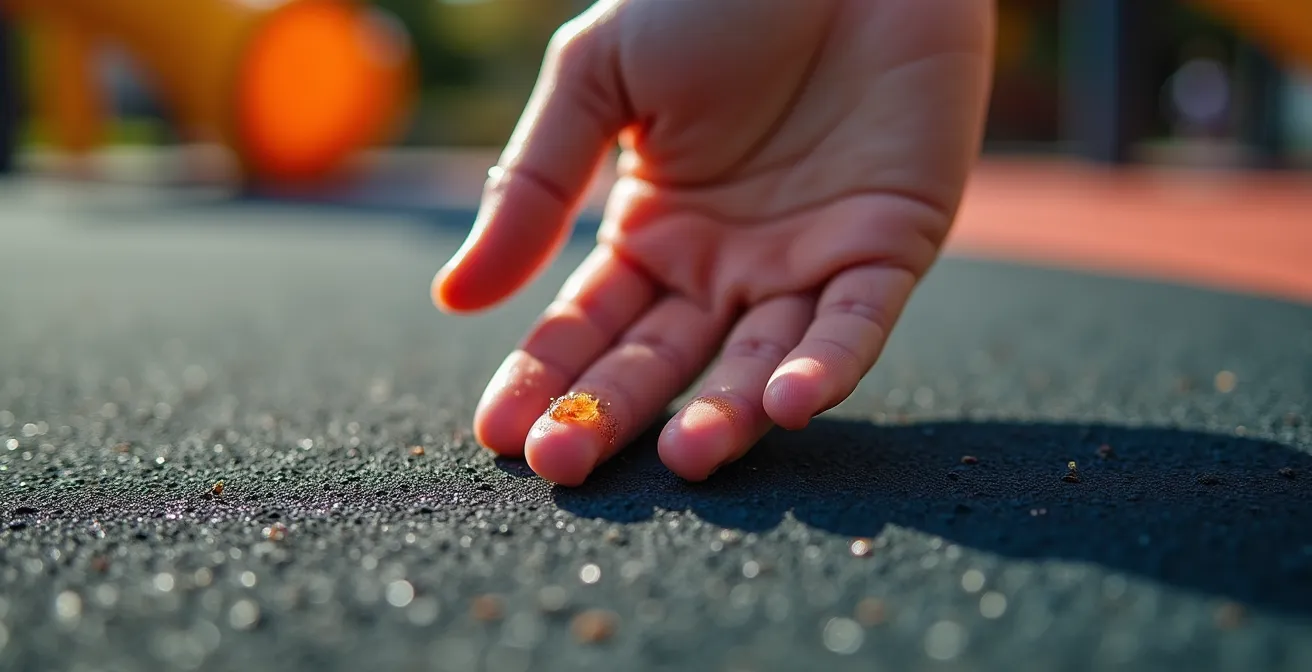
The type of material makes a dramatic difference in heat retention. As you can see from the data below, some surfaces become hazardous far more quickly than others, making them unsuitable for play in direct sun.
The following table, based on data from a recent analysis of surface temperatures, highlights how different materials react to sun exposure on a 100°F day.
| Surface Type | Temperature in Sun (100°F air) | Temperature in Shade | Burn Risk Time |
|---|---|---|---|
| Metal Slide | 160°F | 111°F | Less than 1 second |
| Rubber Ground Cover | 188°F | Not specified | Immediate |
| Concrete | 132°F | Not specified | 6 seconds |
| Handrail | 120°F | Not specified | 5 minutes |
If you have any doubt, steer your child towards equipment in shaded areas or return on a cooler day. The risk of a severe burn is simply not worth it.
Rust or dirt: How to Tell If a Swing Chain Is About to Snap?
The structural integrity of playground equipment is another key area of your inspection. Components wear down over time from use and exposure to the elements. Hardware can loosen, and metal can corrode, compromising the safety of a structure. As the Playground Guardian Safety Experts note in their guide, this is a critical issue:
Protruding bolts and loose or damaged hardware can pose a serious risk to children on your playground. Hardware can cause cuts and bruises or catch on clothing, jewelry, or hair. Loose, damaged, or missing hardware can affect the overall integrity of your play structures
– Playground Guardian Safety Experts, Playground Repair Guide
One of the most common signs of degradation is rust. However, not all rust is equally dangerous. You need to distinguish between harmless surface rust and structural corrosion. Surface rust is a fine, uniform powder that can be wiped away, often staining your fingers. Structural rust is flaky, causes pitting in the metal, and is often accompanied by “weeping” rust stains that run down the equipment. This indicates that water has penetrated the metal and is corroding it from the inside out, severely weakening it.
Your inspection should include a quick “wiggle test.” Firmly shake guardrails, ladders, and other components. There should be no give or wobble. Look for unsafe “repairs” like wire, rope, or zip ties holding parts together—these are major red flags. For swings, visually inspect the entire chain, especially the links at the top and bottom connection points. Look for any signs of elongation or thinning, where the metal has been stretched and worn down. Check that S-hooks and C-hooks are fully closed, with no gaps that a chain link could slip through.
Your quick structural check involves these key points:
- Differentiate Rust: Look for flaky, pitting rust, not just uniform surface powder.
- Perform the “Wiggle Test”: Shake equipment firmly to detect any loose bolts or structural instability.
- Inspect Chain Links: Check for any links that appear stretched, thinned, or elongated.
- Identify Unsafe Repairs: Never trust equipment held together with wire, rope, or zip ties.
- Check Hook Closures: Ensure all S-hooks and C-hooks are completely closed.
This brief but focused check of the equipment’s hardware and stability can prevent a sudden and catastrophic equipment failure.
The “Active Watching” Zone: Where to Stand to Intervene Quickly?
Even on a perfectly maintained playground, supervision is the final and most crucial layer of safety. However, “supervision” is not a passive activity. It’s an active strategy that requires positioning and focus. Research has repeatedly shown that a lack of adequate supervision is linked with a significant portion of playground-related injuries. It’s not about being physically present; it’s about being mentally present and strategically positioned. This is the concept of the “Active Watching” Zone.
The Active Watching Zone is the position that gives you the clearest line of sight and the shortest path to intervene across multiple play areas your child is using. Instead of sitting on a peripheral bench, you should stand in a central location. This allows you to constantly scan your child’s activities and the environment around them. It means putting your phone away and engaging with your surroundings, anticipating potential conflicts with other children or risky behaviors before they escalate.

Your position should change as your child moves. If they are on the climbing structure, be close enough to spot them if they struggle. If they move to the swings, reposition yourself to have a clear view without being in the path of other children. This is especially critical for younger children, who require “touch supervision”—being within arm’s reach at all times. The goal is not to stop them from taking risks, which is an important part of development, but to be there to prevent a minor fall from becoming a major injury.
Effective supervision also means communicating with your child. Before they start playing, point out the safe ways to use equipment (“Feet first down the slide”) and remind them of rules like not walking in front of swings. This proactive communication sets the stage for safer play.
By positioning yourself correctly and remaining attentive, you become the most reliable piece of safety equipment on the playground.
The Bead Risk: Which Accessories Are Unsafe for Children Under 3?
For toddlers and children under three, the playground presents a different set of risks, primarily centered around choking and entrapment. Their smaller bodies, natural curiosity, and tendency to put objects in their mouths require an even higher level of vigilance. The clothing and accessories that are harmless on an older child can become serious hazards for a toddler.
The most significant risk is choking. Any small object can be a danger. A simple way to test this is the toilet paper roll rule: if an object can fit through a standard toilet paper roll, it is a choking hazard for a child under three. This includes beads from a broken necklace, buttons that have come loose, or small, detachable parts from a toy brought to the park. Before letting a toddler play, do a quick scan of their clothing and any items they are carrying.
Beyond choking, certain accessories pose specific risks on playground equipment. Necklaces, scarves, and even pacifier clips with long ribbons can easily get caught, creating an entanglement or strangulation risk. It is safest to remove all such items before play. As mentioned earlier, but worth repeating for this age group, helmets must be removed. While essential for biking to the park, they are a primary cause of strangulation on equipment when a child’s head gets trapped and the strap does not break.
Even clothing choices matter. Hoods on jackets or sweatshirts can obscure a child’s peripheral vision and can get caught on equipment. It’s best to choose clothing that is well-fitted and free of any drawstrings, toggles, or decorative elements that could snag.
By managing these small items, you can mitigate the most severe risks that are unique to the youngest playground visitors.
The Seam Placement Error That Causes Chafing on Sensitive Waists
A child’s clothing is their first line of defense on the playground, but the wrong choices can introduce risks of their own. Beyond the obvious entanglement hazards of drawstrings, the very fabric and fit of an outfit can cause injury. This includes everything from friction burns and chafing to a lack of grip that can lead to a fall. As the SafeSplash Safety Team advises, “Avoid dressing little ones in clothing that could catch on playground equipment or cause injuries. For a trip to the park, a pair of sweatpants is best to offer extra protection in case of falls or bumps.”
Friction burns are a common issue on slides. Coarse fabrics like rigid denim can create intense friction, causing burns on a child’s skin. Opt instead for smooth, flexible athletic fabrics that allow for easy movement and less friction. Similarly, ill-placed seams, especially bulky ones on the waist or inner thighs, can cause painful chafing during active play on swings or climbing structures. Look for clothes with flatlock seams or seamless designs in sensitive areas.
Footwear is arguably the most important piece of “clothing” for playground safety. Open-toed sandals, flip-flops, and slick-soled fashion shoes are inappropriate and dangerous. They lack the grip necessary for climbing and the toe protection needed to prevent crushed fingers and toes. The ideal playground shoe should have a flexible, grippy sole, provide toe protection (closed-toe), and be securely fastened with laces or velcro to prevent it from slipping off.
Use this checklist for a quick, playground-safe clothing assessment:
- Choose Smooth Fabrics: Opt for athletic fabrics over coarse denim to prevent friction burns on slides.
- Select Proper Footwear: Shoes must be closed-toe, have a grippy sole, and be securely fastened. Avoid sandals, Crocs, and flip-flops.
- Remove Drawstrings: Check for and remove any clothing with drawstrings, toggles, or loops, especially around the hood and waist.
- Ensure Proper Fit: Clothes should be well-fitted—not too baggy to catch on equipment, and not too tight to restrict movement.
Dressing your child for a day at the park is not just about comfort; it’s a critical step in proactive injury prevention.
Key takeaways
- The 60-Second Sweep: Adopt an inspector’s mindset to actively check surfaces, equipment integrity, and hidden hazards before play begins.
- Surfaces are #1 Priority: With falls causing most injuries, verifying surface depth and condition is the most critical safety check you can perform.
- Clothing is Equipment: Treat clothing and footwear as safety gear. Remove all entanglement risks (drawstrings, helmets, necklaces) and choose items that protect rather than endanger.
From inspection to action: Becoming a playground advocate
Mastering the 60-second safety sweep empowers you to protect your own child on any given day. However, your role as a vigilant parent doesn’t have to end there. When you discover a significant hazard—a broken swing, a dangerously shallow surface, or a piece of equipment with structural rust—you have the opportunity to protect every child who visits that park. The most powerful step you can take is to report the issue.
This transforms you from a passive user into an active advocate for community safety. Don’t assume someone else has already seen it or will take care of it. Document the hazard if you can with a quick photo on your phone. Note the specific location of the playground and the piece of equipment in question. Then, report the hazard to the organization responsible for the site. This is typically the city’s parks and recreation department, the local school district, or the city council.
Your detailed report provides them with the actionable information they need to schedule repairs and prevent a potential injury. You are providing free, expert-level feedback that helps them maintain a safer environment for everyone. While building a private backyard adventure zone might seem like a solution, taking a few minutes to report a public hazard has a much broader impact, improving the safety and well-being of your entire community.
By turning your observations into action, you secure a safer play space not just for your child, but for every family that follows.
Frequently asked questions about How to Spot Hidden Hazards in Public Playgrounds?
What items pose the greatest entanglement risk?
Loose clothing, drawstrings, or accessories, such as necklaces or scarves, can become entangled in playground equipment, leading to strangulation or other serious injuries.
Where do entanglements most commonly occur?
It is especially common for these hazards to be on swings and slides. The tops of slides and the connection points of swings are where many entanglement hazards are found and should be checked carefully.
How can parents prevent entanglement?
Before play, a quick check is crucial. Remove helmets, tuck in any necklaces under clothing, ensure loose clothing is secured, and visually scan the equipment for any gaps or protruding hardware that could trap small fingers or snag clothing.
What should children remove before playing?
While a helmet is essential for activities like bike riding, it must always be taken off before playing on playground equipment due to the high risk of the strap getting caught and causing strangulation.
What accessories pose choking hazards for toddlers?
For children under three, any item that can fit through a toilet paper roll is a choking hazard. This includes small beads, loose buttons from clothing, or small, detachable parts from toys.