In summary:
- Choosing an ergonomic bag is not about features, but about maintaining your child’s biomechanical integrity under load.
- Proper fit is determined by the bag’s alignment with the spine and torso, not the child’s age or grade level.
- How a bag is packed and adjusted daily is as critical as the bag itself for preventing postural strain.
- The backpack is part of a larger ergonomic ecosystem that includes the desk, chair, and even footwear.
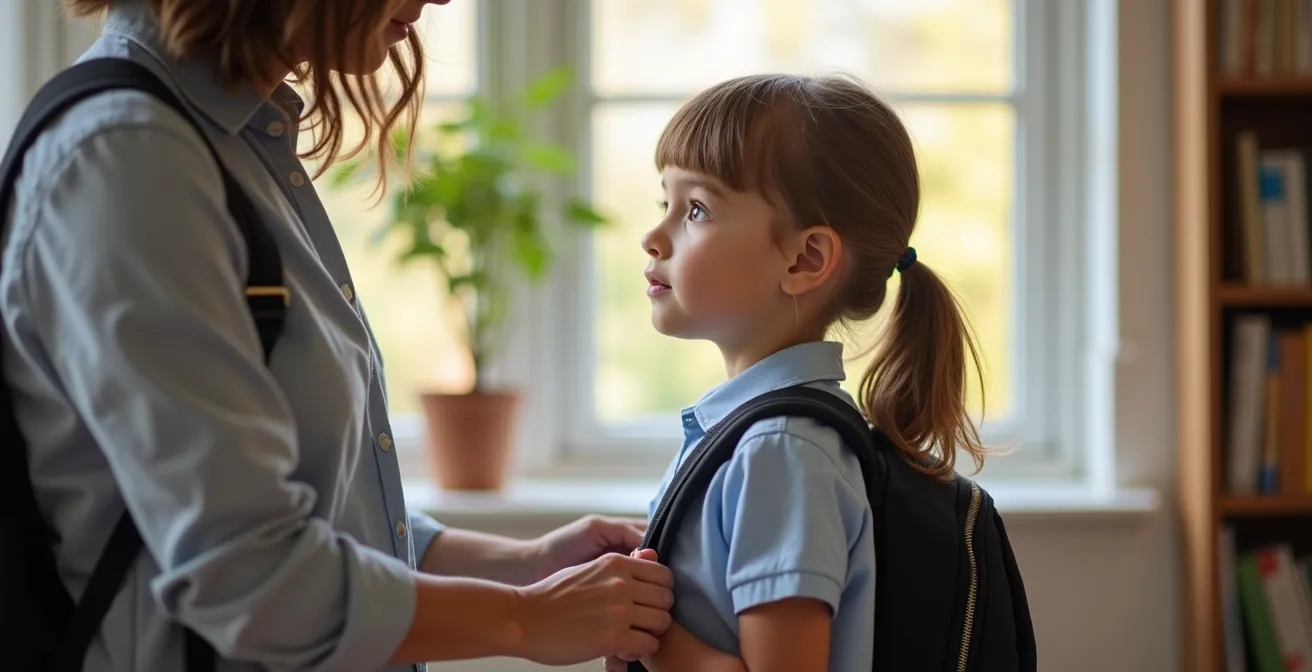
As a pediatric physiotherapist, one of the most common sights I witness is a small child dwarfed by a colossal school bag, their body contorting into a question mark just to stay upright. Parents are often told to look for padded straps or multiple compartments, but this advice barely scratches the surface of a complex biomechanical issue. The daily battle against a poorly chosen or improperly worn backpack can lay the foundation for chronic pain, poor posture, and even spinal distress later in life.
The problem extends beyond the school run. The child’s entire environment, from the height of their homework desk to the support offered by their chair, contributes to their overall postural health. A state-of-the-art backpack is rendered ineffective if the child then spends hours hunched over an ill-fitting study area. True prevention requires a holistic view of your child’s daily physical demands.
But what if the key wasn’t just finding a “good bag,” but understanding the fundamental principles of load-bearing on a developing spine? This guide moves beyond marketing features to provide you with the clinical knowledge needed to protect your child. We will deconstruct the physics of weight distribution, the importance of the body’s center of gravity, and how to create a complete ergonomic ecosystem that supports your child’s biomechanical integrity from the classroom to the homework corner.
By following these principles, you can transform a daily source of physical stress into an opportunity to reinforce healthy postural habits. This article will guide you through the critical checkpoints for selecting, adjusting, and packing a school bag, and then expand to the surrounding ergonomic environment for comprehensive protection.
Summary: A Clinical Guide to Your Child’s Ergonomic Safety
- Why Poor Weight Distribution Leads to Chronic Slouching in 8-Year-Olds?
- How to Adjust Backpack Straps to Align With the Lumbar Curve?
- Rolling Bag or Backpack: Which Causes More Shoulder Strain on Stairs?
- The Oversized Bag Mistake That Throws Off a Child’s Center of Gravity
- How to Pack Heavy Books Closest to the Back for Stability?
- Why “Growing With You” Desks Save Backs and Money Over 5 Years?
- Velcro vs. Laces: Which Provides Better Ankle Stability for Running?
- Which Ergonomic Chair Prevents Slouching for Homework Sessions?
Why Poor Weight Distribution Leads to Chronic Slouching in 8-Year-Olds?
An 8-year-old’s spine is not a miniature version of an adult’s; it is a dynamic, developing structure. The natural S-shaped curves of the spine are still forming and are highly susceptible to external forces. When a backpack’s weight is poorly distributed—hanging too low or pulling away from the body—it creates an off-axis strain. This force pulls the child’s torso backward, away from their natural center of gravity. To avoid falling, the child’s body instinctively performs a dangerous maneuver known as postural compensation.
This compensation involves jutting the head and neck forward and rounding the shoulders. While this action momentarily rebalances the body, it flattens the crucial curve in the mid-back (thoracic spine) and strains the muscles and ligaments in the neck and lower back. When this happens daily, the muscles learn this slouched position as their new normal. This leads to muscle fatigue, pain, and eventually, a chronic slouch that persists even when the backpack is off. The body’s neuromuscular system effectively memorizes a dysfunctional posture, which can become incredibly difficult to correct later in life.
Maintaining the biomechanical integrity of the spine during these formative years is paramount. The goal is to ensure any load is carried axially—that is, directly in line with the spine—to prevent these harmful compensatory patterns. A correctly fitted and packed backpack works with the body’s structure, whereas a poorly managed one forces the body to work against it, paving the way for long-term musculoskeletal issues.
How to Adjust Backpack Straps to Align With the Lumbar Curve?
Proper strap adjustment is the most critical daily intervention a parent can make. It’s the difference between a load that is integrated into the body’s core and one that hangs off it, causing strain. The objective is to secure the bag high and tight against the back, ensuring its weight is transferred through the mid-back muscles and hips, not the delicate shoulder structure. The straps are the primary tool for achieving this perfect lumbar alignment.
The process is precise and should be checked regularly, especially after a heavy packing day. Using sternum and waist straps is not optional; they are integral components for stabilizing the load and preventing compression of the nerves and blood vessels around the shoulders (brachial plexus). Follow this professional protocol to ensure a perfect fit every time.
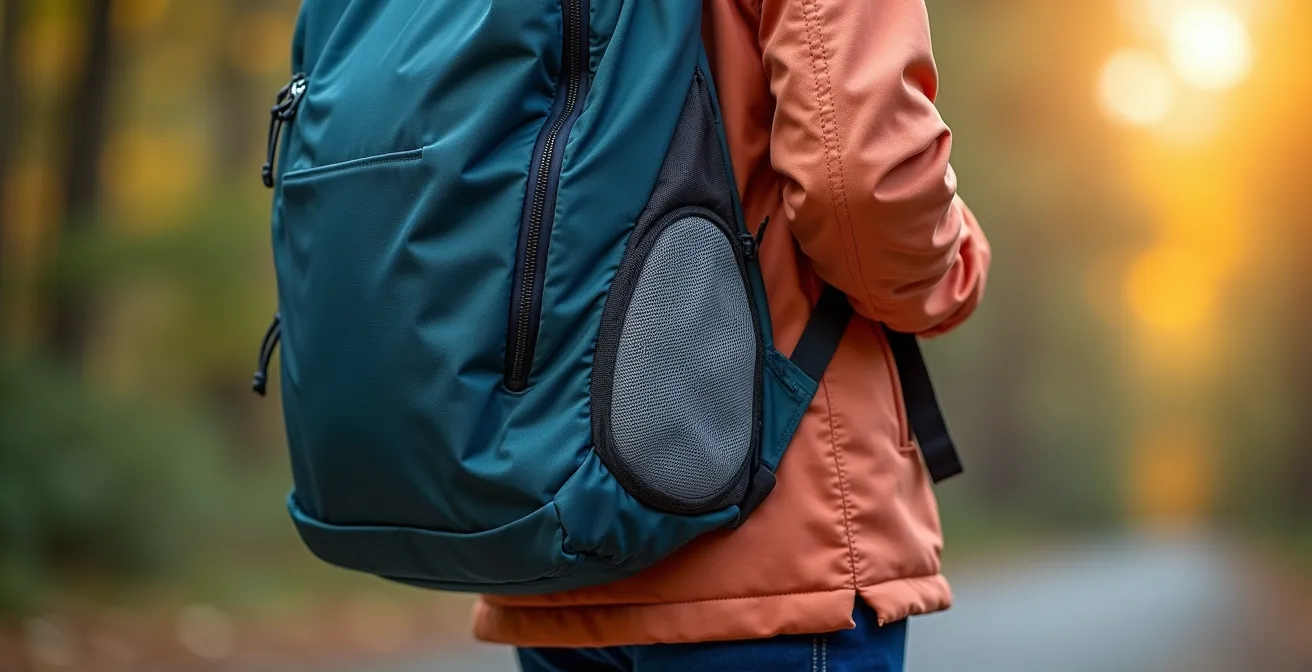
As shown in this detailed view, the backpack should contour perfectly to the child’s back, leaving no gaps. This snug fit ensures the weight becomes an extension of the child’s own body mass, rather than a separate, pulling force. A correctly adjusted bag should allow the child to stand and walk with a completely upright posture.
- Apply the Two-Finger Rule: Tighten the shoulder straps until you can comfortably fit only two fingers between the strap and the child’s shoulder. This ensures the bag is held close without constricting movement.
- Position the Bag High: The top of the bag should be at shoulder level, and the bottom should rest above the hip bones. This positioning engages the stronger mid-back muscles for support.
- Connect the Sternum Strap: Fasten the chest (sternum) strap to pull the shoulder straps inward. This is crucial for taking pressure off the shoulders and preventing nerve compression.
- Ensure a Snug Fit: The bag must sit snugly against the back. If it sags or hangs loosely, the weight will pull backward and cause postural compensation. Adjust until there is no gap.
Rolling Bag or Backpack: Which Causes More Shoulder Strain on Stairs?
The rolling bag is often proposed as the obvious solution to heavy loads, but from a biomechanical perspective, it can introduce a different, more insidious set of problems. While it excels on long, flat corridors, its utility breaks down in crowded hallways, on uneven ground, and most critically, on stairs. Lifting a loaded rolling bag requires a sudden, explosive, and unilateral (one-sided) effort, combining a lift with a twist. This motion places acute strain on the shoulder, wrist, and lower back.
Repeatedly pulling the bag with the same arm also promotes muscle imbalance and spinal torsion, potentially leading to an asymmetrical development of the shoulder and back muscles. A correctly worn backpack, by contrast, distributes the load bilaterally, maintaining symmetry and balance. This is especially important when navigating dynamic environments like staircases. The following comparison, based on a detailed biomechanical analysis, highlights the key differences.
| Factor | Rolling Bag | Backpack (Worn Correctly) |
|---|---|---|
| Stair Navigation | Explosive lift + twist motion causing acute shoulder/wrist strain | Balanced bilateral load, minimal additional strain |
| Muscle Imbalance Risk | High – unilateral pulling creates spinal torsion | Low – weight distributed evenly across both shoulders |
| Terrain Adaptability | Poor – struggles with crowds, uneven surfaces | Excellent – hands-free mobility for all terrain |
| Long-term Posture Impact | Asymmetrical shoulder height development | Maintains symmetrical development when fitted properly |
The distinction between these two systems becomes even clearer when considering the concept of axial versus off-axis loading, a topic that has even been brought before legislators.
Case Study: Oregon Legislative Testimony on Axial Loading Systems
In 2017, physical therapist Marilyn Miller von Foerster testified before Oregon State committees on the topic of student load-carrying. She demonstrated that traditional backpacks, even when worn properly, often cause some degree of off-axis loading and postural distortion. Her research showed that when students carried the same weight in a system designed for pure axial-loading (distributing weight down the spine), they experienced immediate postural improvement and relief. Children in the study reported they could walk faster and move more freely compared to when they used conventional backpacks, illustrating the profound impact of proper load alignment.
The Oversized Bag Mistake That Throws Off a Child’s Center of Gravity
My attention is often drawn to children whose bags do not fit their size, for example, the little girl with the school bag, which she is almost falling backward to carry because it is too big behind.
– Helle Hammer Mortensen, Occupational Therapist, JEVA Ergonomics Study
This observation from a seasoned occupational therapist highlights the single most common fitting error: choosing a bag that is too large for the child’s torso. The issue is not just aesthetic; it’s a matter of physics. Every person has a center of gravity (CoG), an imaginary point where their body weight is balanced. In a child, this CoG is relatively high. An oversized backpack, especially one that is wider than the child’s torso or hangs too low, shifts the combined center of gravity of the child and bag backward and outward. This creates a powerful lever effect, pulling the child off-balance.
To counteract this pull, the child is forced into extreme postural compensation—leaning far forward from the hips and rounding the back significantly. This posture puts immense stress on the spinal erector muscles and ligaments of the lower back. The rule is simple: the backpack should be a compact extension of the torso, never wider or significantly longer. A bag that “they can grow into” is a recipe for immediate postural problems. The fit must be for the child’s current size. The following “Wall Test” is a simple, no-fail method to verify a bag’s size before purchase or use.
- Stand Against the Wall: Have your child stand with their heels, back, and head touching a flat wall.
- Place the Bag: Put the empty backpack on the child’s back.
- Check the Width: The bag’s width should not extend beyond the sides of your child’s torso.
- Check the Height: The top of the bag should not be higher than the child’s shoulders.
- Check the Bottom: The bottom of the bag must sit above the small of their back, not resting on their hips or buttocks.
- Pass or Fail: If the bag fails any of these checks, it is too large and biomechanically unsafe for your child.
How to Pack Heavy Books Closest to the Back for Stability?
Once you have the right bag, the next daily challenge is packing it correctly. The guiding principle is identical to the one for bag sizing: keeping the center of gravity as close to the body as possible. Heavy items like textbooks, laptops, or large binders act like anchors. If placed in the outer pockets of a backpack, they exert a significant backward pulling force, forcing the child to lean forward to compensate. Conversely, when these heavy items are placed flat against the back panel, their weight is integrated into the child’s own CoG, promoting stability and an upright posture.
This isn’t just a minor tweak; it dramatically changes the biomechanics of carrying the load. It’s also vital to control the total weight. Most pediatric and orthopedic associations recommend a backpack’s weight should not exceed 10-15% of the child’s body weight. Exceeding this guideline has a documented clinical impact; recent 2024 research reveals that 63.9% of girls and 50.9% of boys report musculoskeletal pain when carrying bags exceeding just 13.5% of their body weight. This underscores the need for diligent packing and regular clean-outs. The “Packing Pyramid” method is a simple, memorable way to teach this to children.
- Base Layer (Heaviest): Place large, flat, heavy items like textbooks and laptops directly against the back panel of the main compartment.
- Middle Layer (Medium): Add medium-weight items like notebooks and binders in front of the heavy books.
- Top Layer (Lightest): Place lighter, bulkier items like pencil cases or a lunch box towards the top and front of the main compartment.
- Outer Pockets (Featherweight): Use outer pockets only for the absolute lightest items, such as tissues, a small snack, or house keys.
- Weekly Audit: Every Sunday, help your child empty the bag completely. Question the necessity of every single item for the upcoming week to prevent accumulation.
Why “Growing With You” Desks Save Backs and Money Over 5 Years?
A perfectly fitted backpack addresses the dynamic challenge of carrying a load. However, a significant portion of a child’s day is spent in a static posture: sitting at a desk. An ill-fitting desk and chair can undo all the benefits of an ergonomic backpack by forcing a child into a hunched position for hours of homework. The solution is an ergonomic ecosystem where the study furniture is as thoughtfully chosen as the backpack. “Growing with you” or adjustable desks are a cornerstone of this philosophy.
These desks and their accompanying chairs can be fine-tuned to the child’s exact height, ensuring a perfect ergonomic setup at every stage of development. The core objective is to maintain the 90-90-90 rule: 90-degree angles at the elbows, hips, and knees. This posture minimizes strain on the spine and promotes concentration. While the initial investment may be higher than a standard desk, it eliminates the need to buy multiple sets of furniture as the child grows, offering significant long-term savings while safeguarding their spinal health.
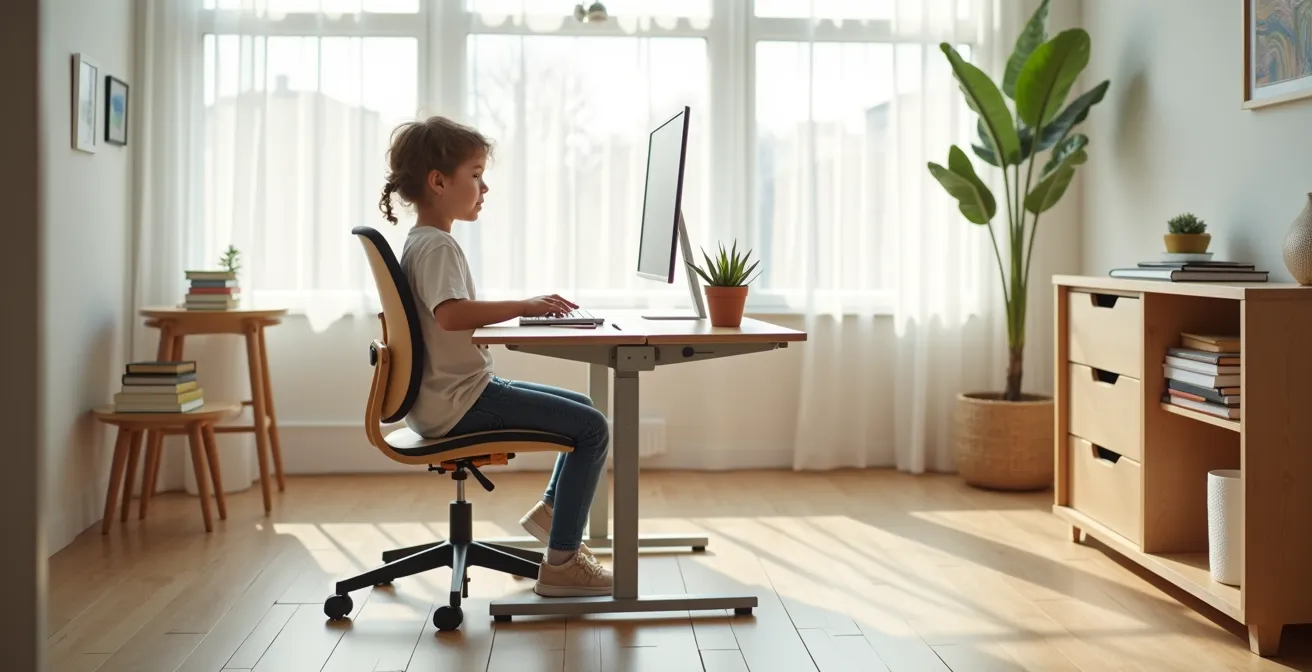
This complete ergonomic homework setup illustrates the ideal. The desk and chair work in harmony to support a neutral spine, open hip angle, and relaxed shoulders. This is the posture that prevents the fatigue and pain associated with long study sessions.
Case Study: Long-term Benefits of the Kid2Youth G6 Ergonomic Desk
The G6-120S adjustable desk system provides a clear example of how ergonomic investment yields returns. Studies on children using height and tilt-adjustable desks show marked improvements in concentration, fewer complaints of back pain, and better homework completion rates. The desk’s ability to adjust for children from ages 3 to 18 means it can maintain the optimal 90-degree angles at the elbows, knees, and hips throughout all critical growth phases. This adaptability not only prevents the development of poor postural habits but also negates the recurring cost and waste of replacing outgrown furniture.
Velcro vs. Laces: Which Provides Better Ankle Stability for Running?
The body’s posture is a kinetic chain, where a weakness in one link can compromise the entire structure. The foundation of this chain is the feet. Unstable footing can cause subtle misalignments that travel up the legs to the hips and spine, which are then magnified when the body is under load from a backpack. Therefore, a child’s footwear is an often-overlooked but crucial part of their ergonomic equipment, especially for active moments like running at recess or walking home.
The debate between Velcro and laces goes beyond convenience. From a stability standpoint, laces offer a superior ability to customize the fit. They allow for micro-zoning, where different parts of the shoe can be tightened or loosened to accommodate the unique shape of a child’s foot (e.g., higher arches, wider forefoot). This customized support prevents the foot from wobbling within the shoe, providing a stable base. Velcro, while quick, applies uniform pressure and is less adaptable. A recent analysis on kinetic chain impact further clarifies this.
| Feature | Laces | Velcro |
|---|---|---|
| Customization | Micro-zoning for different foot areas (high arches, wide feet) | Uniform pressure across entire strap area |
| Stability with Heavy Load | Superior – targeted support prevents wobble effect | Moderate – less adaptable to foot shape changes |
| Kinetic Chain Impact | Minimal – proper foot support maintains hip alignment | Higher risk of gait alteration under load |
| Adjustment Speed | Slower but more precise | Quick but less customizable |
For a child carrying a significant load, the superior stability offered by well-tied laces can be a deciding factor in maintaining proper gait and hip alignment, thereby reducing overall stress on the spine. While Velcro is fine for very young children or casual wear, laced shoes provide better biomechanical support for the demands of a school day.
Key Takeaways
- Fit is Biomechanical, Not Aesthetic: The right bag aligns with the spine’s curves and respects the child’s center of gravity. Width and height relative to the torso are the most critical metrics.
- The Load Inside Matters Most: How a bag is packed and its total weight are as crucial as the bag itself. Heavy items must always be closest to the spine.
- Think Beyond the Bag: True ergonomic safety involves a complete ecosystem, including an adjustable desk, supportive chair, and stable footwear to protect posture during all daily activities.
Which Ergonomic Chair Prevents Slouching for Homework Sessions?
The final pillar of your child’s ergonomic ecosystem is the chair they use for homework. After a day of carrying a backpack, their spine needs a supportive environment to rest and recover, not another challenge to overcome. A standard dining chair or stool forces the body into a static, often unsupported, posture. An ergonomic chair, however, is designed to work with the body, preventing the slouch that inevitably creeps in during long periods of sitting.
British ergonomic studies suggest that children spend over 60% of their study time sitting, making the quality of that sitting time a major factor in their spinal health. The goal of an ergonomic chair is to facilitate the “90-90-90” rule: a 90-degree angle at the knees (with feet flat), a 90-degree angle at the hips (with back against the chair), and a 90-degree angle at the elbows (with hands on the desk). This alignment minimizes stress and allows for sustained focus. Features like adjustable height, lumbar support, and even gentle swivel capabilities encourage “active sitting,” promoting blood flow and preventing stiffness.
Setting up the chair correctly is not a one-time task. As your child grows, the chair must be readjusted to maintain these critical angles. This simple checklist provides the framework for achieving a perfect, slouch-proof setup.
Your Action Plan: The 90-90-90 Rule for Chair Setup
- Knee Position: Adjust the chair height so your child’s knees form a perfect 90-degree angle, with their feet resting flat on the floor or on a stable footrest.
- Hip Position: Ensure their back is fully against the chair’s backrest. This should naturally create a 90-degree angle at the hips, preventing them from slumping forward.
- Elbow Position: Fine-tune the chair and desk height so their elbows rest at a comfortable 90-degree angle when their hands are placed on the desk surface.
- Active Sitting Features: If the chair has them, encourage the use of gentle swivel or tilt functions. These small movements (micro-adjustments) improve blood flow and reduce static muscle load.
- Regular Checks: A child’s growth is rapid. Re-evaluate and readjust the chair setup every 2-3 months to ensure the 90-90-90 angles are perfectly maintained.
By applying these clinical principles not just to the backpack but to your child’s entire daily environment, you move from being a reactive parent treating symptoms like pain to a proactive guardian of their long-term health. Begin today by auditing your child’s backpack, their packing habits, and their homework station to build a foundation of lifelong postural integrity.