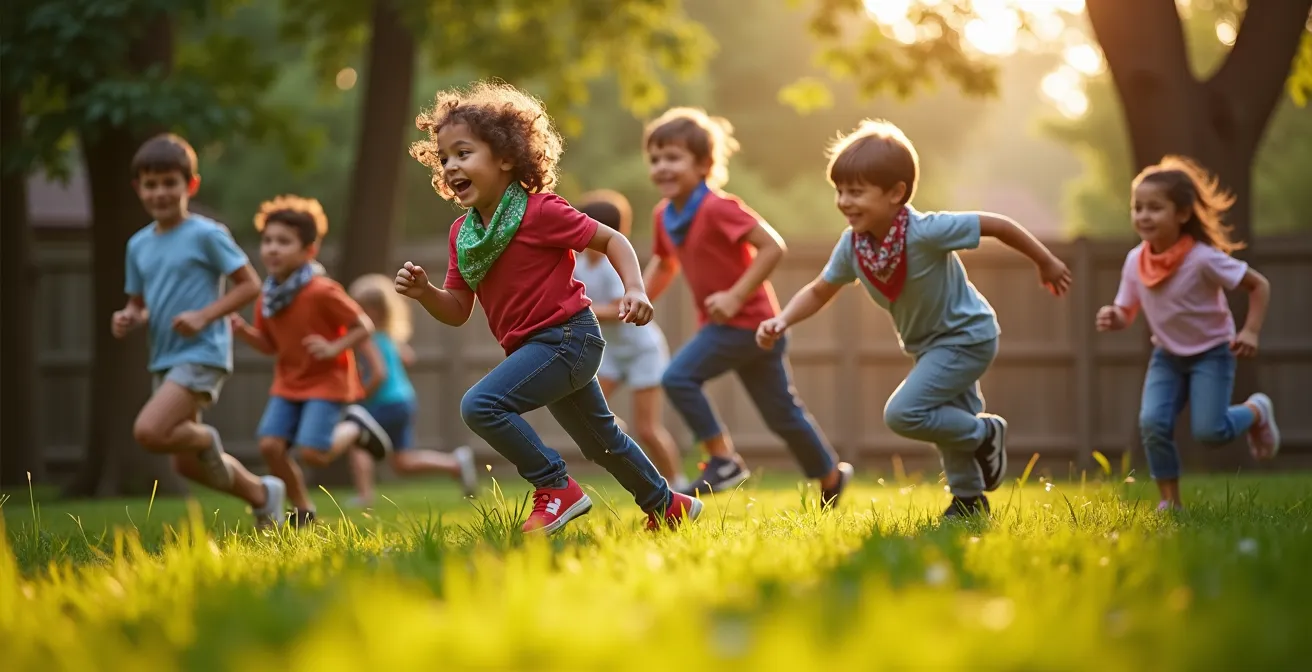
The secret to getting kids off screens isn’t restriction; it’s engineering outdoor play that delivers a bigger psychological and developmental payoff.
- Classic games like Capture the Flag are powerful tools for teaching strategy and real-world teamwork that screens can’t replicate.
- Budget-friendly, DIY projects like scavenger hunts and backyard ninja courses create lasting memories and a sense of ownership.
Recommendation: Start by transforming one classic game using the strategies here. Focus on co-creating the rules and identity with your kids to maximize their buy-in and fun.
Alright team, let’s talk. You’re staring at the back of your kid’s head, which is illuminated by the glow of a screen. You’ve tried the usual tactics: setting time limits, suggesting they “go play outside,” maybe even hiding the tablet. But the magnetic pull of the digital world always seems to win. The frustration is real. We, as parents and educators, are in a constant battle against the passive, easy dopamine that screens provide.
Many guides will give you a simple list of games, but they miss the most critical point. The problem isn’t a lack of things to do outside; it’s that we often fail to make those activities as compelling as their digital counterparts. We’re not just fighting boredom; we’re competing with game designers who have perfected the art of engagement. So, what’s the solution? We need to stop just suggesting play and start engineering fun. This means understanding the “why” behind the games—the psychological hooks that build teamwork, mastery, and pure, unadulterated joy.
This guide isn’t just another list. It’s a PE teacher’s playbook. We’re going to break down how to turn simple, often free, outdoor activities into powerful developmental experiences. We will explore how to build a ninja course with pool noodles, why a simple scavenger hunt creates stronger memories than an expensive party, and how morning sunlight during play can fundamentally fix a child’s sleep cycle. It’s time to shift our strategy from restriction to attraction. Let’s create outdoor adventures so epic that screens become the second-best option.
This article provides a complete playbook, breaking down the strategy and specific tactics for creating unforgettable outdoor games. You’ll find everything you need to transform your backyard into a hub of activity and connection.
Summary: How to Engineer Fun That Beats Screens
- Why “Capture the Flag” Is Still the Ultimate Team Building Game?
- How to Build a Ninja Course Using Pool Noodles and Chalk?
- Tag Variations for Tiny Backyards: How to Run Without Space?
- The Hydration Rule: How to Keep Kids Drinking Without Stopping the Fun?
- Why Morning Sunlight Exposure During Play Fixes Sleep Cycles?
- Vest Only or Full Jacket: What Works Best for Outdoor Summer Events?
- Why Kids Remember Scavenger Hunts More Than Expensive Balloon Arches?
- How to Build a Backyard Adventure Zone on a Budget?
Why “Capture the Flag” Is Still the Ultimate Team Building Game?
In a world of solo screen quests, Capture the Flag remains the gold standard for teaching real-world teamwork. Why? Because it delivers a psychological payoff that digital games struggle to match. The game forces kids to communicate non-verbally, make split-second risk assessments, and coordinate movements across physical space. There are real stakes—getting tagged out means a trip to “jail”—and real triumph in a successful flag capture. It’s not just running; it’s applied strategy in motion.
This kind of group play is a powerhouse for social development. In fact, studies show that outdoor play helps kids socialize, directly improving empathy, cooperation, and confidence. Unlike a video game where a player might respawn instantly, Capture the Flag requires teammates to physically rescue each other, building a tangible sense of interdependence and trust. It’s the perfect environment for “developmental engineering,” where the rules of the game are designed to foster crucial life skills.
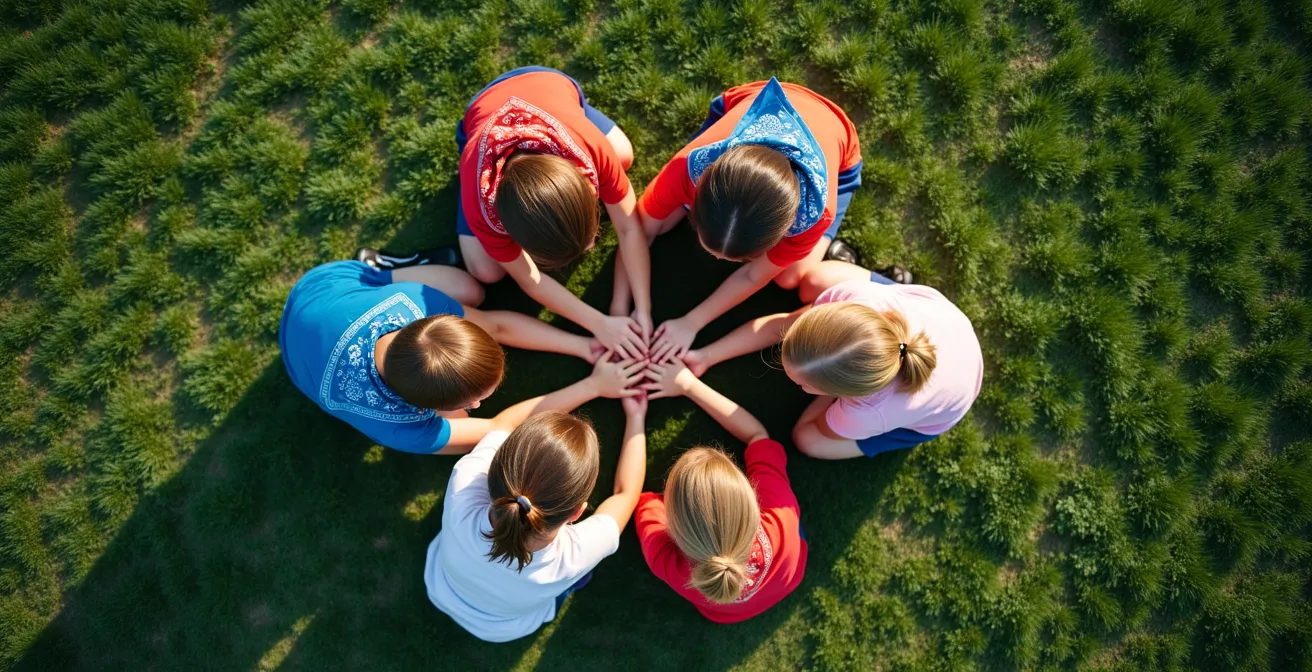
To elevate the game beyond simple chaos, introduce specialized roles. Appoint “Scouts” for reconnaissance, “Defenders” to guard the flag, and “Raiders” for bold offensive moves. This gives every child a purpose and a way to contribute, regardless of their athletic ability. You can even add game-changing variations, like “immunity zones” for a 30-second rest or requiring a special “key” (like a pinecone) to be brought back to base to free captured teammates. This transforms a simple game into a complex, narrative-driven mission.
How to Build a Ninja Course Using Pool Noodles and Chalk?
You don’t need expensive equipment to create the thrill of a “Ninja Warrior” course in your own backyard. The magic lies in using cheap, everyday items to build challenges that develop agility, balance, and body control. This is where the concept of “Effortful Joy” shines—the immense satisfaction kids feel from conquering a physical challenge they helped create. Using simple materials like pool noodles and sidewalk chalk, you can design a dynamic course that costs next to nothing.
The key is scalability. A five-year-old and a ten-year-old can run the same course if you design it with varying difficulty. Chalk lines for a balance beam can be wide for beginners and narrow for advanced ninjas. Pool noodles can be set as ankle-high hurdles for little ones and knee-high obstacles for older kids. This approach allows everyone to feel a sense of mastery and progress. The best part? The course can be redesigned every week with zero cost, keeping the challenge fresh and exciting.
This DIY approach offers massive savings compared to store-bought alternatives. For just a few dollars, you can create a more versatile and personalized set of challenges.
| DIY Option | Cost | Store Alternative | Store Cost | Versatility |
|---|---|---|---|---|
| Pool Noodles (6 pack) | $6 | Agility Hurdles Set | $45 | Can be cut/modified |
| Sidewalk Chalk | $3 | Agility Ladder | $25 | Unlimited designs |
| Cardboard Boxes | Free | Play Tunnel | $30 | Customizable sizes |
| String/Yarn | $2 | Laser Maze Game | $40 | Adjustable difficulty |
| Total DIY Cost | $11 | Total Store Cost | $140 | 92% Savings |
Your Blueprint for a DIY Ninja Course
- Draw an agility ladder with chalk – make squares closer for 5-year-olds (12 inches apart) and wider for 10-year-olds (18 inches).
- Create pool noodle hurdles at varying heights – start at ankle level for beginners, knee-high for intermediate.
- Design a balance beam path using chalk lines – 6 inches wide for young kids, 3 inches for older challengers.
- Add ‘laser maze’ sections with string tied between trees at different heights for crawling and ducking.
- Set up timing stations with different achievement badges: complete under 60 seconds for ‘Speed Demon’, no ground touches for ‘Balance Master’.
Tag Variations for Tiny Backyards: How to Run Without Space?
A lack of space is a common excuse for staying indoors, but it doesn’t have to be a barrier to active play. The solution is to choose games that prioritize strategy over sheer speed. With a few clever rule changes, the classic game of tag can be adapted for even the smallest of backyards, turning spatial constraints into a fun and creative challenge. This is about adapting the environment to maximize the sensory richness of play, even in a 15×15 foot area.
One of the best examples is Shadow Tag. In this version, the person who is “it” doesn’t tag players’ bodies, but steps on their shadows. This simple twist completely changes the game. It naturally slows down the pace and forces kids to think strategically about their position relative to the sun. It becomes a game of angles and timing, perfect for developing spatial awareness without needing a large field to run in. Parents have reported kids staying engaged for 30-45 minutes at a time with this version alone.
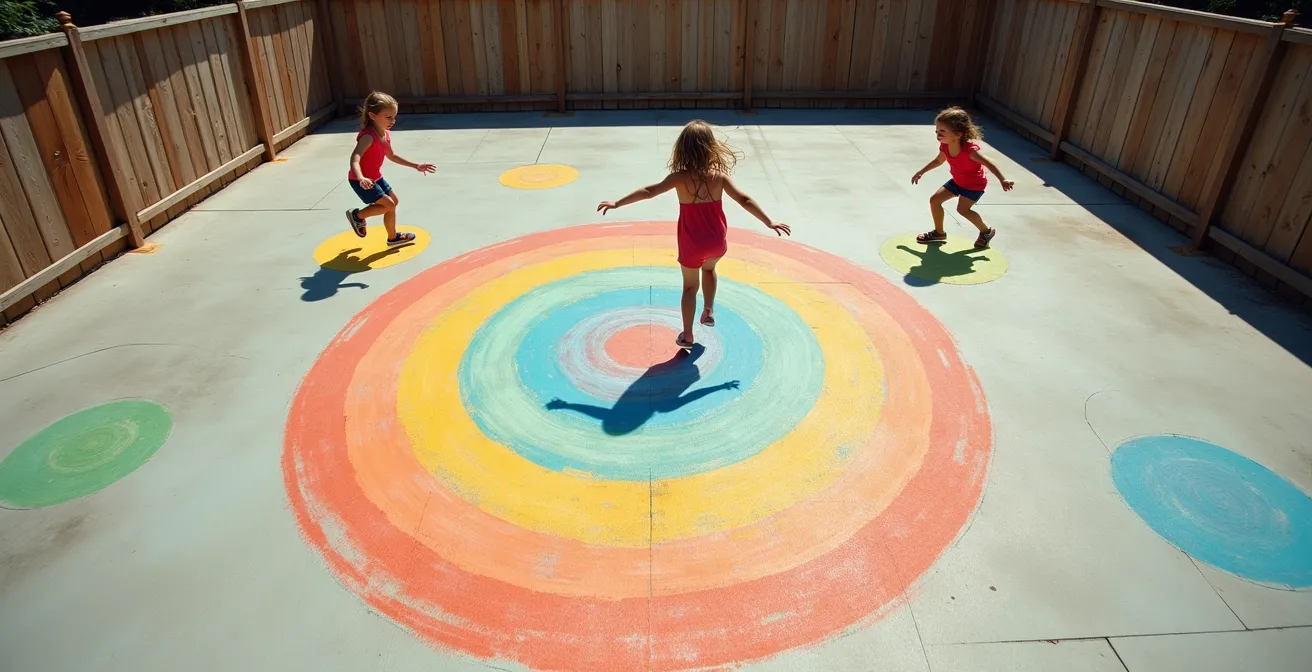
Other variations can also limit movement while increasing fun. In Lava Monster Tag, players can only stand on designated “safe zones,” like chalk circles or patio stones, forcing them to hop and plan their routes. Another great option is Bandaid Tag, where a tagged player must place a hand (a “bandaid”) on the spot they were touched. After two tags, their movement becomes hilariously restricted, naturally leveling the playing field. These games prove that creativity, not acreage, is the key to active fun.
The Hydration Rule: How to Keep Kids Drinking Without Stopping the Fun?
“Stop and drink some water!” How many times have we yelled that, only to be ignored by kids deep in the throes of a game? The problem isn’t that they don’t want to drink; it’s that stopping feels like a punishment that interrupts the fun. The key is to gamify hydration, integrating it directly into the play. Instead of forcing a break, we can make the water station a strategic part of the game itself, a place of power or reward.
The importance of this can’t be overstated. Even mild dehydration can tank a child’s mood and energy. In fact, children who maintain proper hydration during outdoor play show 23% better sustained attention and physical endurance. By keeping them hydrated, we’re not just being safe; we’re actively extending the duration and quality of their playtime, giving them a better chance to experience that “Effortful Joy” we’re aiming for.
So, how do we do it? Turn the water table into a “Healing Spring Station,” a designated safe zone where players are immune from being tagged. Or, set up a “Potion Crafting” table where kids can mix their water with fruit slices and mint, giving them a sense of ownership over their drink. You could even assign a rotating “Water Boss” role, giving a child a special whistle to call official hydration breaks. Another fantastic idea is to create “hydration passports,” where kids earn a sticker or stamp for every bottle of water they finish. These small changes transform a chore into a fun, integral part of the game.
Why Morning Sunlight Exposure During Play Fixes Sleep Cycles?
One of the most powerful but overlooked benefits of outdoor play is its effect on sleep. If you’re struggling with bedtime battles, the solution might not be at 8 PM, but at 8 AM. Exposing children to natural sunlight, especially in the morning, is a potent biological hack that helps regulate their internal clock, or circadian rhythm. This natural light signals to the brain that it’s daytime, which in turn helps it prepare for sleep when evening comes.
This directly counteracts the negative effects of screen time. The blue light emitted from tablets and phones in the evening tricks the brain into thinking it’s still daytime, suppressing the production of melatonin, the hormone that tells our bodies it’s time to sleep. Unstructured physical activity during the day helps children get to sleep, and as unstructured physical activity during the day helps children sleep better, it also improves their mood and concentration the following day. One study found that families who implemented a simple 15-minute morning outdoor play routine saw significant improvements in bedtime resistance and sleep quality within just two weeks.
This doesn’t have to be a major undertaking. A few quick, fun activities are all it takes to get that crucial dose of morning sun. Try a session of Morning Shadow Dancing, where kids use their long morning shadows for creative movements. A Sunrise Scavenger Hunt to find five “morning items” like dewdrops or a specific bird sound can be done in under ten minutes. Even a few simple “Wake-Up Relays” between two trees can do the trick. The goal is to make outdoor time the very first activity of the day, setting their internal clocks for success.
Vest Only or Full Jacket: What Works Best for Outdoor Summer Events?
When you’re organizing a group game like Capture the Flag or a team relay, clear team identification is crucial. But in the summer heat, comfort is just as important as visibility. Heavy t-shirts or jackets can lead to overheating, cutting the fun short. This is where a little bit of planning goes a long way. The best options are lightweight, breathable, and ideally, add to the fun instead of just being a logistical requirement.
Mesh vests, often called pinnies, are the top choice for a reason. They’re extremely breathable, highly visible, and can be worn over any clothing. However, there are many other creative and budget-friendly options. Simple bandanas tied around an arm or head are cheap and effective. For a zero-cost solution, you can cut up old, colored t-shirts into strips to use as armbands. Even face paint can be a fun, single-use way to denote teams, adding to the festive atmosphere of the game.
To really boost engagement, turn team identification into part of the experience. This aligns perfectly with the principle of “Experience over Expense.”
Case Study: Creative Team Building Through DIY Identity
A community summer program transformed team identification into a pre-game activity by having kids create team banners and armbands from old t-shirts and fabric markers. This 20-minute craft session increased game participation by 40% and created stronger team cohesion. Children reported feeling more invested in the games when they had created their own team identity, turning a simple logistics issue into a valuable team-building exercise.
The right choice depends on your budget and goals, but prioritizing breathability and an element of fun is always a winning strategy.
| Option | Cost per Child | Breathability | Visibility | Game Integration | Reusability |
|---|---|---|---|---|---|
| Mesh Vests | $3-5 | Excellent | High | Can hold flags/items | Very High |
| Bandanas | $1-2 | Excellent | Medium | Decorative only | High |
| DIY T-shirt Strips | $0 (recycled) | Good | Medium | Basic ID only | Medium |
| Face Paint | $0.50 | N/A | High | Fun factor high | Single use |
| Colored Wristbands | $0.25 | Excellent | Low | Minimal | Single event |
Why Kids Remember Scavenger Hunts More Than Expensive Balloon Arches?
When planning a party or event, it’s easy to get caught up in decorations. We spend time and money on balloon arches and elaborate themes, only to find kids are more interested in chasing a stray bug. The reason is simple: children, and adults for that matter, form stronger memories from active participation than from passive observation. This is the core of “Experience over Expense.” A 15-minute scavenger hunt will be remembered long after the balloons have deflated.
This phenomenon is so reliable it even has a name in psychology: the “IKEA effect.” As child development researchers note, the principle is clear.
Active participation in a hunt creates stronger, multi-sensory memories than passive observation of decorations. When children help create something, they value it more – this is the IKEA Effect in action.
– Child Development Research, Family Fun Twin Cities – Outdoor Games Guide
A scavenger hunt engages all the senses. Kids are touching leaves, listening for sounds, and using their problem-solving skills to decipher clues. This sensory richness creates multiple pathways in the brain for the memory to anchor itself. It’s an adventure they co-create through their discoveries, giving them a powerful sense of agency and accomplishment that simply looking at decorations cannot provide.
Setting one up doesn’t have to be complicated. The best scavenger hunts are simple and open-ended. Here are a few templates you can set up in under five minutes:
- Nature Rainbow Hunt: Challenge kids to find a natural item for each color of the rainbow.
- Texture Detective: Ask them to locate five different textures (e.g., smooth, rough, fuzzy, bumpy, wet).
- Sound Safari: Have them sit quietly for two minutes and list all the different sounds they can hear.
- Shape Seekers: Give them cards with simple shapes (circle, square, triangle) and have them find objects in nature that match.
Key Takeaways
- Engineer, Don’t Just Suggest: Actively design games to provide a psychological payoff (teamwork, mastery) that competes with screens.
- Experience Over Expense: Memorable fun comes from active participation and overcoming challenges (Effortful Joy), not passive observation of costly items.
- Leverage Natural Benefits: Use outdoor play to tap into powerful, free benefits like circadian rhythm regulation from morning sun and social skill development.
How to Build a Backyard Adventure Zone on a Budget?
The ultimate way to make your backyard the go-to spot is to transform it into a permanent, modular “Adventure Zone.” This sounds expensive, but it’s one of the most budget-friendly projects you can undertake. The secret is upcycling. With a little creativity, common items that are often free for the asking—like old tires and wooden pallets—can become the building blocks for an incredible play space. This is the pinnacle of “developmental engineering” on a budget.
The goal is to create a space that invites imaginative, open-ended play. Wooden pallets, often available for free from local stores, can be sanded down and secured together to create a small climbing wall or the base of a fort. Old tires from a mechanic shop can become planters, sandboxes, or challenging stepping stones in an obstacle course. As one family demonstrated by transforming their yard for under $50, a few PVC pipes from the hardware store can become a water wall, and a repurposed tarp can serve as a fort roof or a slip-n-slide. The possibilities are endless.
The key to a long-lasting adventure zone is making it modular. Instead of cementing everything in place, design elements that can be moved and reconfigured. This allows your children to become co-creators of their own play space, constantly inventing new challenges and narratives. This sense of ownership is a powerful hook that will keep them engaged for months, long after a static, store-bought playset has lost its appeal.
| Material | Source | Adventure Use | Skills Developed |
|---|---|---|---|
| Wooden Pallets | Free from stores | Climbing wall, fort base | Strength, problem-solving |
| Old Tires | Free from tire shops | Obstacle course, sandbox | Balance, jumping |
| PVC Pipes | $20 hardware store | Water wall, fort frame | Engineering, cause-effect |
| Rope | $15 hardware store | Pulley system, swing | Coordination, physics concepts |
| Tarp/Sheets | Repurposed | Fort roof, slip-n-slide | Imaginative play |
Now you have the playbook. It’s time to stop fighting the screen-time battle and start winning the outdoor fun war. Begin today by picking one of these strategies and bringing your kids into the planning process. Let’s get moving!