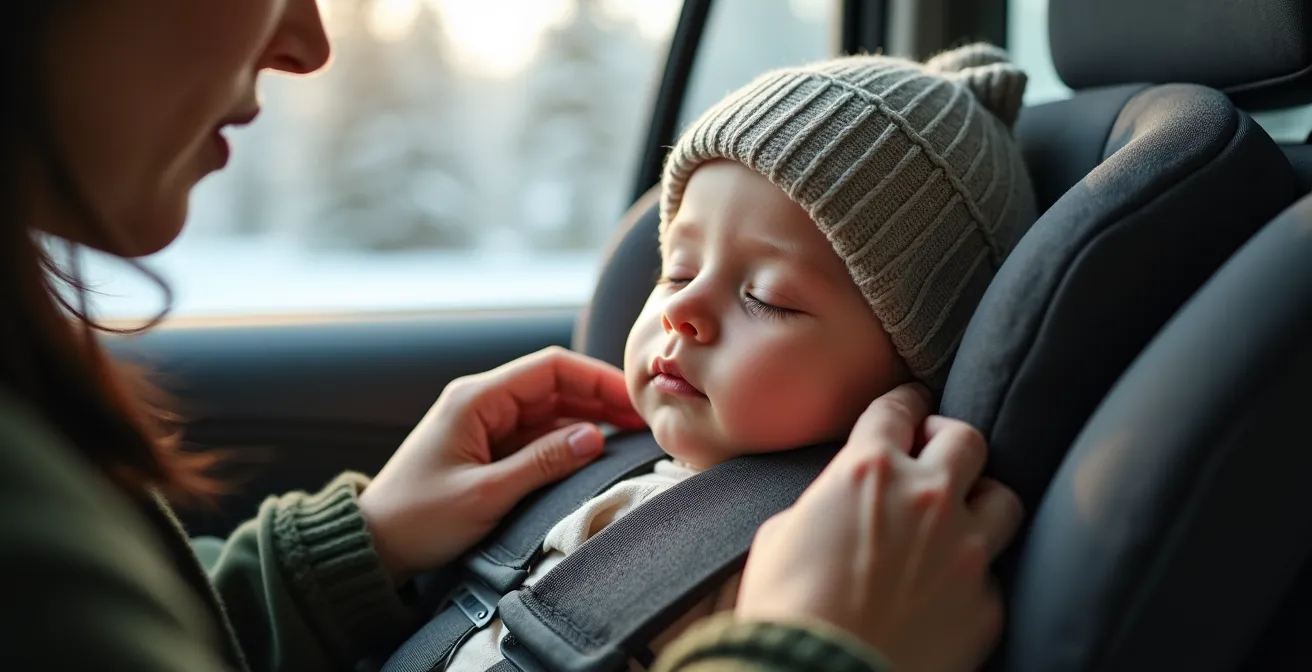
The core challenge for parents in cold climates is not just keeping a baby warm, but doing so without creating a dangerous overheating or suffocation risk in the car seat. The solution lies in understanding the science of an infant’s thermal regulation. This guide moves beyond generic advice to provide a precise, evidence-based framework for selecting moisture-wicking materials and ensuring a safe hat fit, giving you the confidence that your child is both comfortable and secure.
The chill in the air brings a familiar worry for any new parent: how to keep your baby warm during the inevitable car ride. You’ve diligently followed the cardinal rule of car seat safety—no bulky coats or snowsuits under the harness. But the sight of your baby’s tiny, exposed head feels wrong. The instinct to cover it is powerful, yet a nagging voice warns of another danger: overheating. This delicate balance between preventing cold stress and avoiding a dangerous rise in body temperature can feel like an impossible puzzle.
Most advice simply suggests “add a hat” or “dress in layers,” but this overlooks the critical science at play. Parents are left navigating a minefield of choices: Does this fleece hat trap too much heat? Will this beanie slide down and pose a suffocation risk? The anxiety is real because the stakes are high, with overheating being a known risk factor for Sudden Infant Death Syndrome (SIDS).
But what if the key wasn’t just adding warmth, but managing it intelligently? The secret lies in understanding an infant’s unique physiology and the properties of the materials you place against their skin. It’s about creating a safe, stable microclimate within the car seat, rather than just piling on insulation. This guide will move beyond the platitudes to give you a child safety consultant’s precise, evidence-based approach.
We will break down the science of infant heat loss, provide a definitive method for checking your baby’s temperature without waking them, compare the performance of key fabrics, and outline the non-negotiable rules for a safe hat fit. By the end, you will have a clear, actionable strategy to ensure your baby is perfectly warm and perfectly safe on every journey.
This article provides a detailed roadmap for mastering infant temperature regulation in a car seat. Explore the sections below to build your expertise on this critical safety topic.
Table of Contents: A Guide to Safe Infant Warmth in Car Seats
- Why Babies Lose Heat Through Their Heads 4x Faster Than Adults?
- How to Check the Neck for Sweat Without Waking a Sleeping Baby?
- Merino Wool or Synthetic Fleece: Which Regulates Moisture Better?
- The “Loose Fit” Risk: Why Hats That Slide Down Are a Suffocation Hazard?
- How to Protect Ears From Wind Chill Without Blocking Hearing?
- The Overheating Mistake New Parents Make With Winter Fleece
- Breathing Mats: Do They Prevent SIDS or Just Create False Alarms?
- What Outfit to Pack for the Hospital Bag to Ensure Newborn Comfort?
Why Babies Lose Heat Through Their Heads 4x Faster Than Adults?
An infant’s head is not just a smaller version of an adult’s; it’s a proportionally larger and metabolically active heat regulator for their entire body. Understanding this science is the first step in managing their temperature effectively. A baby’s head makes up a much larger percentage of their total body surface area compared to an adult. This larger surface area acts like a radiator, releasing heat into the environment. Compounding this, babies can lose heat up to 4 times more quickly than adults, making them extremely vulnerable to drops in ambient temperature.
The science is clear: the head is the epicenter of a baby’s thermal regulation. Groundbreaking research has shown that the head is responsible for 40% of an infant’s heat production and can account for up to 85% of their total heat loss when they are in bed. While a car seat environment is different, the principle remains the same: an uncovered head in a cold car will lead to rapid cooling of the baby’s entire body. This forces their small system to work overtime to stay warm, leading to what is known as cold stress.
Cold stress isn’t just about feeling chilly; it’s a physiological state where the body burns extra energy and oxygen to generate heat. Early signs can be subtle, long before you would notice an actual drop in their core temperature. These signs include an increased heart rate, faster breathing, and sometimes even lethargy or a decreased interest in feeding. This is why simply “feeling their hands and feet” is an unreliable method, as their body will pull warmth from the extremities first to protect vital organs. Protecting the head is not just for comfort; it is a primary strategy for preventing systemic cold stress.
How to Check the Neck for Sweat Without Waking a Sleeping Baby?
You’ve navigated the cold, secured your baby, and the car is finally warming up. Now, the worry shifts from cold to heat. The most reliable way to gauge your baby’s true body temperature is not by touching their hands or feet, which are often naturally cooler, but by feeling the nape of their neck. The challenge is doing this without startling a sleeping baby. The solution is the gentle and non-invasive “Two-Finger Slide” technique.
Instead of reaching directly for your baby’s skin, which can cause them to stir, this method uses the car seat’s shell as a guide. The goal is to assess the microclimate at the back of their neck for warmth and moisture—the key indicators of their thermal state. This subtle check provides immediate, accurate feedback on whether you need to remove a layer or adjust the car’s temperature.
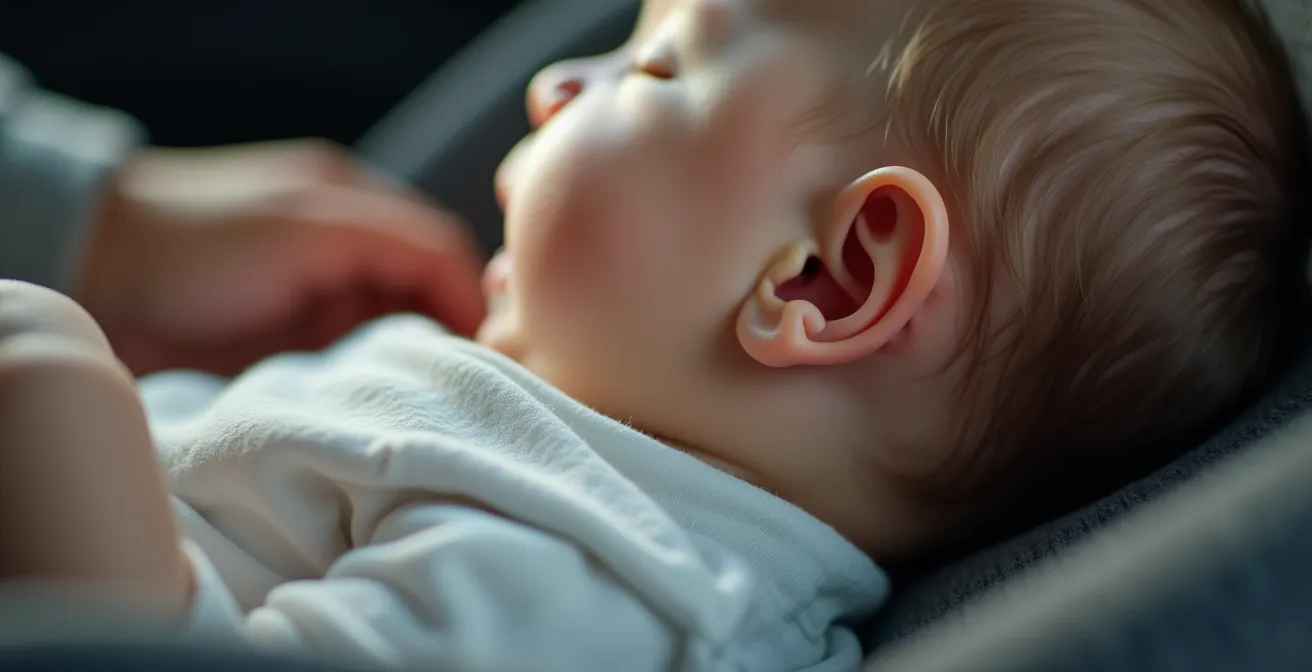
As the illustration demonstrates, the technique is about finesse, not force. Slide two fingers down the inside of the car seat shell, behind your baby’s shoulders, until your fingertips are near the nape of their neck. You can feel the ambient temperature and humidity without making direct, disruptive contact. Here’s how to interpret what you feel:
- Warm and Dry: Perfect. Your baby is comfortable.
- Slightly Damp or Clammy: A warning sign. The baby is starting to overheat. It’s time to remove a layer, starting with the hat.
- Actively Sweaty: Overheating is in progress. Safely pull over and remove a layer of clothing immediately.
- Cool or Cold: The baby may be too cold. Ensure their hat is on and consider adding a blanket over the buckled harness.
Wait at least 10-15 minutes after the car’s heater has stabilized to perform the first check, as this gives your baby’s body time to adjust to the new environment. This simple, respectful method empowers you to monitor their comfort accurately and proactively prevent overheating.
Merino Wool or Synthetic Fleece: Which Regulates Moisture Better?
When choosing a hat or base layer for a car seat, not all fabrics are created equal. The most critical factor beyond simple warmth is moisture management. A fabric that traps sweat against a baby’s skin can quickly lead to a damp chill once the car cools down or cause overheating when it’s warm. This is where the scientific difference between natural fibers like Merino wool and synthetics like fleece becomes paramount.
Synthetic fleece is a popular choice for its softness and insulating properties. However, it functions as passive insulation. It traps air to keep warmth in, but it also traps moisture. When a baby’s body temperature rises and they begin to sweat, fleece does not effectively pull that moisture away from the skin. This creates a “greenhouse effect” inside their clothing, leading to a clammy, uncomfortable feeling and increasing the risk of both overheating and, subsequently, rapid cooling as the sweat evaporates.
Merino wool, on the other hand, is an active thermoregulating fiber. Its complex structure allows it to absorb a significant amount of moisture vapor (up to 30% of its own weight) before it even feels wet to the touch, actively wicking it away from the skin. It then releases this moisture into the drier, outside air. This process means Merino wool helps keep your baby warm in the cold and, crucially, cool and dry when their body temperature rises inside a warm car.
The following table, based on material science principles, breaks down the key differences for car seat safety. As this comparative analysis of materials shows, the choice directly impacts your baby’s comfort and safety.
| Material | Moisture Management | Temperature Regulation | Safety Features |
|---|---|---|---|
| Merino Wool | Actively wicks moisture away from skin | Reacts to body temperature changes, insulates when cold | Naturally fire-resistant, FR-free option available |
| Synthetic Fleece | Traps heat and moisture, creates greenhouse effect | Good insulation but doesn’t adapt to temperature changes | Safe if thin (1-2 layers), dangerous if bulky |
| Bamboo Rayon | Good moisture absorption | Thermoregulating and hypoallergenic | Excellent for sensitive skin or eczema |
While fleece can be used safely in very thin layers, Merino wool offers a superior level of performance for the fluctuating temperatures of a car ride. Its ability to manage moisture and adapt to the body’s needs makes it the gold standard for car seat base layers and hats.
The “Loose Fit” Risk: Why Hats That Slide Down Are a Suffocation Hazard?
While keeping a baby’s head warm is important, the fit of the hat is a non-negotiable safety parameter. A hat that is too loose or has a deep brim poses a significant and often overlooked risk of positional asphyxiation. If a hat slides down over a baby’s face, it can obstruct their nose and mouth. Because young infants lack the motor skills and neck strength to push an item away from their face, this can quickly become a life-threatening emergency.
The danger is compounded by the recline angle of a rear-facing car seat and the gentle vibrations of a moving vehicle, both of which can cause a loose hat to gradually slip downward. That split-second of panic when you glance in the mirror and see fabric covering your baby’s face is something no parent should experience. Therefore, selecting a hat is not a fashion choice; it is a safety equipment decision.
Car seat safety experts have a clear and simple rule for testing a hat’s fit. As child passenger safety technicians at Safe in the Seat recommend, a hat must fit snugly enough that it cannot be pulled down over the eyebrows with a gentle tug. This “gentle tug test” is your definitive check. If you can easily slide the hat down over their eyes, it is too loose and unsafe for the car seat.
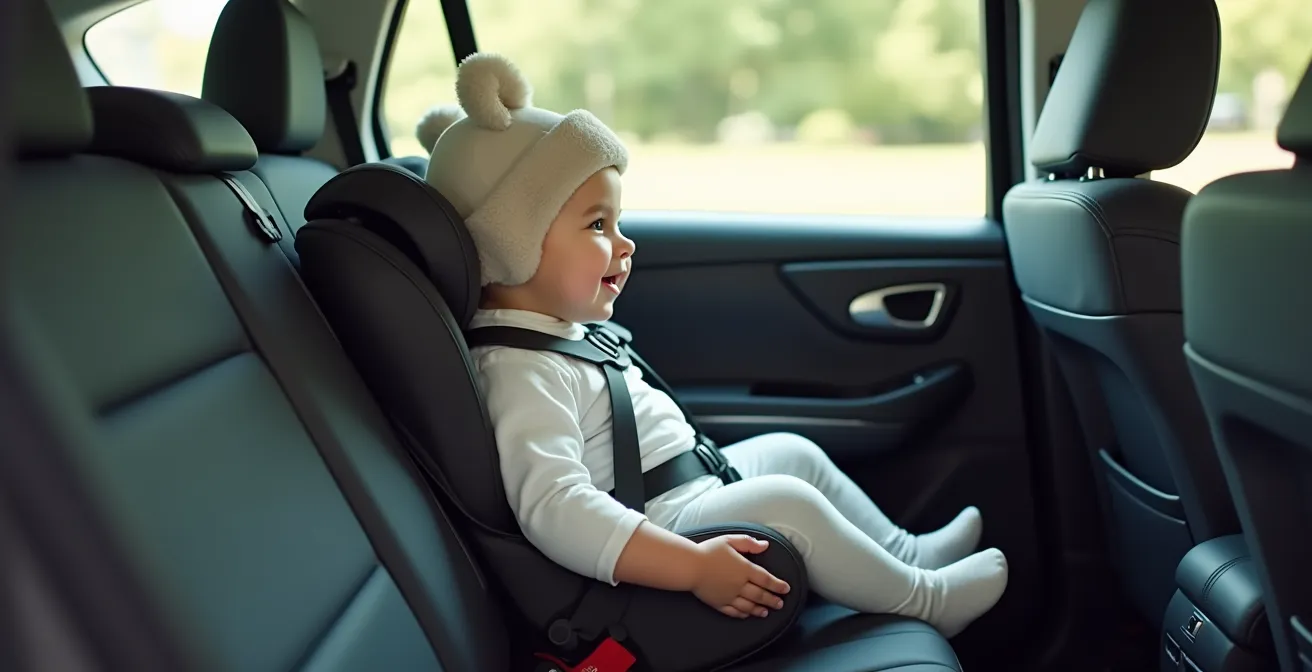
The ideal hat for a car seat is a snug-fitting beanie or a pilot-style cap with ties that secure loosely under the chin. These designs are less likely to shift or rotate. Avoid hats with large pom-poms, thick brims, or any decorative elements that could add bulk behind the head or obstruct the airway if they shift. The fit must be secure before the car is even in motion. Always perform the gentle tug test as the final step after buckling your baby in.
How to Protect Ears From Wind Chill Without Blocking Hearing?
On a frigid day, the short walk from the house to the car can expose a baby’s delicate ears to harsh wind chill. While covering them is a natural protective instinct, it introduces another safety consideration: hearing. A baby’s ability to hear their caregiver’s voice is a source of comfort and a vital sensory connection. Furthermore, completely blocking their hearing can prevent you from noticing subtle sounds of distress. The goal is to shield their ears from the cold without creating sensory deprivation.
Thick, tight-fitting beanies that cover the ears entirely can muffle sound significantly, creating an isolating and potentially distressing environment for the baby. Instead, the safest options are those that provide coverage without a complete seal. This is another area where pilot-style hats excel. Their soft, thin ear flaps can be tied loosely under the chin, protecting the ears from wind without pressing tightly against the ear canal.
For babies who resist hats, a thin, well-fitting hoodie can be an excellent alternative. The key is to ensure the hood’s fabric does not create any bulk behind the baby’s head, as this could interfere with the car seat’s harness and proper head positioning. Always test that your baby can still hear you clearly. Speak to them in a normal tone of voice; if they orient towards you or react as they normally would, their hearing is not dangerously obstructed.
I was worried about how to keep my baby warm during the cold months in Ohio. The pilot-style hat with loose ear flaps was perfect – my baby stayed warm but could still hear my voice during the drive, which kept her calm and comfortable.
– Parent Testimonial
Finally, remember that this protection is primarily for the transition into and out of the car. Once the vehicle has warmed up, it’s best practice to loosen or remove the ear coverage to prevent overheating and ensure your baby remains connected to their surroundings. Always prioritize a design that is easily adjustable.
The Overheating Mistake New Parents Make With Winter Fleece
Fleece is ubiquitous in baby winter wear, loved for its plush feel and insulating warmth. However, its very effectiveness at trapping heat makes it one of the most common culprits in accidental overheating, especially within the confined space of a car seat. The “greenhouse effect” described earlier is amplified by this material. A baby bundled in a thick fleece suit or multiple fleece layers can see their temperature rise to dangerous levels, even in a moderately heated car.
The danger of trapped heat is not theoretical. While the study focused on a warm day, independent temperature testing revealed that car seats covered with blankets could reach over 107°F (41.6°C) in just 30 minutes. The same principle applies to a baby wrapped in non-breathable fleece layers—their own body heat gets trapped, creating a dangerously hot microclimate. This is why fleece snowsuits are strictly forbidden in car seats; they are not only a compression hazard for the harness but also a significant overheating risk.
The mistake isn’t using fleece at all, but using it incorrectly. The key is to use it sparingly and in very thin layers. A single, thin fleece zip-up over a cotton onesie can be appropriate, but it should be considered one of the final layers, easily removable once the car warms up. Parents should also be vigilant about “hidden” fleece, such as the fleece lining in pants or sleepers, which can add unexpected warmth.
To avoid this common mistake, a systematic check of your baby’s outfit is essential before every single ride. Think of it as a pre-flight safety check for your precious cargo. The goal is to ensure warmth without compromising harness safety or thermal regulation.
Your Fleece Layer Safety Checklist
- Remove all fleece snowsuits before buckling into the car seat.
- Check for hidden fleece layers under regular clothes (e.g., lined pants).
- Use a maximum of one to two thin fleece layers.
- Choose fleece that does not compress significantly (use the “pinch test” on the harness straps).
- Consider replacing thick fleece with Merino wool for better temperature regulation.
- Add final warmth with blankets placed OVER the buckled harness, never under it.
Key Takeaways
- An infant’s head is their primary site for heat loss, making a hat essential but also a key factor in overheating risk.
- Material choice is critical: Merino wool actively regulates temperature and moisture, while synthetic fleece traps both, increasing overheating risk.
- A hat’s fit is a non-negotiable safety feature. It must be snug enough that it cannot slide over the baby’s face and cause a suffocation hazard.
Breathing Mats: Do They Prevent SIDS or Just Create False Alarms?
The fear of SIDS and overheating can lead well-intentioned parents toward high-tech solutions like breathing monitor mats and smart socks. These devices promise peace of mind by tracking a baby’s heart rate or movement and sounding an alarm if something seems wrong. However, it’s crucial to understand their limitations. These products are not classified as medical devices and have not been proven to prevent SIDS. For car seats, they are particularly problematic, as the motion of the vehicle can interfere with their readings, leading to a high rate of false alarms that cause unnecessary panic.
The constant anxiety of watching a monitor can detract from a parent’s ability to trust their own observations. As the leading experts on child health state, technology is not a substitute for parental awareness. The American Academy of Pediatrics wisely notes that the most effective tool for ensuring a child’s well-being is an educated and observant caregiver.
The best monitor is an educated parent who knows the observable signs of respiratory distress.
– American Academy of Pediatrics, Car Seat Safety Guidelines
Instead of relying on a device that may provide false security or needless anxiety, a parent’s focus should be on learning the actual, observable signs of respiratory distress. Knowing what to look and listen for is far more empowering and effective than outsourcing your senses to an app. In the context of a car seat, this means ensuring the baby’s airway is always clear (preventing chin-to-chest slumping) and being attuned to their breathing.
The following are critical signs of breathing difficulty that any parent can learn to recognize:
- Chest Retractions: The skin visibly pulls in around the ribs with each breath.
- Nostril Flaring: The nostrils widen with each inhale as the baby struggles to take in more air.
- Grunting or Wheezing: Audible noises made with each exhalation.
- Skin Color Changes: A bluish tint around the lips or face is an emergency signal indicating a lack of oxygen.
Focus your energy on creating a safe environment—proper harnessing, appropriate layering, and a clear airway—and on trusting your own ability to observe your child. This is the true path to peace of mind.
What Outfit to Pack for the Hospital Bag to Ensure Newborn Comfort?
The journey home from the hospital is often a parent’s first real-world test of car seat safety. It’s a moment filled with emotion, and the last thing you want is to be fumbling with an unsafe or impractical outfit. Planning the “going home” outfit is not about aesthetics; it is a critical safety preparation. Bulky or one-piece outfits like sleep sacks are incompatible with a car seat harness and can lead to a dangerously loose fit.
The ideal outfit is comprised of thin, separate layers that allow the harness to be buckled snugly against the baby’s body. This means packing a simple long-sleeved onesie and separate pants or footies. This combination allows for easy harness placement between the legs and ensures the chest clip sits at the correct armpit level. Socks and a thin, snug-fitting hat (that passes the “tug test”) complete the base layers.
The final, crucial elements for warmth are added *after* the baby is securely buckled. Bring a thick, warm blanket to tuck over the baby on top of the harness. For the walk to the car, a “shower-cap” style car seat cover that fits over the top of the seat without interfering with any part of the harness is an excellent way to shield the baby from wind and cold. The cute, special outfit can wait for photos once you’re safely home.
Case Study: The Canadian Premature Babies Foundation Winter Safety Protocol
Recognizing the critical importance of this first ride, the Canadian Premature Babies Foundation implemented a discharge protocol for NICU families. Before leaving, parents were required to practice buckling a doll into a car seat while using appropriate winter layers. This hands-on training taught them that thin layers work better than bulky clothing and that bringing the car seat indoors to be at room temperature before placing the baby inside helps reduce initial body heat loss. This educational protocol empowers parents with practical skills and confidence from day one.
Practicing with a doll or stuffed animal before the big day, as demonstrated by the CPBF protocol, is an invaluable exercise. It turns theory into muscle memory, ensuring that your baby’s first journey is their safest one.
By mastering these principles—from understanding the science of heat loss to selecting the right fabrics and ensuring a safe fit—you can confidently navigate any cold weather journey, knowing your child is not just warm, but truly, deeply safe.