The secret to a fantastic, budget-friendly kids’ party is trading expensive, forgettable props for priceless, interactive memories.
- Focus on hands-on activities like scavenger hunts and DIY craft stations, which create stronger memories than passive decorations.
- Transform simple, low-cost items (a supermarket cake, cardboard boxes) into the main event, boosting engagement and slashing costs.
Recommendation: Shift your mindset from spending money to investing time in creative, shared experiences. The return on investment in joy and memories is infinitely higher.
Planning a child’s birthday party can feel like a financial pressure cooker. In a world of picture-perfect social media feeds, the temptation to splurge on elaborate balloon arches, custom-themed everything, and extravagant cakes is immense. Parents facing inflation often feel caught between the desire to give their child a magical day and the reality of a shrinking budget. It’s common to see advice about simply cutting the guest list or hosting at home, but these tips often miss the core of what truly makes a party special for a child. Many families find themselves wrestling with this, as recent surveys show families spend an average of $300 on a child’s party, with some budgets easily reaching $800 or more.
But what if the entire premise of a “perfect” party is flawed? What if the key to a memorable celebration isn’t found in expensive decor but in shared laughter and hands-on fun? The truth is, children’s memories aren’t built on the color scheme of the napkins or the branding on the party plates. They are forged in moments of discovery, creativity, and active participation. This guide offers a fundamental shift in perspective: stop trying to buy a perfect party and start creating an unforgettable experience. It’s about being resourceful, not restrictive.
This article will walk you through a strategic approach to party planning that prioritizes “memory over materials.” We will explore why simple activities resonate more deeply than costly decorations, how to creatively hack everything from the cake to the costumes, and why smart scheduling can be your most powerful budget-saving tool. Prepare to discover how to throw a celebration that is not only light on your wallet but also incredibly rich in joy.
In this guide, you will find a complete roadmap to planning a creative, engaging, and affordable birthday party. Discover practical tips and strategic insights to make your child’s day truly special without the financial stress.
Summary: A Strategic Guide to a Memorable, Low-Cost Kids’ Party
- Why Kids Remember Scavenger Hunts More Than Expensive Balloon Arches?
- How to Turn a Supermarket Cake Into a Custom Masterpiece for $5?
- Evergreen Interest vs. Current Movie: Which Theme Saves Money on Supplies?
- The Goodie Bag Mistake: Why Plastic Trinkets End up in Trash in 24 Hours?
- What Time of Day Is Best for a Toddler Party to Avoid Nap Conflicts?
- Renting vs. Buying: Which Makes Sense for a Ring Bearer Outfit?
- How to Build a Ninja Course Using Pool Noodles and Chalk?
- How to Create Unique Carnival Costumes Using Recycled Materials at Home?
Why Kids Remember Scavenger Hunts More Than Expensive Balloon Arches?
The core of a memorable party lies in engagement, not decoration. While a towering balloon arch makes for a great photo, it’s a passive backdrop. A scavenger hunt, on the other hand, is an active, immersive experience. Child development experts agree that hands-on learning fosters lasting memories far more effectively than passive observation. When a child is actively searching, touching, and thinking, their brain is firing on all cylinders, creating strong neural pathways. This is why research on experiential learning shows that activities requiring participation are cemented in memory long after visual details fade.
Think about the Engagement ROI (Return on Investment). A $150 balloon arch provides a few minutes of “wow” factor. A $5 scavenger hunt with clues written on recycled paper can provide 45 minutes of collaborative fun, problem-solving, and excitement. Brooklyn mom Mary Stichon shared that her most successful, sub-$200 parties for 10 kids always centered on staff-led games and treasure hunts. She noted the children consistently talked about the activities for weeks, while the decorations were instantly forgotten. This proves that the investment should be in the “doing,” not the “viewing.”
For younger children, a sensory scavenger hunt is a fantastic way to engage them without overwhelming them. It’s simple, costs virtually nothing, and develops key observational skills. Instead of complex riddles, the clues focus on sensory experiences, making it accessible and fun for toddlers. Here are a few ideas to get you started:
- Find something fuzzy (develops tactile exploration)
- Find something that smells like flowers (engages olfactory senses)
- Find something red (teaches color recognition)
- Find something smooth (encourages texture differentiation)
- Find something that makes a sound when you shake it (promotes auditory awareness)
Ultimately, a child won’t recall the exact shade of the tablecloths, but they will absolutely remember the thrill of finding the final clue and the shared victory with their friends.
How to Turn a Supermarket Cake Into a Custom Masterpiece for $5?
The birthday cake is often a huge budget-buster, with custom creations easily topping $100. Yet, the secret to a spectacular cake isn’t the price tag—it’s the creativity. A plain, inexpensive supermarket sheet cake or even a simple homemade cake from a mix is a blank canvas. The trick is to reframe the cake from a finished product you buy into an interactive activity you create. This is the ultimate “theme hack” and a massive cost-saver, considering that budget party planning experts note a custom cake can start at $100 while a mix is just a few dollars.
Set up a DIY cake decorating station. Provide bowls of sprinkles, edible glitter, small candies, and tubes of colored icing. Let the kids become the cake artists. This not only saves you money but also serves as a built-in party activity that keeps them engaged and excited. The focus shifts from a professionally perfect cake to a collaboratively fun one.
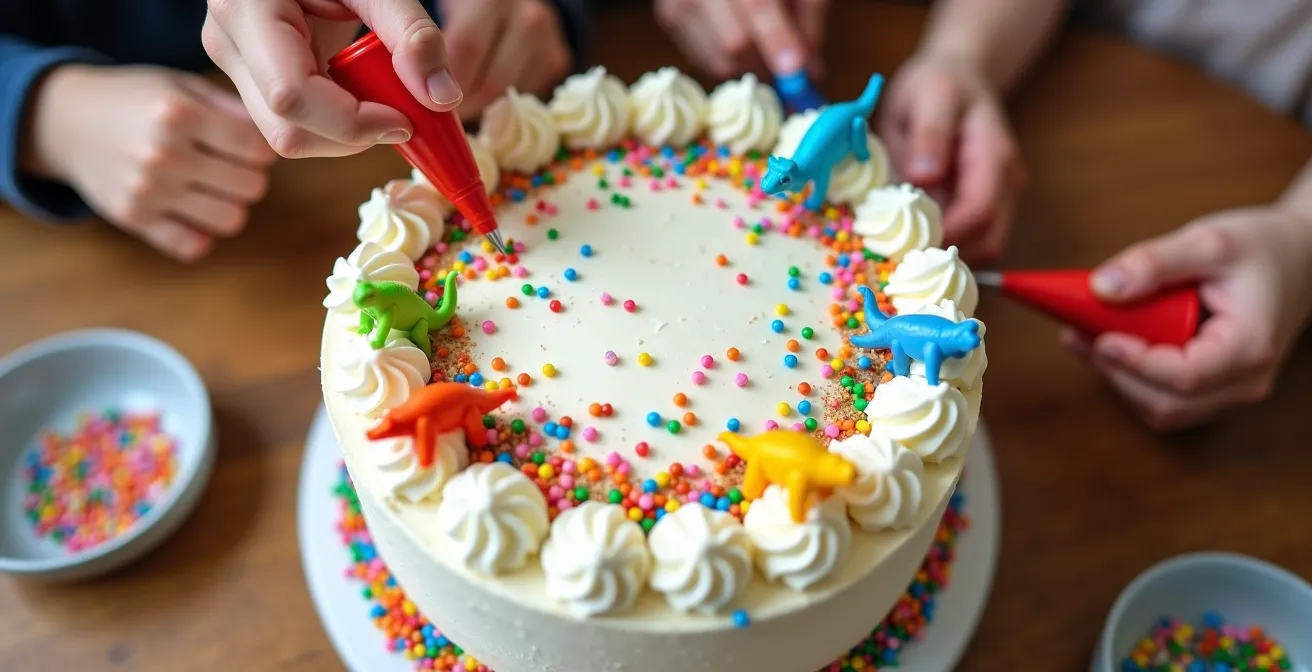
As you can see, the joy comes from the act of creation. Another brilliant, low-cost strategy is to use the child’s own toys as themed toppers. Frugal living expert Tawra once threw a complete birthday party for under $21. For the cake, which cost only $1.25 to make, she simply placed her child’s own clean Furby toy in the middle and piped a decorative border around it. It was instantly personalized and cost-effective. The same can be done with clean dinosaur figures for a Jurassic theme, or small cars for a racing party. This approach is not only cheap but also deeply personal to your child.
This hands-on approach guarantees a cake that’s not only unique but also a core memory of the celebration itself, all for just a few dollars in toppings.
Evergreen Interest vs. Current Movie: Which Theme Saves Money on Supplies?
Choosing a party theme is exciting, but it can also be a significant budget trap. The biggest mistake is tying the party to the latest blockbuster movie or TV show. While popular, these themes come with a high price tag. Licensed merchandise—from plates and napkins to banners and balloons—is always marked up significantly. Furthermore, these themes have a very short shelf life. The supplies you buy today will be dated in six months, making them impossible to reuse or resell.
The far more frugal and creative approach is to choose an evergreen theme. These are broad, timeless concepts like dinosaurs, space, pirates, superheroes (generic, not specific characters), a garden party, or even just a vibrant color scheme. Supplies for these themes are widely available, unbranded, and significantly cheaper. A pack of solid blue plates will always cost less than a pack featuring a copyrighted cartoon character. This strategy of “theme hacking” allows you to create a fantastic atmosphere without paying the premium for licensed branding.
The cost difference is substantial. An evergreen theme can be executed beautifully for a fraction of the cost of a trendy movie theme. Here’s a look at how different themes compare in terms of cost and reusability, based on an analysis of party supply costs.
| Theme Type | Cost Score (1-5) | Reusability | Average Supply Cost |
|---|---|---|---|
| Colors/Bubbles | 1 | Very High | $20-30 |
| Dinosaurs/Space | 2-3 | High | $30-50 |
| Superheroes (generic) | 3 | Medium | $40-60 |
| Current Disney Movie | 5 | Very Low | $75-150 |
Evergreen themes also open the door for more creative, hands-on activities. Instead of just buying pre-made decorations, you can build the theme into the party itself. Here are some budget-friendly evergreen ideas that double as activities: a “Dinosaur Dig” in a sandbox, a “Backyard Camping” adventure using existing tents, or a “Garden Party” where kids decorate a pot and plant a seed to take home.
This choice gives you more financial freedom to focus on what truly matters: the food, the fun, and the shared experiences that your child and their friends will cherish.
The Goodie Bag Mistake: Why Plastic Trinkets End up in Trash in 24 Hours?
The traditional goodie bag is often the most wasteful and least memorable part of a birthday party. Parents feel obligated to provide them, and end up spending money on small plastic toys, stickers, and candy that, more often than not, are broken, lost, or thrown away within 24 hours. This practice represents a poor “Engagement ROI”—money is spent, but no lasting value or memory is created. It’s time to rethink the party favor entirely and move toward more meaningful, sustainable, and often cheaper alternatives.
Instead of a bag of trinkets, consider an “interactive favor.” This is an item that is part of the party’s activities and that the child gets to take home. This approach serves a dual purpose: it provides entertainment during the party and serves as a meaningful souvenir afterward. For example, if you have a craft station where kids decorate a t-shirt, a wooden picture frame, or a superhero mask, the finished craft *is* the favor. This consolidates your budget and ensures the takeaway item is something the child is proud of and has a personal connection to.
Another wonderful alternative is an experience-based favor. This could be something that grows or can be used for a future activity. Giving each child a small packet of seeds with planting instructions is a beautiful, eco-friendly option that costs very little.
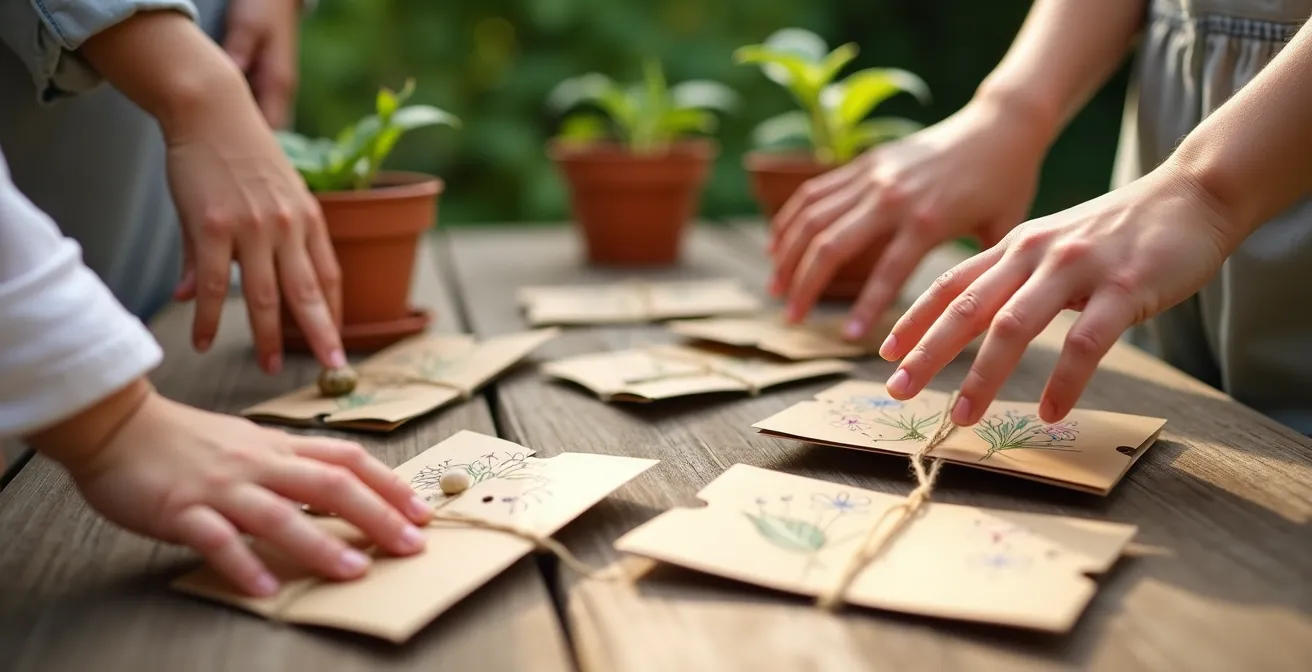
As this image suggests, the favor becomes a story that continues after the party ends. Other ideas include a “recipe in a jar” for cookies they can bake at home, or a bundle of art supplies like a new set of chalk or a unique crayon. These types of favors encourage more creativity and family time, offering far more value than a plastic spinning top. They transform the goodie bag from an afterthought into a thoughtful extension of the party’s spirit.
This shift not only saves money but also teaches a subtle lesson about the value of creating and experiencing things over simply acquiring them.
What Time of Day Is Best for a Toddler Party to Avoid Nap Conflicts?
For parties involving toddlers and preschoolers, timing isn’t just a matter of convenience—it’s a strategic tool for managing both budgets and moods. The biggest challenge with this age group is the sacred nap schedule. A party that conflicts with naptime is a recipe for meltdowns and stress for everyone. But beyond avoiding tired tears, strategic scheduling can drastically cut down on your single largest expense: food.
The most budget-savvy parents know to schedule parties between traditional mealtimes. The two golden slots are typically 10:00 a.m. to 12:00 p.m. or 2:00 p.m. to 4:00 p.m. A morning party, ending before lunch, allows you to serve light snacks and cake without the expectation of a full meal. Similarly, an afternoon party that starts after lunch means you are only responsible for snacks and dessert. One family in a Ramsey Solutions report saved over $100 on their party budget simply by hosting from 2-4 p.m. and serving only cake and simple snacks instead of a catered lunch.
This timing also works perfectly with toddler energy levels. A 10:00 a.m. start catches them when they are fresh and full of energy. A 2:00 p.m. start typically finds them rested and ready for action after their afternoon nap. By working with their natural rhythm instead of against it, you create a much more enjoyable and harmonious atmosphere for the little guests. This careful planning prevents the party from devolving into a group of cranky, over-tired children.
Furthermore, if you’re considering an external venue, off-peak timing can unlock significant savings. Many play spaces or community halls offer discounts for less popular time slots. According to party planning resources, party venues report that booking 10 a.m. Saturday or weekday afternoon slots can come with a reduced rental fee. This double-dip saving—on both the venue and the food—makes strategic scheduling one of the most powerful frugal party-planning techniques available.
By scheduling smartly, you ensure the kids are happy, the parents are relaxed, and your wallet remains intact.
Renting vs. Buying: Which Makes Sense for a Ring Bearer Outfit?
The question of dressing up for a special occasion, whether it’s for a wedding or a birthday party, often presents a classic dilemma: rent, buy, or DIY? For a one-time-use outfit like a ring bearer’s suit or a specific birthday costume, buying new rarely makes financial sense. Children grow so quickly that a purchased outfit is often outgrown before it can be worn a second time. Renting can be an option for formal wear, but for a child’s birthday party, the most creative and frugal solution is to embrace the power of DIY and community sharing.
Instead of a single, perfect outfit, consider creating a “costume box” as a central party activity. Provide a wealth of simple, recycled materials and let the birthday child and their friends create their own costumes. This approach has a tremendous “Engagement ROI,” turning a passive element (what to wear) into an active, creative game. Old t-shirts become superhero capes, cardboard boxes become robot armor, and paper plates become animal masks. This activity is not only incredibly cheap but also champions imagination and resourcefulness.
Your Action Plan: The DIY Costume Box
- Create superhero capes from old t-shirts or pillowcases and fabric markers.
- Make crowns and tiaras from cardboard, aluminum foil, and craft jewels.
- Design suits of armor from cardboard boxes, duct tape, and bottle caps.
- Craft a variety of animal masks using paper plates, elastic bands, and crayons.
- Build futuristic jetpacks from plastic soda bottles and colored streamers.
Another brilliant, community-focused alternative is to organize or participate in a costume swap. Many local community centers, schools, and parent groups have informal networks for sharing special occasion outfits. One YMCA’s outfit exchange program reported saving participating families over $200 per year. This system allows parents to access high-quality outfits for one-time events without the expense or the storage burden. It’s a win-win for your budget and for reducing clothing waste.
This strategy not only saves a significant amount of money but also provides another layer of interactive fun that children will remember long after the party is over.
How to Build a Ninja Course Using Pool Noodles and Chalk?
Why spend a fortune on a party venue when your own backyard can become the most exciting adventure park on the block? The cost of renting a party space can be staggering, with local venue pricing showing rentals often cost $150-$200, while a set of creative DIY backyard activities can cost as little as $15. A homemade ninja warrior or obstacle course is the perfect example of how to deliver maximum fun for minimal cost. It transforms a familiar space into a world of challenges and triumphs, tapping directly into kids’ love for physical play.
The beauty of a DIY course is its reliance on imagination and common household items. You don’t need expensive equipment; you need a creative mindset. Pool noodles, chalk, chairs, buckets, and some rope are all you need to build a thrilling course. The key is to create a series of varied stations that test different skills like balance, agility, and coordination. This not only keeps the kids physically active and engaged for a long time but also fosters a sense of accomplishment as they conquer each obstacle.
Building your course is simple. The goal is to set up a sequence of challenges that are safe, age-appropriate, and fun. Here is a 5-station ninja course blueprint you can build for under $15, using materials you likely already have or can purchase cheaply:
- Noodle Hurdles: Arch pool noodles and stick the ends into buckets filled with sand or soil to create a series of low hurdles to jump over.
- Chalk Agility Ladder: Use sidewalk chalk to draw a ladder pattern on the pavement. Kids must practice their footwork by stepping in and out of the squares.
- ‘Laser’ Maze: String yarn or pool noodles between chairs or trees at various heights, creating a “laser” grid for kids to crawl under and step over without touching.
- Balance Beam: Lay a 2×4 wooden board flat on the ground or simply draw a long, winding chalk line that kids must walk along without stepping off.
- Noodle Javelin Throw: Hang a hula hoop from a tree branch and have kids try to toss pool noodles through it like javelins.
A DIY obstacle course is the ultimate party hack—it’s an activity, a theme, and a source of endless entertainment all rolled into one, proving that the best fun is often the kind you create yourself.
Key takeaways
- The most memorable parties prioritize active engagement (games, crafts) over passive decorations (balloons, banners).
- Transforming the cake, costumes, and favors into DIY activities saves money and serves as built-in entertainment.
- Strategic scheduling and choosing evergreen themes are powerful tools that drastically reduce the biggest party expenses.
How to Create Unique Carnival Costumes Using Recycled Materials at Home?
One of the most powerful strategies for a successful, low-cost party is to make the main activity the creation of a take-home item. A “costume creation station” is a perfect example of this principle in action. Instead of asking guests to arrive in costume or providing pre-made ones, you turn the act of making costumes into the centerpiece of the party. This idea has a phenomenal Engagement ROI, keeping a group of kids happily occupied for over an hour with minimal cost and supervision.
The concept is simple: gather a mountain of recycled materials and let their imaginations run wild. Cardboard boxes of all sizes, paper towel tubes, aluminum foil, tape, markers, paper bags, and old plastic bottles are the building blocks of this creative endeavor. A “Robot Creation Station,” for instance, has been reported by party hosts to be a massive success. Using just boxes, tape, and foil, children aged 5-10 can create their own wearable robot costumes. This activity costs less than $10 in basic supplies and brilliantly solves the goodie bag problem—the costume they make *is* the party favor.
You don’t need to be an expert crafter to facilitate this. The key is to provide simple, no-sew “formulas” that kids can easily follow or adapt. These formulas give them a starting point and empower them to bring their own ideas to life. Here are some proven, no-sew costume formulas from recycled materials:
- Box Formula: A large cardboard box + paint + rope straps = An instant robot, car, or building costume.
- Paper Plate Formula: A paper plate + string + markers = A unique animal mask in under 10 minutes.
- Pillowcase Formula: An old pillowcase + fabric markers = An immediate superhero cape, no sewing required.
- Bottle Formula: Two plastic bottles + tape + foil = A futuristic space jetpack.
By empowering kids to be creators, you provide an afternoon of fun, a unique souvenir, and a powerful lesson in resourcefulness—all while staying firmly within your budget.