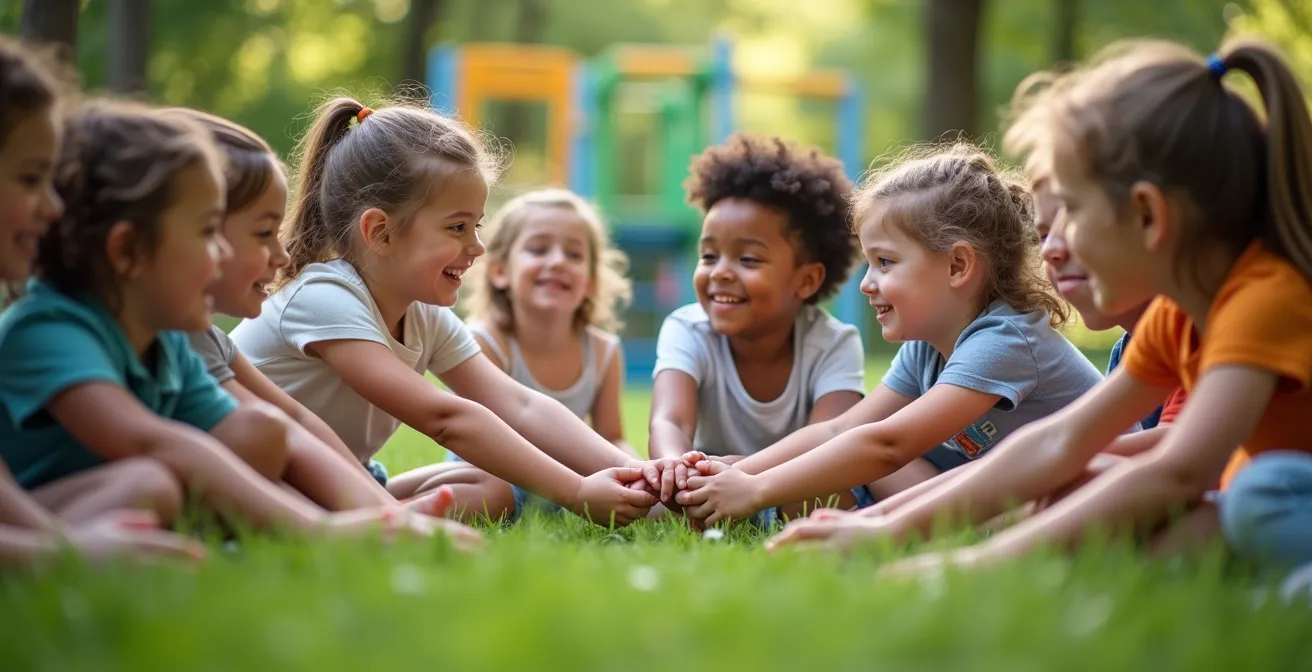
The secret to fostering social skills isn’t just picking ‘cooperative’ games, but becoming a ‘gameplay architect’ who actively designs the play experience.
- Competitive games often trigger anxiety, while cooperative play releases hormones that build empathy.
- Simple rule modifications can make almost any game inclusive for different ages and temperaments.
Recommendation: Start by focusing on games with a shared goal to build a foundation of psychological safety before introducing more complex social dynamics.
As a parent, you’ve likely witnessed it: the board is flipped, tears are shed, and someone storms off shouting, “It’s not fair!” You wanted a fun family game night, but you ended up with a masterclass in sibling rivalry and sore-loser syndrome. The common advice is to simply switch to cooperative games where everyone wins. But this is often a temporary fix that misses the bigger picture. It treats the symptom—the conflict—without strengthening the underlying social muscles of empathy, resilience, and collaborative problem-solving.
The real challenge isn’t just avoiding competition. It’s understanding the mechanics of play and how they shape your children’s social and emotional development. What if, instead of being a referee, you could become a gameplay architect? Someone who intentionally selects and adapts games to teach specific skills, from managing frustration to leading a team with grace. This approach moves beyond the simple “win vs. lose” binary and transforms playtime into a powerful, hands-on learning laboratory for life skills.
This guide will give you the tools to do just that. We won’t just list games. We will deconstruct the “why” behind cooperative play, offering concrete strategies to modify game rules for different ages, choose activities for specific temperaments, and build a play environment that fosters genuine connection. You will learn to see games not just as entertainment, but as a strategic tool for nurturing emotionally intelligent and socially adept children.
This article breaks down the essential strategies for transforming your family’s playtime. You will discover the science behind cooperative play, practical ways to adapt games for any situation, and how to use them to cultivate crucial social skills.
Summary: A Guide to Choosing and Adapting Games for Cooperative Play
- Why Cooperative Games Build Empathy Faster Than Competitive Sports?
- How to Modify Rules So a 4-Year-Old and 8-Year-Old Can Play Together?
- Active Tag or Board Game: Which Is Better for Shy Children?
- The “You’re Out” Risk: Why Elimination Games Cause unnecessary Anxiety?
- When to Stop High-Energy Games Before Bedtime to Ensure Sleep?
- Why Pretending to Be Someone Else Expands a Child’s Empathy?
- The “Cooperative First” Strategy: Why Start With Games You Win Together?
- Which Group Games Teach Leadership Without Exclusion?
Why Cooperative Games Build Empathy Faster Than Competitive Sports?
At a fundamental level, the difference between a cooperative game and a competitive one lies in their neurochemical impact. While competitive sports often focus on individual achievement and dominance, cooperative activities are wired to foster connection. When children work together toward a shared goal—like building a fort or solving a puzzle as a team—their brains are doing more than just processing rules. They are building the very foundations of empathy.
The key ingredient is oxytocin, often called the “bonding hormone.” It promotes feelings of trust, generosity, and empathy. The brain releases it during positive social interactions, such as working collaboratively. In fact, research shows that cooperative activities trigger markedly higher oxytocin release in the brain’s orbitofrontal cortex compared to tasks performed alone. This creates a positive feedback loop: working together feels good, which encourages more cooperation, which in turn strengthens social bonds and the ability to understand another’s perspective.
In contrast, high-stakes competition can activate the body’s stress response, releasing cortisol and adrenaline. This can lead to a “win-at-all-costs” mentality that narrows a child’s focus to their own success, often at the expense of others’ feelings. By prioritizing games that require shared goals and mutual support, you are quite literally helping to wire your child’s brain for empathy and connection, building a crucial social muscle that will serve them far beyond the game board.
This biological advantage makes cooperative play one of the most effective tools for social-emotional learning.
How to Modify Rules So a 4-Year-Old and 8-Year-Old Can Play Together?
One of the biggest hurdles to a peaceful game night is the age and skill gap between siblings. An 8-year-old is focused on strategy and rules, while a 4-year-old is still mastering taking turns. Forcing them to play by the same rules is a recipe for frustration. The key is not to “dumb down” the game for the older child, but to become a gameplay architect and create asymmetric but equally vital roles.
This strategy involves modifying the rules so that each child has a meaningful job suited to their developmental stage. Instead of being direct competitors, they become collaborators with different responsibilities. This approach validates both children’s abilities and teaches them that a team is strongest when everyone contributes their unique strengths. It turns a potential conflict into a lesson in teamwork and mutual respect.
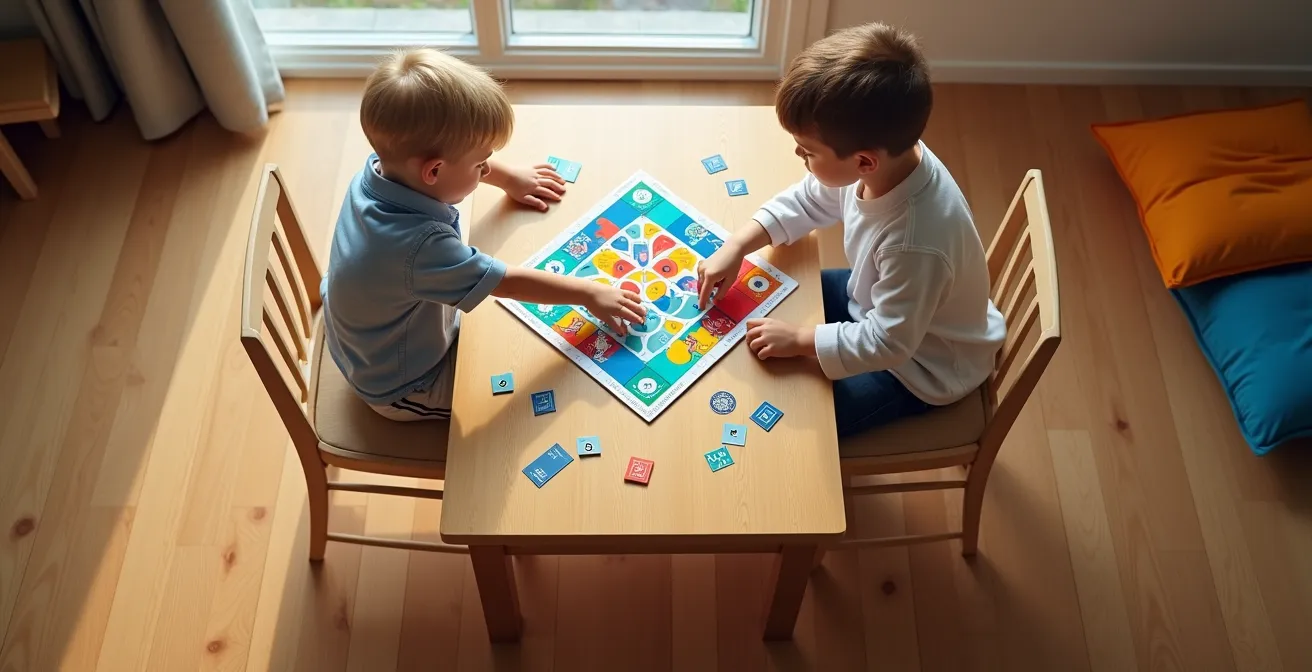
As the image shows, you can structure a game where one child’s role is strategic and the other’s is executional. Here are some concrete ways to adapt games:
- Assign Differentiated Roles: In a board game, the older child can be the ‘Strategist,’ responsible for reading cards and planning moves, while the younger child is the ‘Executor,’ in charge of moving the pieces and rolling the dice.
- Create Tiered Objectives: The team has one main goal, but each child has a personal sub-goal. The younger child might need to collect three red tokens, which contributes to the older child’s more complex goal of reaching the final space.
- Implement a ‘Mentor’ System: Frame the older child’s role as a guide. Their success isn’t just winning, but how well they can help their younger sibling understand the game. This transforms their superior knowledge from a weapon into a tool for connection.
By making these small adjustments, you shift the dynamic from rivalry to a partnership, where each child’s contribution is essential for the team to win.
Active Tag or Board Game: Which Is Better for Shy Children?
For a shy or socially anxious child, group activities can feel overwhelming. The choice between a high-energy game like tag and a structured board game is not just about preference; it’s about managing social pressure. As a social skills coach, I advise parents to think about games in terms of their “interaction script.” A predictable script lowers anxiety, while an unpredictable one can raise it.
Cooperative board games often provide a low-anxiety environment because the interaction is structured and object-focused. As experts from Responsive Classroom note, “Cooperative board games offer a predictable ‘script’ for interaction (e.g., ‘It’s your turn to roll’), which is low-anxiety.” The focus is on the game pieces and the board, not on intense, face-to-face social negotiation. Turn-taking provides a clear, manageable rhythm, giving a shy child time to process and respond without feeling put on the spot.
However, this doesn’t mean active games are off-limits. While the spontaneous nature of games like tag can be intimidating, modified active games can be beneficial. Physical activity is a natural anxiety-reducer, and collective movement can create a sense of belonging without demanding complex conversation. The key is to choose active games with a shared group focus, like parachute games, where the collective goal of keeping the ball on the parachute outweighs individual performance.
This table compares the different dynamics to help you choose the right fit:
| Game Type | Social Pressure Level | Benefits for Shy Children | Challenges |
|---|---|---|---|
| Cooperative Board Games | Low – Structured interaction with predictable ‘scripts’ | Object-focused interaction, minimal eye contact required, turn-taking provides clear structure | May require verbal communication |
| Active Tag Games | High – Spontaneous, unpredictable interaction | Physical activity can reduce anxiety, group movement creates belonging | Direct physical contact, unpredictable social demands |
| Modified Parachute Games | Medium – Group activity with defined roles | Collective focus on parachute, individual contribution to group success | Requires coordination with others |
Start with low-pressure, object-focused games to build confidence, then gradually introduce more dynamic, active games as the child feels more secure within the group.
The “You’re Out” Risk: Why Elimination Games Cause Unnecessary Anxiety?
The phrase “You’re out!” might seem like a harmless part of games like Musical Chairs or Dodgeball, but for a child, it can be a moment of intense social stress. Elimination is a form of temporary social rejection, and the impact is more than just a feeling of disappointment. It triggers a genuine, measurable response in the brain. Being excluded, even in a simple game, activates the same neural pathways associated with physical pain.
This isn’t an overstatement; neuroscience research reveals that being eliminated triggers the same neural pathways as physical pain. The anterior cingulate cortex, which lights up when you stub your toe, also becomes active when you experience social ostracism. For children still developing their emotional regulation skills, this can create significant anxiety. Instead of learning to play, the child on the sidelines is learning that they weren’t good enough and are now excluded from the fun. This dynamic is the opposite of what we want to achieve with play: inclusion, participation, and building resilience.
The good news is that many classic elimination games can be modified to keep everyone involved. The goal is to change the consequence of being “out” from exclusion to a new form of participation. This maintains engagement and removes the social sting. Here are a few alternative mechanics:
- Ghost Player: In a tag game, a tagged player becomes a “ghost” who can’t run but can walk and create barriers to help the active tagger.
- Helper Role: In Musical Chairs, a child without a chair becomes a “judge” for the next round, helping to spot who sat down last.
- Team Lives: Instead of individual elimination, the entire group shares a pool of “lives.” This shifts the focus from individual survival to collective success.
The best games are not those that weed out the “weakest” players, but those that find a way to keep everyone playing together until the very end.
When to Stop High-Energy Games Before Bedtime to Ensure Sleep?
That final burst of wrestling or chasing before bed may seem like a great way to “tire the kids out,” but it often has the opposite effect. High-energy activities spike cortisol, the body’s primary stress and alertness hormone. Throwing a child into bed right after a pillow fight is like asking a sprinter to fall asleep at the finish line. Their body is primed for action, not rest, which can delay sleep onset and lead to bedtime battles.
The key to a smooth transition to sleep is not to eliminate evening play, but to manage its intensity with a structured “cooldown” period. A successful approach involves creating a predictable “Energy Arc” with your game choices, gradually de-escalating the level of physical and mental stimulation as bedtime approaches. This allows a child’s cortisol levels to decrease naturally, signaling to their body that it’s time to wind down.
Case Study: The Cortisol Cooldown Strategy
A structured approach to bedtime transitions involves creating an ‘Energy Arc’ with games. Start with high-energy cooperative games 90 minutes before bed, transition to focused tabletop activities 60 minutes before, and end with quiet storytelling games 30 minutes before sleep. This gradual de-escalation helps children’s cortisol levels naturally decrease, making the transition to sleep smoother and more peaceful.
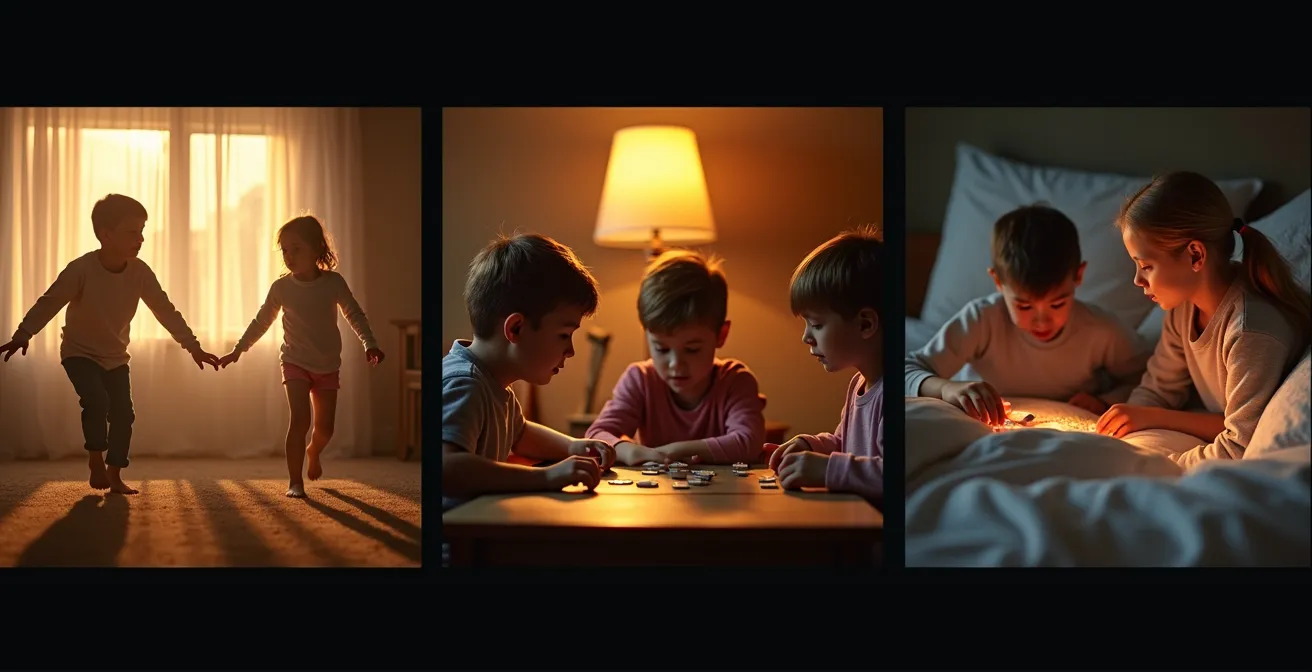
This visual progression shows the ideal flow. A general rule of thumb is to end all high-intensity, physically demanding games at least 60 to 90 minutes before bedtime. This buffer zone is crucial. The hour before bed should be reserved for calm, engaging activities like cooperative board games, reading, or collaborative storytelling, which lower stimulation and promote the release of sleep-friendly hormones like melatonin.
By consciously designing this energy arc, you replace chaotic bedtime struggles with a predictable and calming routine that supports healthy sleep habits.
Why Pretending to Be Someone Else Expands a Child’s Empathy?
Pretend play is far more than just a fun diversion; it is a critical workout for a child’s developing “Theory of Mind”—the ability to understand that others have beliefs, desires, and perspectives different from one’s own. When a child pretends to be a doctor, a parent, or a dragon, they are stepping into an “emotional simulator.” This allows them to safely explore different viewpoints and emotional responses without real-world consequences.
This process of embodiment is foundational to empathy. As pioneering researcher Andrew Meltzoff explains, this ability to see another as “like me” is a cornerstone of social cognition. By acting out a role, a child isn’t just mimicking actions; they are trying on the motivations and feelings associated with that role. “What would a sad king do?” “How does a brave firefighter feel?” Answering these questions through play builds a child’s emotional vocabulary and their capacity to imagine the inner world of others.
The capacity to code the ‘like me’ analogy between self and others may represent a basic prerequisite for the development of social cognition.
– Meltzoff, Mirroring others’ emotions relates to empathy and interpersonal competence in children
Research on role-play interactions confirms that this process is vital for enhancing empathy. Studies show that when children actively embody different characters, they are practicing perspective-taking. A game of “house” becomes a lesson in understanding a parent’s responsibilities. A game of “superheroes” can be a lesson in teamwork and protecting others. These are not just games; they are complex social negotiations that build the cognitive architecture for empathy.
By encouraging and participating in pretend play, you are giving your child one of the most powerful tools for developing a deep and authentic understanding of other people.
Key Takeaways
- The primary goal is not to eliminate competition but to build a foundation of cooperation and psychological safety first.
- Game mechanics matter more than the game’s label; parents can act as “gameplay architects” to adapt rules for specific social goals.
- Cooperative play has a biological basis, triggering the release of oxytocin, which strengthens empathy and social bonds.
The “Cooperative First” Strategy: Why Start With Games You Win Together?
Before a child can handle the complex emotions of winning and losing gracefully, they first need to feel safe and connected within the group. The “Cooperative First” strategy is about intentionally front-loading playtime with games where everyone is on the same team, working toward a single, shared goal. This isn’t about avoiding competition forever; it’s about building a strong foundation of psychological safety first.
When a group succeeds together, it establishes a baseline of trust and camaraderie. Children learn that the other players are allies, not obstacles. This experience is intrinsically motivating; studies confirm that most kids naturally prefer games where everyone is trying to attain the same goal. This initial phase of pure cooperation acts as a “social-emotional warm-up,” equipping children with the tools they will need for more complex interactions later.
Think of it as building a teamwork toolbox. Through simple, shared-goal games, children practice essential skills in a low-stakes environment. They learn to communicate their ideas, negotiate roles, and celebrate a collective victory. This positive shared experience becomes the bedrock upon which they can later navigate the frustrations of individual competition. Without this foundation, a competitive game can quickly devolve into conflict because the players haven’t yet learned how to function as a supportive unit.
Your Action Plan: Building a Teamwork Toolbox
- Establish Safety: Start with simple shared-goal games (e.g., collectively building the tallest tower) to establish psychological safety and a sense of “we’re in this together.”
- Practice Communication: Introduce games that require verbal coordination, like describing a drawing for someone else to replicate, to hone communication skills.
- Develop Negotiation: Move to games involving resource sharing (e.g., a cooperative board game where players trade items) to practice negotiation and fairness.
- Celebrate Others: Reinforce the joy of team achievement in games where a group victory is the only victory, teaching children to celebrate others’ contributions.
- Integrate Problem-Solving: Introduce collaborative puzzle games or escape room-style challenges that require the group to brainstorm solutions together.
Only once this toolbox is filled and the foundation of trust is solid should you begin to gradually introduce games with healthy, low-stakes competition.
Which Group Games Teach Leadership Without Exclusion?
Traditional leadership models in children’s games often involve one person being “the boss,” which can lead to exclusion and power struggles. However, a more constructive approach is to use cooperative games to teach facilitative and situational leadership, where leadership is a role that serves the group rather than dominates it. These games are designed so that everyone gets a chance to lead and, more importantly, learns that leading is about enabling the success of others.
The most effective method for this is the “Rotating Leader” model. In these games, the leadership role is temporary and task-specific. For example, in a collaborative storytelling game, each child leads for one sentence, adding to the narrative before passing the “leader” role to the next person. In a group building challenge, the role of “architect” might rotate every two minutes. This structure ensures that every child, regardless of how shy or assertive they are, has the opportunity to practice making decisions, giving directions, and taking responsibility in a low-stakes context.
Cooperative games thrive on players working together, pooling their strengths, and supporting each other’s weaknesses. By promoting cooperation, these games help children develop essential social skills like communication, empathy, leadership, and conflict resolution. The leadership demonstrated here is not about being the best or the fastest, but about guiding the group toward a shared goal. The table below outlines different models of inclusive leadership games.
| Game Category | Leadership Style | Inclusion Method | Example Activities |
|---|---|---|---|
| Orchestra Games | Facilitative | Everyone contributes to harmony | Rhythm circles, group soundscapes, collaborative murals |
| Rotating Leader Games | Situational | Leadership changes based on task | Story circles, construction challenges, relay variations |
| Collective Decision Games | Democratic | Group consensus required | Escape rooms, treasure hunts, problem-solving challenges |
This approach redefines leadership for children, moving it away from a model of dominance and toward one of collaboration and shared success.