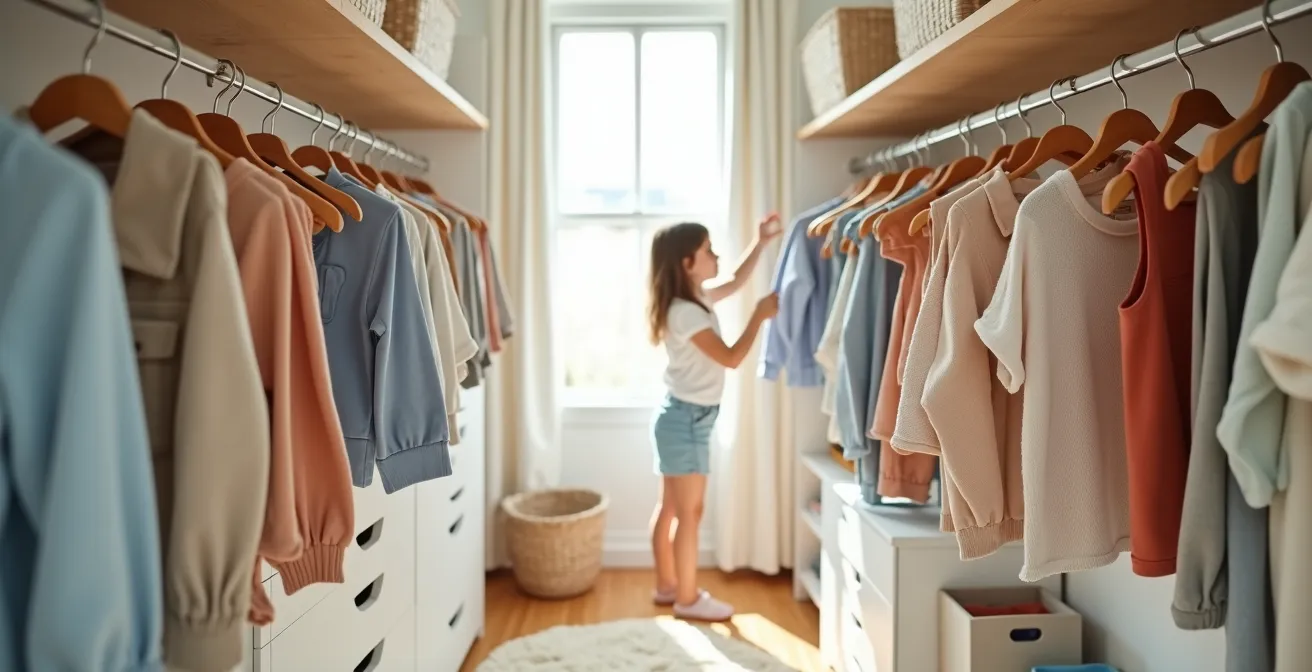
A kids’ capsule wardrobe is a financial strategy that transforms clothing from a disposable expense into a recoverable asset.
- Focus on “cost-per-wear” over the initial sticker price to make smarter purchasing decisions.
- Integrate timeless vintage finds and durable fabrics to create a high-value wardrobe with unique style.
- Maintain clothes strategically to resell them for up to 50% of their original value, creating a self-funding system.
Recommendation: Shift your mindset from simply “buying clothes” to “investing in and managing a wearable asset cycle.”
Opening a child’s closet can feel like looking at a timeline of wasted money. That adorable shirt worn twice, the trendy pants now too short, the pile of fast-fashion items that pilled and faded after three washes. For budget-conscious parents who value style but despise waste, this cycle is endlessly frustrating. The common advice is always the same: buy neutrals, focus on layering, and choose quality over quantity. While not wrong, this advice only scratches the surface and misses the most powerful aspect of a curated wardrobe.
What if the real secret wasn’t just about minimalism, but about financial intelligence? What if you could reframe your child’s wardrobe not as a constant expense, but as a revolving asset fund? This approach moves beyond simply buying fewer items and into the realm of strategic asset management. It involves understanding the true cost of cheap clothing, mastering the art of the mix-and-match, and implementing care routines designed to maximize resale value. This is about turning the inevitable need for children’s clothing into a sustainable, economical, and stylish system that pays for itself over time.
This guide will walk you through the essential strategies to build that system. We will deconstruct the hidden costs of fast fashion, explore the economic power of vintage finds, and reveal the mathematical advantage of a well-planned color palette. You will learn not just what to buy, but how to maintain and eventually resell those items, closing the loop on waste and expense.
Summary: A Strategic Guide to a Year-Round Kids’ Capsule Wardrobe
- Why Cheap Fast Fashion Actually Costs You $200 More Per Year?
- How to Integrate Vintage Finds Into a Modern Wardrobe for Unique Style?
- Neutral Basics vs. Trendy Prints: Which Offers More Outfit Combinations?
- The 3 “Micro-Trends” That Will Look Dated in Less Than 6 Months
- How to Maintain Clothes to Resell Them for 50% of Original Value?
- How to Size Up Denim Without It Falling Down While Running?
- Why a Statement Scarf Can Upgrade a Hand-Me-Down Coat Instantly?
- Which Fabrics Survive Toddler Playtime Without Tearing After 3 Washes?
Why Cheap Fast Fashion Actually Costs You $200 More Per Year?
The allure of a $5 t-shirt is powerful, especially when you know it might be covered in mud or outgrown in six months. However, this short-term saving often masks a much larger long-term cost. The real financial metric to watch isn’t the price tag; it’s the cost-per-wear. This simple calculation—dividing the item’s price by the number of times it’s worn—reveals the true economic drain of fast fashion.
When a cheap garment falls apart, shrinks, or fades after only a handful of wears, its cost-per-wear skyrockets. It forces you back to the store, perpetuating a cycle of buying, discarding, and rebuying that accumulates significant expense over a year. The time spent shopping, returning items, and constantly reorganizing a cluttered closet also represents a hidden cost. Investing in fewer, higher-quality pieces that withstand play and washing drastically lowers the cost-per-wear, saving you money and time.
Cost-Per-Wear in Action
The financial difference is stark when you look at the numbers. In a direct comparison, one parent calculated that a €3 kids’ shirt that became unwearable after only two wears had a cost-per-wear of €1.50. In contrast, a durable €15 shirt that lasted through 20 wears and multiple children had a final cost-per-wear of just €0.75. The “expensive” shirt was literally twice as economical.
Your Action Plan: Calculate Your True Clothing Cost
- Track every clothing purchase for one season, including clearance buys.
- Count the actual number of wears before an item becomes unwearable or is outgrown.
- Calculate the cost-per-wear for each item by dividing its price by the number of wears.
- Factor in the time you spend shopping, returning, and reorganizing low-quality items.
- Compare your total spending to the projected cost of a capsule wardrobe of 15-20 quality pieces.
How to Integrate Vintage Finds Into a Modern Wardrobe for Unique Style?
Creating a stylish wardrobe on a budget isn’t just about buying new, durable items; it’s also about tapping into the vast and growing world of second-hand fashion. Integrating vintage or pre-loved pieces is a masterstroke for any kids’ capsule. It injects personality and uniqueness that can’t be found in mass-market stores, ensuring your child’s style stands out. More importantly, it’s a brilliant economic move. You gain access to higher-quality construction—think durable vintage denim or thick corduroy—for a fraction of its original price.
The key is to pair these unique finds with your modern, neutral basics. A vintage band t-shirt with modern gray joggers, a retro floral dress with a simple denim jacket, or classic overalls over a new long-sleeve tee. This mix-and-match approach prevents the wardrobe from looking like a costume and instead creates a curated, personal style. With the global second-hand market booming, you’re not just buying clothes; you’re participating in a sustainable and economically savvy fashion movement. In fact, the global second-hand fashion market is expected to grow from $208.6 billion in 2025 to over half a trillion dollars by 2034, making it a major source for quality finds.

As this image demonstrates, the texture and character of vintage pieces like corduroy overalls blend seamlessly with simple modern basics. This creates a look that is both timeless and full of personality, proving that style longevity and economic sense can go hand-in-hand.
Neutral Basics vs. Trendy Prints: Which Offers More Outfit Combinations?
The mathematical heart of a capsule wardrobe lies in its combinatorial power. Every item you add should multiply, not just add to, the number of possible outfits. This is where the strategic battle between neutral basics and trendy prints is won. While a bold, character-covered t-shirt might seem fun, it’s often a “one-and-done” piece that only pairs with solid, simple bottoms. Its versatility is inherently limited.
Neutral basics, on the other hand, are the ultimate team players. A single pair of gray trousers can be paired with every single top in the closet. A classic white tee works under overalls, with skirts, or over leggings. By building a foundation of versatile neutrals (like cream, navy, gray, olive, and tan) and adding a few complementary accent colors (like rust, mustard, or dusty blue), you create a system where almost every top works with every bottom. This exponentially increases the number of outfits you can create from a minimal number of items, delivering maximum value from your investment.
The only rule to a simple kids’ capsule wardrobe is that all of the tops and bottoms have to match each other. Choose whatever color scheme you like, as long as every piece can be mixed and matched with everything else.
– Rich in What Matters, 5 Tips For Creating a Capsule Wardrobe for Kids
The numbers don’t lie. A small, well-curated collection of mix-and-match pieces offers far more versatility and a lower cost-per-outfit than a larger collection of trendy, mismatched items, as a recent analysis of mix-and-match potential shows.
| Wardrobe Type | Number of Items | Possible Combinations | Cost Per Outfit |
|---|---|---|---|
| All Neutrals (beige, gray, white) | 10 pieces | 45 combinations | $8-12 |
| Mix of Neutrals + 2 Accent Colors | 10 pieces | 35 combinations | $10-14 |
| All Trendy Prints | 10 pieces | 10-15 combinations | $20-30 |
The 3 “Micro-Trends” That Will Look Dated in Less Than 6 Months
While a sprinkle of trendiness can be fun, micro-trends are the financial black holes of a child’s wardrobe. These are the fleeting fads, often pushed by fast-fashion giants, that have an extremely short style longevity. Investing in them is the equivalent of buying a stock you know will crash in a few months. As a stylist focused on value, spotting these trends is crucial to protecting your clothing budget. They may be popular today, but they lack the classic appeal that allows an item to be worn for years or passed down.
Here are three types of micro-trends to approach with extreme caution:
- Oversized, Hyper-Specific Character Prints: We’re not talking about a classic Mickey Mouse silhouette. This refers to the secondary character from the latest animated movie splashed across the entire garment. Once the movie’s hype fades, the clothing instantly looks dated. Opt instead for abstract patterns, classic stripes, or solid colors that won’t be tied to a specific cultural moment.
- Novelty Fabric Textures: Think of the sudden craze for “pop-it” textures on shirts, iridescent crinkle fabrics, or excessive faux fur on non-winter items. These materials are often difficult to care for, show wear quickly, and are so distinctive that they scream “last season” once the novelty wears off. Stick with timeless textures like denim, cotton, wool, and linen.
- Extreme Silhouettes: This includes ultra-puffy sleeves, super-flared leggings (as opposed to a classic bootcut), or asymmetrical hemlines. While fun for a single event, these dramatic shapes are often the first to fall out of fashion. A well-fitting, classic cut will always look more polished and can be easily updated with accessories.
Avoiding these micro-trends doesn’t mean a boring wardrobe. It means making a conscious financial decision to invest in pieces with enduring style, which will always yield a better return on investment through extended wear and higher resale potential.
How to Maintain Clothes to Resell Them for 50% of Original Value?
Buying quality clothing is only half the equation. The other half is what we call resale value engineering—a strategic approach to care and maintenance designed to keep garments in pristine condition. This transforms clothing from a disposable good into a recoverable asset. When you can consistently resell outgrown items for 50% or more of their original price, you create a self-funding system where the sale of old clothes finances the purchase of new ones. This requires intentionality from day one.
It starts before the first wear. Setting dyes in new denim, for example, prevents fading that would lower its value. The washing process is equally critical. Cold water, gentle cycles, and turning items inside out are non-negotiable rules for preserving fabric integrity and color vibrancy. Air-drying is perhaps the single most effective way to prevent the shrinking and fiber degradation caused by high-heat dryers. Finally, immediate stain treatment is paramount; a small spot can be the difference between a high-value resale and a donation-pile reject.
Capsule wardrobes save money by giving me reason to avoid mindless shopping and impulse buys.
– Kelly, mother of two
This disciplined approach pays off. Parents who adopt these methods report not only saving money by avoiding impulse buys but also successfully recouping a significant portion of their initial investment through resale platforms, proving the financial viability of the capsule wardrobe asset cycle.
Pre-Wear and Maintenance for Maximum Resale Value:
- Pre-treat new items: Soak denim in a vinegar-and-water solution before the first wash to set the dye and prevent fading.
- Wash protocol: Always wash clothes inside out in cold water (max 30°C) on a gentle cycle to protect fibers and colors.
- Drying strategy: Air-dry everything. This maintains fabric elasticity, prevents shrinking, and is the single best way to extend the life of a garment.
- Storage method: Use a vertical folding method (like KonMari) to prevent deep creases and allow you to see every item at a glance.
- Spot treatment: Address stains immediately with a targeted treatment before they have a chance to set in the wash.
- Rotation system: Ensure even wear across all items by rotating favorites rather than wearing the same two outfits repeatedly.
How to Size Up Denim Without It Falling Down While Running?
One of the smartest capsule wardrobe hacks is buying key items—especially durable ones like denim—one size up to maximize their lifespan. This is a great strategy for extending your cost-per-wear, but it comes with a practical problem: a waistband that’s too loose for an active child. A belt is often too bulky and impractical for toddlers and young kids. The solution is a simple, no-bulk DIY adjustment that makes any pair of jeans or trousers fit perfectly now, with room to grow.
The most effective method involves creating your own internal adjustable waistband using buttonhole elastic. This is the same system found in many higher-end children’s pants, and it’s surprisingly easy to replicate. It allows you to cinch the waist for a secure fit while the length and seat have room for a growth spurt. This single trick can add an extra six months to a year of wear to a quality pair of pants, making it one of the highest-return DIYs a parent can learn. For a completely no-sew option, a simple trick with clear hair elastics can also provide a temporary fix.

This close-up shows the core technique: threading buttonhole elastic through the waistband. This simple modification ensures a snug fit on day one, with the flexibility to expand as your child grows, locking in the value of your investment for the long term. Follow these steps to master the technique:
- Get Supplies: Purchase 1-inch wide buttonhole elastic and two small, flat buttons from any craft store.
- Create Openings: Use a seam ripper to make a small, vertical slit on the inside layer of the waistband, on both sides near the back.
- Thread the Elastic: Attach a safety pin to one end of the elastic and thread it through the waistband from one opening to the other.
- Secure the Buttons: Sew a button on the inside of the waistband, next to each opening you created.
- Adjust and Fasten: Pull the elastic to the desired tightness and loop the nearest buttonhole over the button to secure it. Trim any excess elastic, leaving a few inches for future growth.
Key Takeaways
- Focus on “cost-per-wear,” not the initial price tag, to make smarter financial decisions.
- A mix of neutral basics and timeless accent pieces provides maximum versatility and style longevity.
- Strategic maintenance isn’t a chore; it’s the key to high resale value, turning expenses into assets.
Why a Statement Scarf Can Upgrade a Hand-Me-Down Coat Instantly?
A hand-me-down or thrifted coat is one of the best economic wins for a kids’ capsule wardrobe. It’s often a high-cost item that you can acquire for a fraction of the price. But sometimes, a pre-loved coat can feel a bit plain or show minor signs of its previous life. The most effective, style-forward, and budget-friendly way to completely transform it is with a single, high-impact accessory: a statement scarf.
This works because of a simple principle of styling: creating a focal point. The human eye is naturally drawn to color, pattern, and texture. A vibrant, beautifully patterned, or richly textured scarf worn with a neutral coat immediately captures attention. It tells the eye where to look, making the scarf the “hero” of the outfit. The coat becomes a perfect, supportive backdrop rather than the main event. This psychological trick instantly elevates the entire look, making the hand-me-down coat feel intentional, stylish, and new.
Choosing the right scarf is key. Look for one in a complementary accent color from your child’s capsule palette. A classic wool plaid, a soft cashmere-blend in a jewel tone, or a chunky knit in a vibrant hue can all work wonders. It’s a tiny investment—often less than $15—that can completely revitalize a major wardrobe piece, maximizing its wearability and proving that smart style is often about strategic additions, not complete overhauls.
Which Fabrics Survive Toddler Playtime Without Tearing After 3 Washes?
The foundation of a financially sound capsule wardrobe—the very base of your asset management strategy—is fabric. The wrong material can undermine all your efforts. A garment that tears, pills, or warps after a few sessions at the playground has a cost-per-wear that’s through the roof and a resale value of zero. Choosing fabrics with a high durability index is not just practical; it’s the most critical economic decision you’ll make.
For toddler and kid-centric wardrobes, certain fabrics consistently outperform others in abrasion resistance, stain release, and structural integrity through repeated washing. Heavy-weight denim and cotton canvas are legendary for their toughness, making them ideal for pants and jackets. However, newer, sustainable blends are proving to be powerful contenders. Tencel-cotton mixes offer impressive durability with a softer feel and excellent shape retention, while bamboo blends are fantastic for their softness and natural stain-releasing properties. Understanding the strengths and weaknesses of each fabric allows you to build a wardrobe that is truly built to last.
Sustainable Fabric Spotlight: Bamboo
Beyond traditional choices, innovative materials offer both durability and eco-credentials. Bamboo fiber is a prime example. It is naturally hypoallergenic, antibacterial, and incredibly soft, making it comfortable for sensitive skin. Crucially for a capsule wardrobe, it’s also highly durable and biodegradable, making it an excellent choice for parents aiming to reduce their ecological footprint without sacrificing performance.
The following scorecard, based on an analysis of fabric performance in children’s wear, provides a clear guide to which materials offer the best return on investment for active kids.
| Fabric Type | Abrasion Resistance | Stain Release | Shrinkage Risk | Overall Score |
|---|---|---|---|---|
| Denim (Heavy Weight) | 5/5 | 3/5 | 4/5 | 4.0 |
| Canvas Cotton | 5/5 | 3/5 | 3/5 | 3.7 |
| Bamboo Blend | 3/5 | 5/5 | 4/5 | 4.0 |
| Tencel-Cotton Mix | 4/5 | 4/5 | 5/5 | 4.3 |
| 100% Polyester | 5/5 | 2/5 | 5/5 | 4.0 |
By shifting your perspective from consumption to asset management, you can build a kids’ capsule wardrobe that not only survives the rigors of childhood but also serves as a smart, sustainable, and stylish financial system. Start today by evaluating one item’s cost-per-wear and taking one step to improve its maintenance for resale.