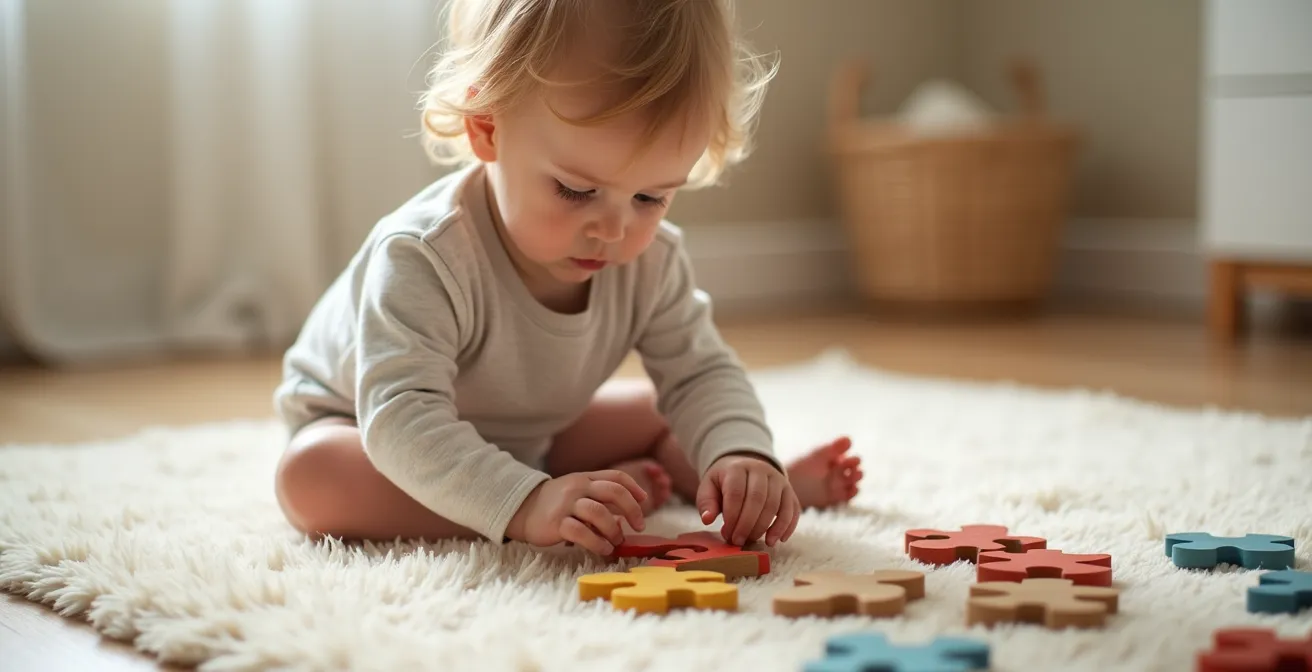
The true value of a puzzle isn’t in its completion, but in using it as a safe space for your toddler to practice managing difficult emotions.
- Instead of focusing on the finished picture, a therapist’s approach prioritizes the process of trying, failing, and trying again.
- Specific language and puzzle choices can transform frustrating moments into powerful lessons in resilience and emotional regulation.
Recommendation: Shift your praise from the outcome (“You finished it!”) to the process (“I love how you kept trying to turn that piece!”). This builds an internal sense of competence and persistence.
Watching your toddler try a puzzle can feel like a miniature drama unfolding on the living room floor. There’s the initial excitement, the focused concentration, and then, inevitably, the moment a piece just won’t fit. For many parents, this is where the frustration erupts—a piece is thrown, a wail of despair is let out, and the game is declared “over.” The common advice is often to simplify the task or distract the child, focusing on puzzle types or fine motor skills. We’re told to find the right number of pieces or to praise them when they finally succeed.
But what if we’re looking at it all wrong? What if the goal of puzzle time isn’t actually to finish the puzzle? As a cognitive behavioral therapist for children, I encourage parents to see these moments not as failures, but as invaluable opportunities. The frustration isn’t a bug; it’s the feature. Puzzles provide a controlled, low-stakes environment where a child can have a “problem,” feel a “big feeling” about it, and learn to navigate that feeling with your help. It’s a cognitive rehearsal for life’s bigger, messier challenges.
This article reframes the entire concept of puzzle play. We will move beyond simply matching shapes and explore how to use puzzles as a deliberate tool for building emotional resilience. We will break down how to choose the right puzzles not just for their piece count, but for their cognitive load, how to use specific language to coach your child through frustration, and how to track their emotional growth without adding any pressure. It’s time to stop trying to prevent the frustration and start using it as the most important teaching tool you have.
To help you navigate this new approach, this guide is structured to walk you through the key stages and strategies, from the physical to the emotional aspects of puzzle play.
Summary: Using Puzzles as a Tool for Emotional Growth
- Knob Puzzles to Jigsaws: When to Increase the Piece Count?
- Why Pincer Grasp Practice on Puzzles Helps Handwriting Later?
- Realistic Photos or Cartoons: Which Is Easier for Brains to Decode?
- The “Lost Piece” Strategy: How to handle Incomplete Sets Without Drama?
- Why Doing Puzzles Before Bed Calms the Nervous System?
- The “You’re Out” Risk: Why Elimination Games Cause unnecessary Anxiety?
- Why Solving Riddles for Treats Boosts Critical Thinking Skills?
- How to Track Cognitive Milestones Without Obsessing?
Knob Puzzles to Jigsaws: When to Increase the Piece Count?
The first question parents often ask is about complexity. When is the right time to move from a simple three-piece knob puzzle to a ten-piece jigsaw? While every child develops at their own pace, there are developmental guidelines that can help. The key isn’t age alone, but observed ability and emotional readiness. Forcing a puzzle that is too difficult is a recipe for overwhelm, while one that is too easy offers no opportunity for growth. The sweet spot is a puzzle that presents a “manageable challenge”—difficult enough to require effort and focus, but not so hard that it leads to complete shutdown.
The goal is to create a positive feedback loop where effort leads to success, building confidence for the next challenge. For instance, developmental research shows that while a two-year-old might be mastering puzzles with 3-4 pieces, a three-year-old can often progress to sets with 10-20 pieces. This progression isn’t just about numbers; it’s about the brain’s growing ability to hold and manipulate multiple pieces of information at once. Instead of pushing for a higher piece count, observe your child’s process. Are they developing a strategy, like finding the edge pieces first? This is a much better indicator of readiness than their age.
Focusing on the process over the piece count is fundamental. We are not training a puzzle-solving machine; we are nurturing a resilient problem-solver. The right puzzle is one that stretches their abilities just enough to make them work for the win, reinforcing the idea that persistence pays off. This is the first step in teaching them that frustration is simply a signal that their brain is working hard on something new.
Checklist: Signs Your Toddler Is Ready for More Complex Puzzles
- Consistently completes current puzzles in under 30 seconds.
- Begins developing a systematic approach, like finding edge pieces or grouping by color.
- Shows the ability to rotate pieces purposefully rather than trying them randomly.
- Demonstrates sustained focus for 5-10 minutes on puzzle-related tasks.
- Successfully completes familiar puzzles without any adult assistance.
Why Pincer Grasp Practice on Puzzles Helps Handwriting Later?
While we focus on the emotional benefits, we can’t ignore the profound physical skills that puzzles build, which are deeply connected to a child’s confidence and ability to tackle future academic tasks. One of the most critical of these is the pincer grasp—the precise coordination of the thumb and index finger to pick up small objects. Every time your toddler grasps the knob of a puzzle piece or picks up a small jigsaw piece, they are performing a micro-workout for the very muscles they will later use to hold a pencil.
This connection is not trivial. Strong fine motor skills can reduce the physical frustration of learning to write, allowing the child to focus on the cognitive task of forming letters rather than struggling with the mechanics of holding the tool. Research indicates that nearly 90% of 12-month-olds show early signs of the pincer grasp, making puzzles an ideal activity to refine this crucial milestone. It turns a developmental necessity into a playful, engaging activity.
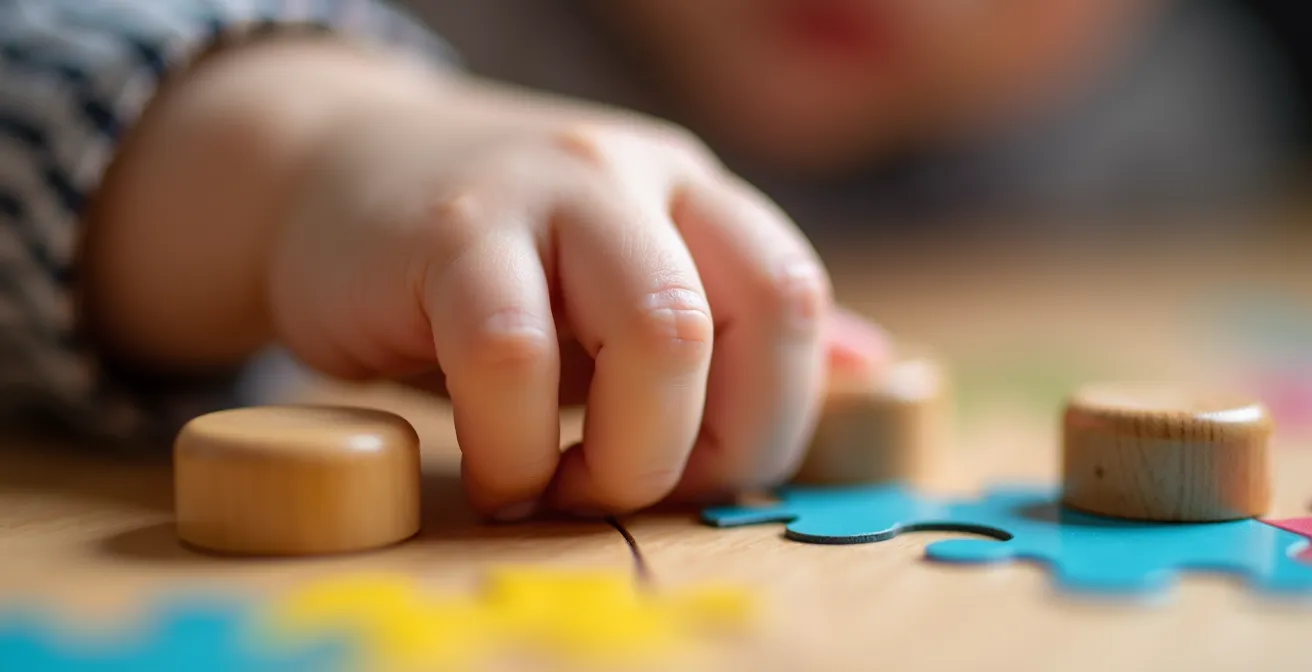
As you can see, this simple action requires immense concentration and coordination. By offering puzzles with knobs and, later, interlocking pieces, you are laying the foundational wiring for handwriting, buttoning a shirt, and tying shoelaces. This physical mastery contributes to a child’s sense of “I can do it,” a belief that is essential for tackling not just puzzles, but all learning challenges. A child who feels physically capable is more likely to persist when faced with cognitive or emotional hurdles.
Realistic Photos or Cartoons: Which Is Easier for Brains to Decode?
The image on a puzzle is far more than just decoration; it has a direct impact on the cognitive demand placed on your toddler’s brain. When a child is very young (around 12-24 months), their brain is working hard to make sense of the world by mapping objects to words and concepts. A puzzle featuring a realistic photograph of a banana is a direct, one-to-one match with the real banana they see in the fruit bowl. This creates a clear connection and lowers the symbolic load, allowing the child to focus purely on the spatial task of fitting the piece.
A cartoon banana, on the other hand, is an abstraction. It has “banananess”—it’s yellow and curved—but it’s not a real banana. To solve this puzzle, a child’s brain must do double duty: it has to both recognize the abstract symbol *and* solve the spatial problem. This is a higher-level skill, typically more appropriate for children over 24 months who are beginning to understand that symbols can represent real things. This is a core tenet in Montessori education, which favors realism to ground children in the concrete world first.
As Guide & Grow Montessori Education points out in their progression guide, this choice is about building a solid foundation. They note:
Puzzles are considered aligned with Montessori if they have a realistic appearance.
– Guide & Grow Montessori Education, Montessori Puzzle Progression Guide
By starting with realistic imagery, you are isolating the skill you want to build—spatial reasoning. Once that is established, you can introduce more abstract images, which serves as a wonderful bridge to recognizing other abstract symbols, like letters and numbers. The following table from an analysis of cognitive processing breaks this down clearly.
| Aspect | Realistic Photos | Cartoon Images |
|---|---|---|
| Symbolic Load | Lower – Direct mapping to real objects | Higher – Requires abstract thinking |
| Best Age Range | 12-24 months | 24+ months |
| Cognitive Demand | Focus on spatial skills only | Spatial + symbolic processing |
| Visual Clarity | High contrast, clear details | Can be visually busy |
| Developmental Bridge | Object recognition | Prepares for letters/numbers |
The “Lost Piece” Strategy: How to handle Incomplete Sets Without Drama?
Sooner or later, it will happen: a puzzle piece goes missing. For a toddler, this can feel like a catastrophe. The picture can’t be finished, the goal is unattainable, and the sense of incompletion can trigger a full-blown meltdown. As a parent, our first instinct might be to frantically search for the piece or quickly put the puzzle away. However, from a therapeutic perspective, this is a golden opportunity. The lost piece is a perfect, real-world lesson in coping with imperfection and managing disappointment.
This is where your role as an emotional coach, or “co-regulator,” comes in. Instead of fixing the problem, you guide your child through the feeling. This involves a technique called scaffolding language, where you provide the words and the framework for them to understand their emotions. First, acknowledge and validate the feeling: “It’s so frustrating when a piece is missing! You worked so hard, and it feels sad that we can’t finish it.” This shows them their feelings are normal and acceptable.
Next, shift the focus from what’s missing to what has been accomplished. Celebrate the process: “Wow, look at all these other pieces you put together! You found the spot for the red car and the blue boat all by yourself.” Finally, you can problem-solve together, which builds agency: “What should we do? Should we draw our own piece to go there, or should we celebrate the puzzle as it is?” This entire sequence teaches a critical life skill: things don’t always go as planned, and that’s okay. We can feel disappointed, and then we can find a new way forward.
- Acknowledge the feeling: “I see you’re sad the piece is missing. It’s frustrating when we can’t finish!”
- Validate the effort: “Look at all the amazing work you did putting these other pieces together!”
- Offer perspective: “Sometimes things aren’t perfect, and that’s okay.”
- Create a solution together: “Should we make our own piece from cardboard?”
- Celebrate what was accomplished: “Let’s count how many pieces you did fit together!”
Why Doing Puzzles Before Bed Calms the Nervous System?
In our hyper-stimulating world, a quiet and focused activity before bed can be a powerful tool for helping a toddler’s busy brain and body wind down. Puzzles are exceptionally good at this because they engage the mind in a structured, logical way that actively counteracts the state of anxiety or overstimulation. It’s not just a quiet activity; it’s a neurologically calming one. This process involves a fascinating interplay between different parts of the brain.
When a child is anxious, over-tired, or hyper, their amygdala—the brain’s “alarm center”—is highly active. It’s a state of emotional reactivity. A puzzle, by its nature, requires concentration, spatial reasoning, and logical thought. These tasks are governed by the prefrontal cortex, the brain’s center for executive function and rational thinking. As Dr. Alyssa Bowman, a mental health counselor, explains, this creates a sort of neural tug-of-war where the “thinking” brain wins.
Puzzles require focused, logical thought, which activates the prefrontal cortex. This consciously pulls brain resources away from the amygdala, the brain’s ‘anxiety center’, effectively reducing anxious feedback loops.
– Dr. Alyssa Bowman, Banner Health
This redirection of brain resources from the emotional center to the logical center has a tangible calming effect on the entire nervous system. The child’s breathing may slow, their muscles may relax, and their mind shifts from a state of chaotic emotion to one of ordered problem-solving. It’s a form of mindfulness, anchoring them in the present moment with a singular, achievable task. Integrating a simple puzzle into the bedtime routine can be a fantastic, screen-free way to facilitate this transition to sleep.
The “You’re Out” Risk: Why Elimination Games Cause unnecessary Anxiety?
To understand what makes puzzles such a powerful tool for building resilience, it’s helpful to contrast them with activities that can have the opposite effect. Many traditional children’s games are based on elimination—think Musical Chairs or Duck, Duck, Goose. While seemingly harmless, these games can create a steady hum of social anxiety for young children. The core mechanic is centered on the fear of being “out,” which can feel like a form of public failure or rejection to a sensitive toddler.
In these games, the “fun” is often derived from avoiding exclusion. This teaches children to focus on not losing rather than on the joy of participation. For a child who already struggles with frustration or has a sensitive temperament, being the first one “out” can feel deeply personal and reinforce feelings of inadequacy. This is the antithesis of the safe failure that puzzles provide. When a puzzle piece doesn’t fit, it’s a private, neutral event. The piece is wrong, not the child. There is no audience and no social consequence, allowing for risk-free trial and error.
Instead of games that create winners and losers, we can reframe puzzle play with a collaborative spirit. This shifts the focus from individual performance to group achievement, teaching teamwork and shared joy. A puzzle is inherently a solitary or cooperative task, not a competitive one. By working on a large floor puzzle together, you model cooperation and celebrate a collective goal, completely removing the anxiety of elimination.
- Floor Puzzle Race: Work as a team to place all the pieces before a song ends.
- Puzzle Relay: Take turns adding one piece at a time, cheering for each other’s success.
- Story Puzzle: As each person places a piece, they add a sentence to a collective story about the picture.
- Timer Challenge: Work together to beat the family’s previous completion time.
- Helper Puzzle: An older child can “coach” a younger one by asking questions (“Where do you think a blue piece might go?”), without touching the pieces.
Why Solving Riddles for Treats Boosts Critical Thinking Skills?
Puzzles are masters at teaching visual-spatial problem-solving. But to build a truly well-rounded critical thinker, it’s beneficial to pair these concrete tasks with more abstract challenges, like riddles. While seemingly different, they engage complementary parts of the problem-solving brain. As a study in the PMC archives notes, puzzle play involves transforming pieces to fit specific locations, providing immediate, concrete feedback. A piece either fits or it doesn’t. This builds what is known as convergent thinking—the ability to narrow down options to find a single correct solution.
Riddles, on the other hand, are a playground for divergent thinking. A riddle like, “What has an eye but cannot see?” requires the brain to think laterally and creatively, moving away from the literal definition of “eye” to consider other possibilities (the eye of a needle). There isn’t a single shape to match, but a concept to unlock. When a child tries different puzzle orientations, they are practicing a simple form of divergent thinking before zeroing in on the correct fit.
Combining these activities creates a powerful cognitive workout. You can make it a game: to “earn” the next puzzle piece, the child has to solve a simple riddle. This links verbal-abstract reasoning with visual-spatial reasoning. For example: “I am yellow and you can peel me. What am I?” The child solves the riddle (banana!), and you give them the banana puzzle piece. This simple pairing teaches them that problems can come in many forms—some you solve with your hands, and some you solve with your words—but the underlying process of thinking through a challenge is the same.
Key Takeaways
- The goal of puzzle play is not completion, but practicing the process of navigating frustration in a safe environment.
- Praise the effort, strategy, and persistence—not just the outcome—to build your child’s internal motivation.
- Choose puzzles and use language that intentionally coaches your child through challenges, turning frustration into resilience.
How to Track Cognitive Milestones Without Obsessing?
In a world of milestone charts and developmental checklists, it’s easy for parents to turn puzzle play into another performance metric. Are they keeping up? Are they doing it “right”? This pressure, however subtle, can be felt by the child and undermines the entire goal of building frustration tolerance. The key is to shift from tracking outcomes to observing the process. Instead of asking, “Did they finish the 20-piece puzzle?”, ask, “How did they approach the 20-piece puzzle?”
Process-oriented observation means you become a curious scientist of your own child’s learning. You’re not judging, you’re just noticing. Keep a mental or written log of the *strategies* they use. For instance: “A month ago, he would try to force pieces. Today, I saw him purposefully turn a piece three different ways before finding the right fit.” This is a huge cognitive leap! It shows developing spatial awareness and the replacement of brute force with strategy. Another example is documenting emotional regulation: “Last week, the wrong piece led to tears. Today, he huffed, put it down, and picked up another one.” This is a monumental victory in frustration tolerance.
Your praise should reflect this focus on process. Instead of a generic “Good job!”, be specific and effort-focused. As behavioral scientist Dr. Jennifer Weeks suggests, a simple, observational phrase can be incredibly powerful:
I love how you kept trying that piece until it fit!
– Dr. Jennifer Weeks, Ph.D.
This tells the child that their persistence is what’s truly valued. By documenting these small, qualitative shifts in strategy, persistence, and emotional response, you get a much richer, more meaningful picture of their development than any checklist can provide—and you do it without adding an ounce of pressure.
- Note strategy emergence: “Started turning pieces purposefully instead of forcing.”
- Track approach changes: “Began sorting edge pieces before attempting the center.”
- Document emotional regulation: “Asked for help calmly instead of throwing pieces.”
- Record persistence markers: “Returned to a challenging puzzle after taking a break.”
- Celebrate process wins: “Tried three different orientations before it clicked. That was great thinking!”
By shifting your focus from the finished picture to the beautiful, messy process of getting there, you give your child a gift far more valuable than a completed puzzle: the unshakeable belief that they can handle hard things.
Frequently Asked Questions About How Puzzles Teach Frustration Tolerance to Toddlers?
What is divergent thinking in puzzle play?
Divergent thinking is the process of generating multiple possible solutions to a problem. In puzzle play, this happens when a toddler tries a piece in several different spots or turns it multiple ways before finding the correct fit, exploring all the possibilities rather than knowing the answer immediately.
How do puzzles teach convergent thinking?
Convergent thinking is the ability to narrow down multiple options to arrive at a single correct solution. Puzzles are excellent for this because, ultimately, only one piece fits in each specific spot. Through trial and error, a child learns to discard incorrect options and converge on the right one.
Why combine riddles with puzzle activities?
Combining these activities creates a more holistic cognitive workout. Puzzles primarily build visual-spatial and convergent thinking skills. Riddles, on the other hand, develop verbal-abstract reasoning and divergent thinking. Using both together helps a child become a more flexible and well-rounded problem-solver.