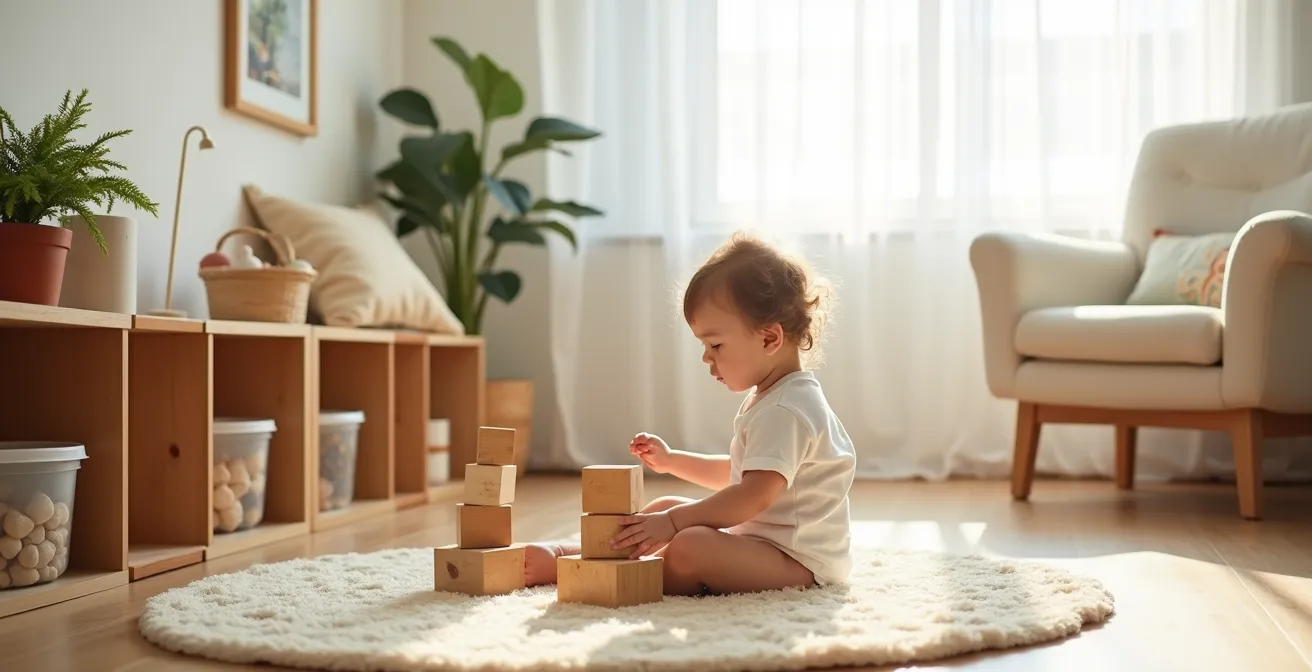
Conventional wisdom on child development overlooks the single most powerful tool you have: the architectural design of your home.
- Visual and auditory clutter (like messy shelves and background TV) actively consumes a toddler’s limited cognitive resources, hindering focus and language skills.
- Simple, static toys (like blocks) stimulate more complex, creative neural pathways than their battery-operated counterparts.
Recommendation: Shift your focus from buying more ‘educational’ products to intentionally designing a sensory-calm, physically engaging environment that allows your child’s brain to build itself.
As a parent dedicated to giving your child an intellectual edge, you’ve likely focused on enrichment activities, educational toys, and quality interactions. These are undoubtedly important. But what if the silent, ever-present structure of your home environment was having an even more profound impact on their developing brain? We often think of home design in terms of aesthetics or functionality, but rarely as an active tool in neurodevelopment. The common advice—to read more or buy specific toys—often misses the foundational layer: the sensory and spatial ecology in which your child spends most of their formative years.
The truth is, a toddler’s brain is not just passively absorbing information; it is being actively sculpted by its surroundings. The arrangement of furniture can either invite or inhibit the development of spatial mapping. The number of toys on a shelf can either foster deep concentration or create a state of perpetual cognitive overload. This is the domain of neuro-architecture: understanding that every choice, from the color of the walls to the type of toy storage, is a design decision that engineers neural pathways.
This article moves beyond the platitudes. We will not simply tell you to ‘tidy up’ or ‘limit screen time’. Instead, we will deconstruct the home environment through the lens of a neuro-architect, revealing the scientific mechanisms at play. We will explore how specific, evidence-based environmental designs can either accelerate or impede cognitive growth, giving you the power to transform your home into an optimized laboratory for your toddler’s brain development.
This guide provides a detailed blueprint, examining the critical environmental factors that shape a young mind. Explore how to harness the power of your home’s design to foster concentration, creativity, and foundational cognitive skills.
Summary: How Your Home Environment Shapes Your Toddler’s Brain
- Why Cluttered Shelves Hinder Concentration in 4-Year-Olds?
- Calm Blues or Active Reds: Which Color Promotes Deep Play?
- Battery Toys vs. Static Toys: Which Generates More Synaptic Connections?
- The Background TV Mistake: How Constant Noise Delays Language Skills
- How to Arrange Furniture to Encourage Crawling and Spatial Mapping?
- Why Clear Containers Boost Creativity More Than Opaque Bins?
- Why Stacking Blocks Predicts Math Skills in High School?
- Which Ergonomic Chair Prevents Slouching for Homework Sessions?
Why Cluttered Shelves Hinder Concentration in 4-Year-Olds?
The prevailing belief is that more toys equal more stimulation and learning. Neuro-architectural principles, however, reveal the opposite is true. A cluttered shelf is not a landscape of opportunity but a source of significant visual static that overwhelms a toddler’s developing prefrontal cortex. This part of the brain, responsible for executive functions like focus and decision-making, is still highly inefficient. When faced with too many choices, it doesn’t get stimulated; it gets paralyzed. The child’s attention flits from object to object, unable to engage deeply with any single one. This prevents the state of “deep play” necessary for building robust neural connections.
This isn’t just theory. Compelling research shows that toddlers with 4 toys experienced more engaged and creative playtime than those with 16. The reduced cognitive load of a minimalist environment allows the brain to allocate its limited resources to creativity and problem-solving rather than constantly scanning and filtering. As research from Princeton professor Sabine Kastner suggests, for some children, what appears as a focusing problem is often an issue of being overwhelmed by visual clutter. Reducing this sensory overload is a direct intervention that supports sustained concentration.
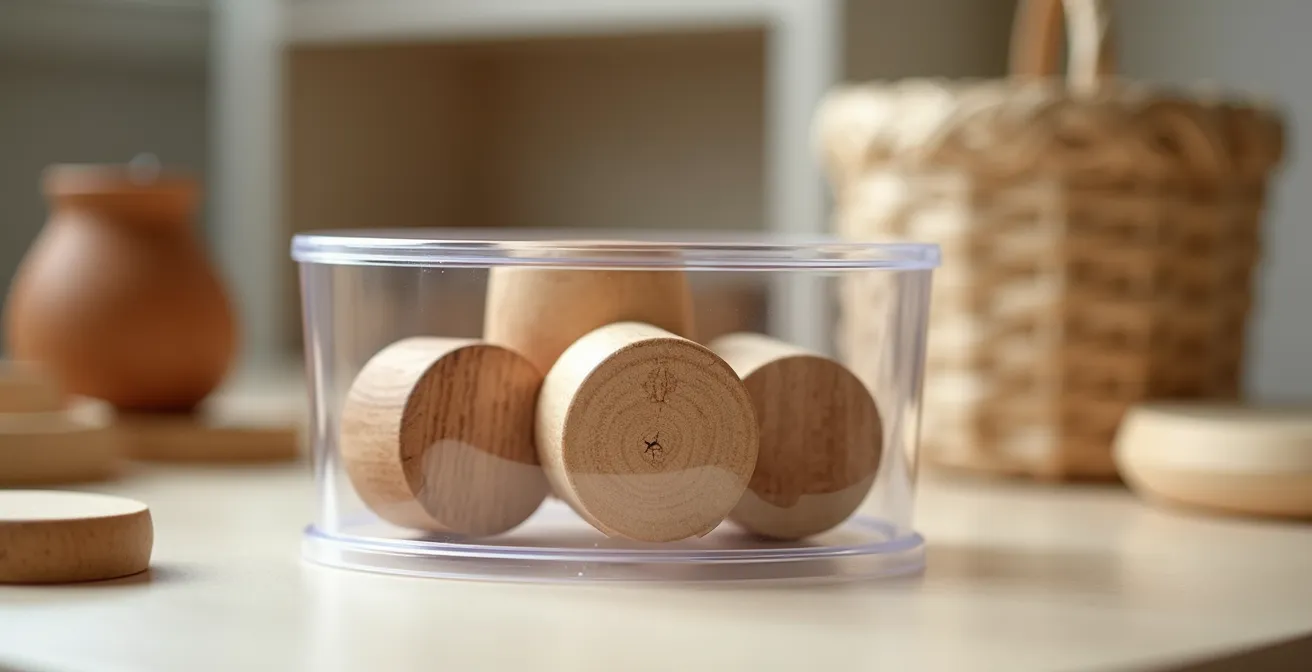
As this image demonstrates, organization is about more than tidiness; it’s about cognitive clarity. Each toy has a designated space, making it visually accessible without competing for attention. This structured visual field reduces the mental energy required for a child to select a toy and, more importantly, to stay engaged with it. By curating the environment, you are essentially curating your child’s ability to concentrate.
Calm Blues or Active Reds: Which Color Promotes Deep Play?
The sensory ecology of a room extends to its color palette, a factor often chosen for aesthetics rather than its psychological impact. The colors surrounding a child are not neutral backdrops; they are active environmental signals that influence mood, energy levels, and cognitive states. High-saturation, warm colors like bright red and orange are known to be physically arousing. While excellent for a playroom designed for gross motor activity, they can create a state of low-level agitation that is counterproductive to the quiet, focused state required for deep play and learning.
Conversely, colors with lower saturation and cooler tones, such as soft blues, greens, and earthy neutrals, have a calming effect on the nervous system. They reduce visual noise and help create a serene atmosphere conducive to concentration. This doesn’t mean a child’s room should be devoid of color. The neuro-architectural approach is about zoning. Use calm, neutral palettes in areas designated for reading, quiet play, and sleep. Reserve vibrant, energetic colors for specific zones or accessories related to active play. This strategy helps the brain associate different spaces with different energy levels, making it easier for a child to transition between states of high excitement and calm focus.
The goal is to create a balanced sensory diet. A room that is entirely beige can be under-stimulating, while a room that is a riot of primary colors can be perpetually overstimulating. By using color intentionally, you can help regulate your child’s nervous system and create an environment that supports a full spectrum of developmental activities, from contemplative block-building to energetic dancing.
Battery Toys vs. Static Toys: Which Generates More Synaptic Connections?
In the world of toys, it’s easy to mistake features for benefits. A battery-operated toy that lights up and makes noise seems inherently more “educational” than a simple set of wooden blocks. However, from a neurodevelopmental perspective, the opposite is often true. The critical question to ask is: “Who is doing the work?” With most electronic toys, the toy does the work, and the child becomes a passive observer. The play pattern is fixed: push a button, get a predetermined response. This creates very simple, repetitive neural circuits.
Static, open-ended toys like blocks, clay, or even cardboard boxes demand that the child’s brain does the work. They are 90% child, 10% toy. A block can be a car, a phone, or a piece of a castle. This act of imaginative transformation and construction forges a vast and complex network of synaptic connections. As children manipulate these objects, they are engaging in rudimentary physics, geometry, and spatial reasoning. They are testing hypotheses, solving problems, and developing fine motor skills in a self-directed way.
That shape-sorting toy you may have received at your baby shower is great for developing spatial awareness and mathematical ability. Once babies get a bit older, building blocks can help continue that development. With blocks, babies are testing their environment and really getting into some complex concepts related to math, such as volume, distance and how structures work.
– Sarah R. Lytle, Ph.D., Director of outreach and education, Institute for Learning & Brain Sciences (I-LABS), University of Washington
The key is that static toys foster divergent thinking—the ability to generate multiple solutions to a single problem. Electronic toys, with their single-function buttons, promote convergent thinking—finding the one correct answer. While both are useful skills, early childhood is the critical window for building the creative, flexible neural architecture that divergent play provides.
The Background TV Mistake: How Constant Noise Delays Language Skills
Many parents believe that as long as their toddler isn’t actively watching television, having it on in the background is harmless. However, neuroscience reveals that “background TV” is a significant environmental pollutant for a developing brain. A toddler’s brain has not yet developed the ability to effectively filter out irrelevant auditory information. To them, the dialogue from a talk show or the noise from a cartoon is not “background”; it is part of their immediate auditory environment, competing directly with the most important source of language learning: their parents’ speech.
The impact is twofold. First, the constant, non-contingent noise creates a confusing soundscape that makes it harder for a child to parse and learn the patterns of human speech. Research is alarmingly clear on this point. A large-scale Korean national study revealed that toddlers watching 2-3 hours of TV daily had a 2.7 times higher risk of language delay. Second, and perhaps more insidiously, background television changes the behavior of the adults in the room. Studies show that when a TV is on, parents talk less to their children, use fewer new words, and are less responsive to their child’s vocalizations. This reduction in high-quality, one-on-one linguistic interaction is a primary driver of language delays.
Eliminating background noise is one of the most powerful, zero-cost interventions a parent can make. When the home is quiet, the child’s brain can tune into the subtle sounds of the environment and, most importantly, the rich, responsive language of their caregivers. This creates an optimal auditory environment for language acquisition, where the parent’s voice is the main signal, not just noise competing with a screen.
How to Arrange Furniture to Encourage Crawling and Spatial Mapping?
Before a child can understand abstract concepts of space on a map, they must first master it with their body. The physical layout of your home is your child’s first gymnasium and first geography lesson. For an infant and toddler, the act of moving through space—crawling, climbing, navigating obstacles—is a primary driver of cognitive development. This process, known as proprioception (the sense of self in space), is fundamental to building the brain’s capacity for spatial mapping, which later underpins skills in mathematics and logic.
A neuro-architectural approach to furniture arrangement goes beyond safety and aesthetics; it involves creating an “obstacle course” of opportunities. Instead of wide-open, empty floor space, consider arranging low, sturdy furniture to create clear pathways, tunnels, and destinations. A low ottoman placed a few feet from a sofa encourages a crawling infant to make a journey. A soft rug can define a “zone” for play, while a different textured floor provides a new sensory experience to cross. This intentional design motivates movement and problem-solving. How do I get around this coffee table? How do I pull myself up on this cushion?

As Canadian developmental research demonstrates that physical activity directly benefits cognitive functions, the environment must invite it. The layout seen here is not accidental; it is a “movement landscape.” It provides safe challenges that build not only muscle but also the neural architecture for spatial awareness. By thinking of your floor plan as a 3D map for exploration, you provide the raw materials for your child to build their internal GPS.
Why Clear Containers Boost Creativity More Than Opaque Bins?
The choice between clear and opaque storage bins may seem trivial, but it has direct consequences for a child’s cognitive load and creative agency. Opaque bins, while hiding mess, create an “out of sight, out of mind” problem. For a toddler to decide what to play with, they must first hold a mental inventory of what each bin contains. This task consumes a significant portion of their limited working memory—the brain’s ‘sticky note’ for holding temporary information.
Working memory—the brain’s ‘sticky note’—holds data we need in the next 10–20 seconds. Each extraneous object costs a sliver of that limited capacity. Over time, the brain learns to tune out persistent mess, but this suppression carries a metabolic price: greater activation of the anterior cingulate cortex.
– Nurture Your Nature Psychotherapy Research Team, Clinical observations on clutter and cognitive function
Clear containers solve this problem elegantly. They allow the child to see their options at a glance, externalizing the memory task from their brain to the environment. This frees up precious cognitive resources to be used for the actual task of playing and creating. The child can be spontaneously inspired by the sight of their colorful blocks or animal figures without having to first remember they exist and then rummage through a bin to find them. This visual accessibility promotes autonomy and self-directed play. It’s a simple design choice that reduces frustration and empowers the child to act on their creative impulses immediately.
Furthermore, this principle reinforces the idea that objects should be respected and cared for, not just hidden away. When toys are visible and organized, it sends a message that they have value. This contrasts sharply with the “toy dump” model of opaque bins, which teaches that cleanup is about making things disappear. As longitudinal data from the National Institute of Child Health and Human Development shows, children in chaotic homes can exhibit developmental delays, making environmental organization a key factor in cognitive health.
Why Stacking Blocks Predicts Math Skills in High School?
It may seem like a stretch to connect a toddler stacking blocks to their future high school math performance, but the link is direct and well-documented. This simple activity is a powerful, hands-on lesson in the foundational principles of physics, engineering, and spatial reasoning—the very concepts that underpin higher mathematics. When a child stacks blocks, they are intuitively learning about gravity, stability, balance, and geometry. They are conducting micro-experiments: “If I place this long block on top of this small one, what happens?”
This “serve and return” interaction with the physical world builds what experts at Harvard’s Center on the Developing Child call sturdy brain architecture. Each successful stack and each toppling tower provides immediate feedback, strengthening neural pathways related to cause-and-effect and problem-solving. This early, intuitive grasp of spatial relationships and structural integrity forms the cognitive framework upon which abstract mathematical concepts will later be built. A child who has physically experienced the concepts of “more,” “less,” “taller,” and “equal” through block play has a more robust foundation for understanding numerical symbols and operations.
Long-term studies confirm this connection. For example, research using the HOME assessment tool confirms that the quality of the early home environment, including the availability of appropriate play materials, predicts cognitive function through age 18. Providing simple, open-ended materials like blocks isn’t just about keeping a toddler busy; it’s a long-term investment in their cognitive future, laying the groundwork for abstract thought and academic success.
Key Takeaways
- Your home’s design is an active tool for brain development, not a passive backdrop.
- Reducing sensory clutter (visual and auditory) is one of the most effective ways to improve a toddler’s concentration and language acquisition.
- Open-ended, static toys like blocks build more complex and creative neural pathways than passive, battery-operated toys.
Which Ergonomic Chair Prevents Slouching for Homework Sessions?
As toddlers transition into childhood, the nature of their focused activities shifts from floor-based play to table-based tasks like drawing, puzzles, and eventually, homework. With recent research revealing that children use screen media nearly two hours a day by age 2, the importance of proper posture starts earlier than ever. An ergonomic setup is not a luxury; it’s a prerequisite for sustained concentration. When a child is physically uncomfortable—slouching, feet dangling, or reaching up too high—their body sends constant signals of discomfort to the brain, consuming cognitive resources that should be dedicated to the task at hand.
The ideal ergonomic chair for a child is one that is fully adjustable. The key principle is the 90-90-90 rule: a 90-degree angle at the knees, a 90-degree angle at the hips, and a 90-degree angle at the elbows when resting on the work surface. This means the chair’s height must be adjustable, and crucially, it must provide foot support. A simple stool or a stack of sturdy books can serve as a footrest if the chair is too high. This physical stability grounds the child, providing a secure base that allows their upper body and mind to focus. An adjustable chair that grows with the child is a wise investment in their physical health and cognitive endurance.
However, the chair is only one component of a focus-optimized workspace. The surrounding environment must also be designed to minimize distraction and cognitive load. This is where all the principles of neuro-architecture converge: a clear desk, organized supplies, and a quiet background are just as important as the chair itself.
Action Plan: Designing a Focus-Optimized Workspace
- Clear the desktop and immediate workspace of all non-essential items to reduce competing visual noise.
- Organize remaining supplies (crayons, paper) into clear, designated containers or zones to minimize decision fatigue when retrieving them.
- If toys are in the room, implement a rotation system, keeping only a few accessible to prevent the lure of distraction during focus time.
- Ensure the workspace is in a zone with calm, neutral colors, reserving bright, stimulating colors for active play areas elsewhere.
- Remove, cover, or turn off all screens in the vicinity when not in active use for the task to eliminate background visual and auditory distraction.
By implementing these neuro-architectural strategies, you can consciously engineer a home environment that not only nurtures your child but actively builds a better brain. The next step is to assess your own space and begin making small, impactful changes.