In summary:
- Card games transform abstract math concepts like “greater than” into tangible, rule-based play.
- Simple games like “War” and “Memory” can be adapted with addition or equations to grow with your child’s skills.
- Game-based learning is neurologically superior to rote drills, reducing math anxiety and improving retention.
- A single deck of cards becomes a portable, durable, and versatile tool for educational entertainment anywhere.
Waiting for food at a restaurant or enduring a long car ride with children often leads parents down a familiar path: handing over a phone for a passive app or pulling out a well-worn coloring book. When we feel particularly ambitious, we might even attempt a few math problems on a napkin, only to be met with groans. The conventional wisdom is that math practice requires quiet focus and repetitive drills—the kind of environment that’s impossible to find on the go. We accept that “fun” and “math practice” are two separate activities.
But what if the most powerful tool for building mathematical fluency wasn’t an app or a worksheet, but something that fits in your pocket? What if the key wasn’t rote memorization, but active, engaged play? This is where the humble deck of cards enters the picture. It’s more than just a way to pass the time; it’s a portable cognitive gym. The core argument of this guide is that card games are not just *more fun* than drills; they are neurologically more effective at building a deep, intuitive understanding of math.
This article will deconstruct the “worksheet trap” and reveal the cognitive science behind why play-based learning works. We will explore how classic games can be adapted for different age groups, discuss the practicalities of choosing the right cards for sticky fingers, and examine how games can either soothe or spike a child’s anxiety. Prepare to see that deck of cards as the ultimate tool for portable pedagogy.
This guide breaks down exactly how to turn a simple deck of cards into a powerful math-learning tool. Discover specific games, practical tips, and the science that makes them so effective.
Summary: How Card Games Build Math Skills Faster Than Worksheets
- How “War” Teaches Greater Than/Less Than Concepts effortlessly?
- Memory Match Variations: How to Increase Difficulty for Older Kids?
- Plastic vs. Paper Cards: Which Survives Sticky Fingers and Spills?
- Speed Games: Do They Help or Hinder Anxious Children?
- How to Pack 5 Games in One Box for Vacation?
- The Worksheet Trap: Why Formal Drills Kill Love of Learning in Toddlers?
- Structured Games or Free Play: Which Causes Less Social Friction?
- Best Strategy Board Games for Kids That Parents Enjoy Too?
How “War” Teaches Greater Than/Less Than Concepts effortlessly?
The classic card game “War” is perhaps the most intuitive entry point into numerical comparison for young children. Its beauty lies in its simplicity: each player flips a card, and the player with the higher number wins the round. This single action provides instant, repetitive practice in identifying which number is greater. Unlike a worksheet that asks a child to circle the bigger number, the game provides a tangible outcome—winning the cards—which makes the concept of “greater than” immediately meaningful. This is a perfect example of embedded learning, where the lesson is part of the game’s objective, not an external task.
The game bypasses the abstract nature of symbols on a page and connects them to a concrete, competitive goal. For very young children, this is crucial. To make this even more effective, educational institutions like Mathnasium have developed specialized decks numbered 0-12, removing the confusing face cards (Jacks, Queens, Kings). This allows children to focus solely on the numerical values without the extra cognitive load of translating pictures into numbers. It’s a small tweak that streamlines the learning process significantly.
But the real power of “War” is its scalability. Once a child has mastered basic number comparison, the game can easily evolve to teach more complex operations. This isn’t about introducing a new, complicated game; it’s about adding a single new rule to a familiar structure. This method of layering complexity is a cornerstone of effective teaching, as it builds on a foundation of confidence. The game becomes a versatile tool that grows with the child’s abilities, making it a long-lasting part of your portable math kit.
Your Action Plan: 5 War Variations to Scale Math Learning
- Basic War: Start by having players compare single cards for simple greater than/less than practice.
- Addition War: Have each player flip two cards and add them together. The player with the highest sum wins the round.
- Fraction War: Instruct players to create proper fractions with two cards (e.g., a 2 and a 5 become 2/5). The player with the highest value fraction wins.
- Decimal War: Use cards to create decimal numbers for comparison (e.g., a 3 and a 4 could be 3.4 or 0.34).
- Negative Number War: For advanced play, designate red cards as negative numbers and black cards as positive to practice integer comparison.
Memory Match Variations: How to Increase Difficulty for Older Kids?
“Memory,” or “Concentration,” is another classic game that serves as a fantastic cognitive gym for kids. At its most basic level, it strengthens visual recognition and working memory—the ability to hold and manipulate information over short periods. For toddlers, simply matching identical numbers or pictures is a significant achievement. This foundational version builds the “scaffolding” for more complex mathematical thinking by training the brain to hold a card’s value and location in mind simultaneously.
As children grow, the game can be easily modified to target specific math skills beyond simple recall. Instead of matching identical numbers, you can create pairs that “make 10” (e.g., a 3 and a 7). This single change transforms the game from a simple matching exercise into a dynamic practice for addition facts. The child is no longer just looking for a “4” to match their “4”; they are actively calculating what number they need to complete the pair. This active problem-solving is what separates deep learning from rote memorization.
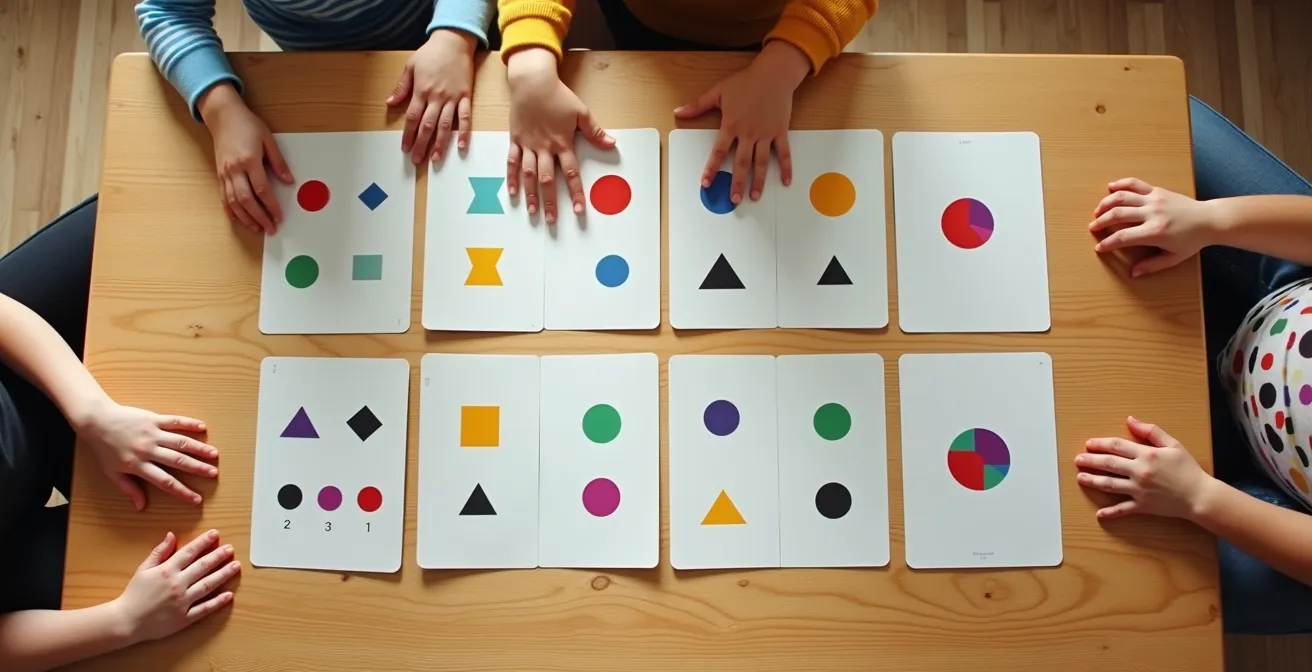
For even older kids, the concept can be extended to matching an equation with its answer (e.g., a card showing “3×4” matches with a “12”) or a fraction with its decimal equivalent (e.g., “1/2” matches with “0.5”). The grid-based layout, as shown above, provides a clear, organized field of play that helps children focus. The key is to keep the core mechanic—flipping two cards to find a match—the same, while changing what constitutes a “match.” This allows you to introduce advanced concepts within a familiar, low-stress context.
The following table illustrates a clear progression for adapting the game of Memory to a child’s evolving skill level, ensuring it remains challenging and engaging.
| Age Group | Card Range | Match Type | Array Size |
|---|---|---|---|
| Preschool (3-5) | 0-5 | Exact number match | 3×4 (12 cards) |
| K-1st Grade (5-7) | 0-10 | Sum to 10 pairs | 4×4 (16 cards) |
| 2nd Grade+ (7+) | 0-20 | Equation matching | 5×4 (20 cards) |
Plastic vs. Paper Cards: Which Survives Sticky Fingers and Spills?
When considering cards for portable entertainment, durability isn’t a luxury; it’s a necessity. A standard paper deck of cards is an economical choice, but it’s notoriously vulnerable to the realities of life with children: juice spills, sticky fingers, and the inevitable frustrated bend or tear. For a game kit designed for restaurants and travel, investing in a more robust material can save you money and frustration in the long run. The choice between paper, plastic-coated, and 100% plastic cards is a trade-off between upfront cost and long-term usability.
Plastic-coated cards offer a good middle ground. They can resist minor moisture and are easier to shuffle than plain paper, but a determined spill will still cause them to warp and peel over time. They represent a modest upgrade in lifespan for a small increase in price. However, for the ultimate in parental peace of mind, 100% plastic cards are the gold standard. They are completely waterproof, washable, and nearly impossible to tear. You can wipe them clean after a messy meal or even wash them in the sink, making them practically indestructible and ideal for repeated use in any environment.
While plastic cards have a higher initial cost, their longevity often makes them more economical over time, as they can last for years instead of months. For families who prefer a more hands-on approach or wish to create custom math cards, laminating a standard paper deck is also a highly effective option. This DIY method provides a similar level of waterproof durability to commercial plastic cards. The table below breaks down the key differences to help you make an informed decision based on your family’s needs and budget.
| Material Type | Durability | Average Cost | Lifespan with Daily Use | Environmental Impact |
|---|---|---|---|---|
| Standard Paper | Low – tears easily | $1-3/deck | 1-2 months | Biodegradable |
| Plastic-Coated | Medium – water resistant | $3-5/deck | 6-12 months | Mixed materials |
| 100% Plastic | High – washable | $8-15/deck | 2+ years | Non-biodegradable |
| DIY Laminated | High – waterproof | $2 + laminating | 1-2 years | Non-recyclable |
Speed Games: Do They Help or Hinder Anxious Children?
Many popular card games rely on speed, rewarding the fastest player to spot a match or solve a problem. While this can be exciting and motivating for some children, it can be a significant source of stress and anxiety for others. For a child who struggles with math anxiety, the pressure of a ticking clock can trigger a “fight or flight” response, shutting down the very cognitive processes needed for learning. Instead of building fluency, speed-based games can reinforce a child’s belief that they are “bad at math,” creating a negative feedback loop.
The goal of portable pedagogy is to make learning enjoyable and accessible, not to create a high-pressure test. For anxious children, the focus should shift from speed to strategy and cooperation. Choosing games that emphasize turn-taking and thoughtful decision-making over rapid responses can transform the experience. A study on numerical card games highlights this, stating:
Playing a card game with another person required children to take turns, which may help children practice inhibiting their automatic response. Playful learning experiences that require turn-taking and cooperative play provide a developmentally appropriate context for young children to develop their executive functioning skills.
– Hassinger-Das et al., Benefits of Playing Numerical Card Games Study
This focus on executive function—skills like impulse control and planning—is a far more valuable lesson than simply being the fastest.

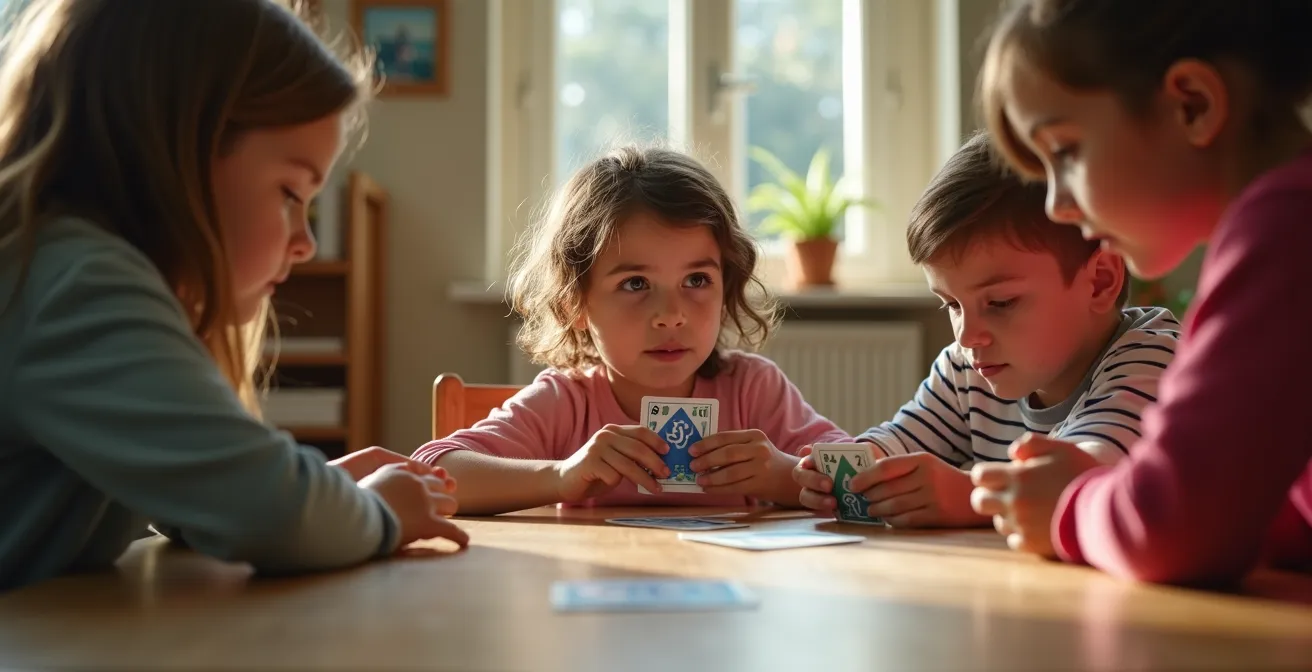
Games that foster collaboration, as depicted above, create a safe space for learning. Instead of competing against each other, players can work together towards a common goal, such as making as many pairs as possible in a cooperative game of Memory. This reframes mistakes as learning opportunities for the group, not as individual failures. Research from Warwick Business School reinforces this, finding that students who included games in their learning not only saw a 7% increase in average exam scores but also reported higher satisfaction and attendance. By removing the pressure of speed, you allow the child’s brain to engage with the mathematical concepts calmly and effectively.
How to Pack 5 Games in One Box for Vacation?
The true elegance of using a deck of cards as a teaching tool is its incredible versatility. You don’t need to pack five different boxes of games for a vacation; you just need one deck of cards and a list of rules. This minimalist approach is the essence of portable pedagogy. A single, standard 52-card deck can be used to play dozens of games, from the simplest matching exercises for toddlers to complex strategy games for older kids and adults. This makes it the ultimate travel companion for families.
The key is to think of the deck not as a single game, but as a “game system.” Your “box” is the deck itself, and the “software” is the set of rules you bring to it. To create your multi-game vacation kit, simply select 3-5 games that target different skills and are appropriate for the ages of your children. For example, a single deck can facilitate:
- Go Fish: Teaches number and set recognition.
- Memory: Builds working memory and can be adapted for addition facts.
- War: Reinforces greater than/less than concepts and can be scaled for different operations.
- Tens: A simple solitaire-style game where you remove pairs of cards that add to 10, great for reinforcing number bonds.
- Sevens: A strategy game requiring players to build sequences of cards, teaching logical ordering.
This approach has been validated by experts. For instance, researchers at Boston College, in collaboration with Tandem, Partners in Early Learning, developed a system of family card games designed to build early math skills. As highlighted by a DREME Stanford initiative, this work proves that a curated set of games using a simple deck can have a significant impact. You can create your own version by printing out or handwriting the rules for your chosen games on a few index cards and storing them in the card box. This ensures you’re always ready with a new activity when the current one loses its appeal.
The Worksheet Trap: Why Formal Drills Kill Love of Learning in Toddlers?
The “worksheet trap” is the well-intentioned but misguided belief that early and frequent exposure to formal drills will give a child a head start in math. For toddlers and preschoolers, whose brains are wired for learning through play and exploration, a worksheet is often a source of frustration, not education. It presents math as a static, two-dimensional task of matching, counting, or circling. This approach is not only boring but can be actively detrimental, fostering an early aversion to a subject that should be exciting and dynamic.
As Mathnasium of Littleton notes, the simple truth is that ” Games are inherently motivating.” A game has a clear objective, immediate feedback, and a sense of agency for the player. A worksheet has none of these. The neurological difference is stark: play-based learning activates reward centers in the brain, making the experience memorable and desirable. Rote drills, on the other hand, rely on passive recall, which is a far less effective pathway for long-term retention. A compelling study showed that students using the My Math Academy digital game app for just 30 minutes a week outperformed their peers by 5.71%, demonstrating the powerful efficiency of game-based learning.
Furthermore, worksheets often isolate children, turning learning into a solitary and sometimes stressful activity. Card games, by contrast, are inherently social. They teach vital skills that go far beyond arithmetic, such as turn-taking, communication, and good sportsmanship. They create a shared experience between parent and child, strengthening bonds while simultaneously building cognitive skills. Escaping the worksheet trap doesn’t mean abandoning math practice; it means redefining it. It’s about choosing methods that align with how a young child’s brain is naturally designed to learn: through joyful, interactive, and meaningful play.
Structured Games or Free Play: Which Causes Less Social Friction?
While “free play” is essential for fostering creativity and imagination, it can sometimes be a source of social friction among children, especially when sharing is involved or different play styles clash. Arguments over who gets to be the hero or how a block tower should be built are common. This is where structured games, like card games, offer a distinct advantage. By providing a clear set of rules and a defined objective, they create a predictable framework that minimizes ambiguity and potential for conflict.
The rules of a card game act as a neutral, third-party referee. It’s not one child’s opinion against another’s; it’s simply “what the rules say.” This external authority helps depersonalize the experience, making it easier for children to accept outcomes, like losing a round or having to wait their turn. This structure is particularly beneficial for developing self-regulation and executive function. As a study with low-income preschoolers demonstrated, children who played numerical card games over just a few short sessions showed improved numeral identification skills, a benefit that was maintained weeks later. The implicit structure of the game provided the perfect environment for learning.
Of course, the parent’s role as a guide is crucial to ensuring a positive experience. By establishing guidelines before the game starts, you can preempt many common disagreements. Modeling good sportsmanship and using neutral language can teach children how to navigate competition and collaboration gracefully. Here are a few simple guidelines for parents acting as the “referee”:
- Establish clear rules before starting—write them down if needed.
- Model good sportsmanship by celebrating others’ wins.
- Use neutral language: “The rules say…” instead of “You can’t do that.”
- Build in “practice rounds” where mistakes don’t count.
- Rotate who goes first to ensure fairness over time.
- End with a positive reflection, like, “What was your best move today?”
By providing this light-touch guidance, you can ensure that the structured play of a card game reduces social friction and maximizes both learning and fun.
Key takeaways
- Card games transform abstract math concepts like addition and comparison into tangible, rule-based play.
- Adapting classic games (e.g., Memory with equations, War with fractions) allows the challenge to grow with your child’s skills.
- Structured games with clear rules naturally teach vital executive functions like turn-taking and impulse control, reducing social friction.
Best Strategy Board Games for Kids That Parents Enjoy Too?
While this guide focuses on the supreme portability of card games, the strategic principles found in the best board games can absolutely be applied to advanced card play. The question often isn’t about the format (board vs. card) but about the type of thinking the game demands. Many parents seek games that are engaging for their children but aren’t mind-numbingly simple for adults. The sweet spot lies in games that require genuine strategic thinking, making them enjoyable for a mixed-age group. These games move beyond simple luck and introduce elements of planning, resource management, and probability.
The skills developed in these more complex games are directly applicable to higher-level mathematics. For example, a game that requires resource management teaches budgeting and long-term planning. A game involving risk calculation introduces the intuitive feel for probability. As children get older, a standard deck of cards can be used for games that demand these very skills, such as “Sevens,” which requires pattern recognition and sequential planning, or games like “Target Number,” which involve multi-step planning to reach a specific sum using multiple cards. These games are a far cry from the simple luck of “War.”
Choosing a game based on the strategic skill it develops is a powerful way to target specific cognitive abilities. The table below, inspired by a framework for math games, categorizes different types of strategic thinking found in card games that both kids and parents can enjoy. This allows you to select a game that not only entertains but also serves as a targeted workout for the brain, turning family game night into a shared challenge rather than a chore for the parents.
| Game Type | Strategic Skill | Age Range | Example Game |
|---|---|---|---|
| Resource Management | Planning ahead, budgeting | 8+ | Capture (collect most cards) |
| Probability Assessment | Risk calculation | 7+ | Math Boggle variations |
| Pattern Recognition | Identifying sequences | 6+ | Sevens (sequential placement) |
| Multi-step Planning | Forward thinking | 9+ | Target Number games |
By seeing a simple deck of cards not as a single toy but as a versatile, powerful, and portable cognitive gym, you can transform downtime into a valuable opportunity for learning. Start with one simple game like Addition War on your next outing and watch your child engage with numbers in a whole new way.