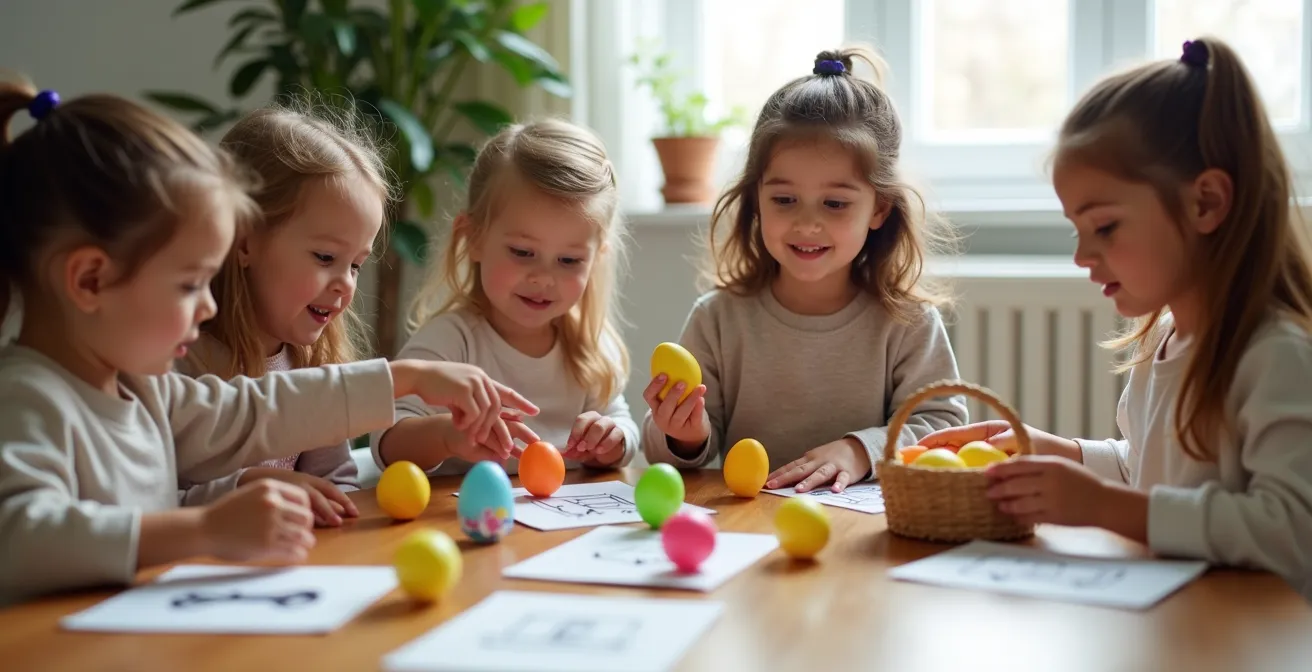
Transforming a traditional egg hunt into a cognitive scavenger hunt isn’t about making it harder; it’s about making it smarter by intentionally designing it as a learning experience.
- The key is to create clues that match a child’s “Zone of Proximal Development,” making them challenging but not frustrating.
- Visual, sequential, and narrative-based clues build foundational logic, memory, and critical thinking skills long before a child can read.
Recommendation: Shift your focus from the “what” (the treats) to the “how” (the problem-solving journey) to create a memorable and impactful developmental activity.
The scene is familiar: a sunny afternoon, a basket clutched in a small hand, and the joyful chaos of children scrambling for brightly colored plastic eggs. The traditional egg hunt is a cherished ritual, but it often culminates in little more than a sugar rush and a pile of candy wrappers. Many parents feel a missed opportunity, wondering if this excitement could be channeled into something more meaningful. The common advice is to simply add riddles, but this often overlooks the unique cognitive landscape of a preschooler.
What if we could re-architect this beloved game from the ground up? What if, instead of being a frantic race for treats, the hunt became a carefully constructed journey designed to build a child’s brain? This isn’t about eliminating the fun; it’s about amplifying it by embedding learning directly into the fabric of the game. The secret lies not in the complexity of the puzzles, but in the intentionality of their design. It’s about understanding how a four-year-old’s mind works and crafting an experience that gently stretches their cognitive abilities.
This guide moves beyond generic ideas to give you an early childhood educator’s framework for success. We will explore the science behind why solving challenges for a reward is so effective for young minds. You’ll learn how to create solvable visual clues for non-readers, manage the logistics of the hunt to prevent meltdowns, and calibrate the difficulty perfectly. Ultimately, we will show you how to transform this single event, and even daily play, into a powerful, pressure-free learning opportunity that creates lasting memories.
This article provides a complete roadmap for parents and educators. We’ll cover everything from the cognitive science of riddles to the practical steps for turning everyday play into a learning adventure.
Summary: A Smarter Scavenger Hunt: From Clues to Cognitive Growth
- Why Solving Riddles for Treats Boosts Critical Thinking Skills?
- How to Draw Picture Clues for Non-Readers That Are challenging but Solvable?
- Indoor vs. Backyard Hunt: Which Is Best for Supervision of Large Groups?
- The “Too Hard” Mistake: How to Gauge Clue Difficulty to Avoid Frustration?
- How Many Clues Are Too Many Before a 4-Year-Old Loses Interest?
- How Sequencing Movements Teaches Logic Before Reading?
- Why Kids Remember Scavenger Hunts More Than Expensive Balloon Arches?
- How to Turn Daily Play Into Learning Without Pressure?
Why Solving Riddles for Treats Boosts Critical Thinking Skills?
At its core, a scavenger hunt is a game of problem-solving. When a child deciphers a clue to find a treat, they aren’t just playing; they are engaging in a full cognitive workout. The process requires them to hold information in their short-term memory, analyze it for meaning, and disregard irrelevant details. This is the very foundation of critical thinking. The “aha!” moment when they solve the puzzle provides a rush of dopamine, a powerful neurotransmitter that reinforces the learning pathway and makes them eager to tackle the next challenge. This loop of effort, discovery, and reward is one of the most effective ways to build intellectual confidence.
However, it’s crucial to understand the developmental stages of this skill. While riddles are fantastic tools, their effectiveness varies significantly with age. For instance, research shows that while older children thrive on linguistic puzzles, the abstract nature of riddles can be a major hurdle for preschoolers. One study highlights this gap, noting that while 70% of 8-11 year-olds could correctly explain a riddle, only 3.5% of 4-5 year-olds could do the same. This doesn’t mean preschoolers can’t think critically; it means we must use different tools.
For this age group, the “riddle” should be visual or action-based rather than verbal. The cognitive processes activated are the same: they must analyze key details, make connections, and filter out distractions to reach a logical conclusion. By framing the hunt as a series of solvable mini-mysteries, we are exercising their analytical and reasoning skills in a way that feels like pure play. The treat at the end isn’t just a prize; it’s the satisfying confirmation that their thinking process was successful.
This initial “win” builds the momentum and motivation needed to sustain engagement throughout the entire activity, turning potential frustration into a feeling of empowerment.
How to Draw Picture Clues for Non-Readers That Are challenging but Solvable?
Creating clues for children who can’t yet read is an art of translation. The goal is to convert an abstract idea (like “look under the sofa”) into a concrete, recognizable image. The challenge lies in making the clue obvious enough to be solved but intriguing enough to feel like a real puzzle. Direct, literal drawings are a great starting point, but the real cognitive benefit comes from gradually introducing more abstract representations. This technique, known as symbolism scaffolding, gently pushes a child to think more conceptually.
You can begin with a literal photograph of the exact hiding spot—for example, a picture of *your* specific blue armchair. For the next clue, you might progress to a simple line drawing of a generic chair. This requires the child to make a mental leap from a specific object to a category of objects. The next level of abstraction could be a drawing of a person reading a book, which conceptually represents a place where one sits and reads. This progression builds the brain’s ability to think in symbols, a critical precursor to understanding that letters themselves are symbols for sounds.
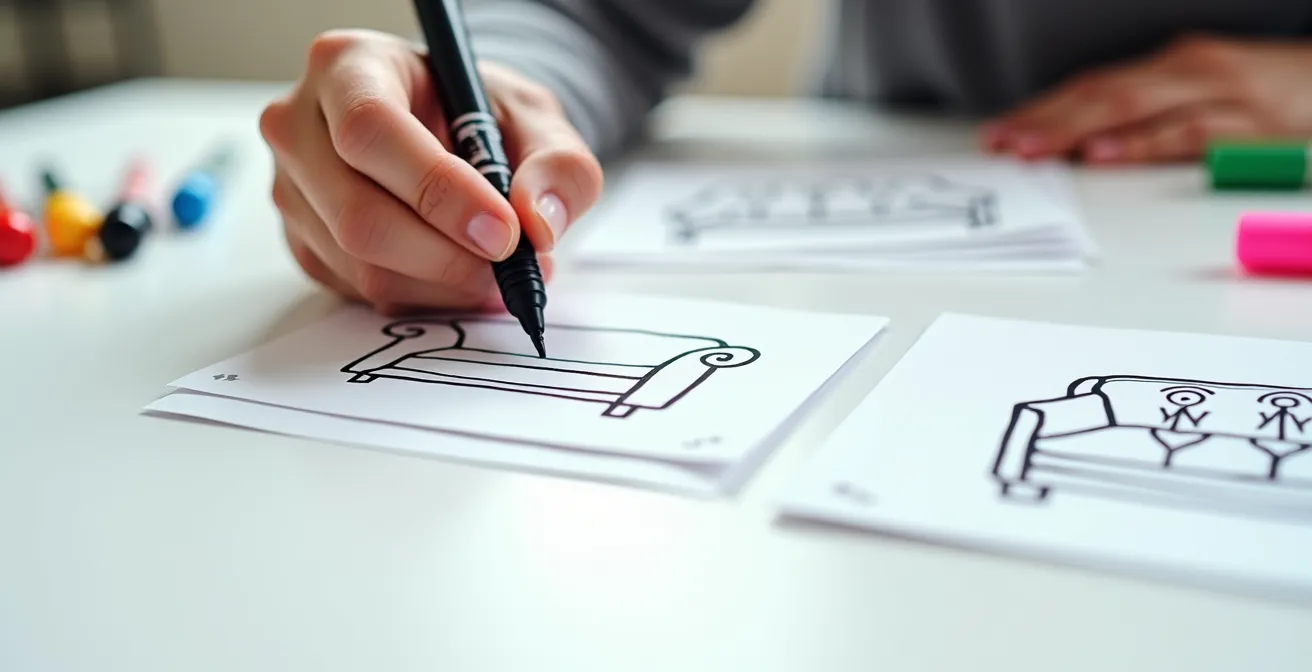
As the image above illustrates, moving from literal to conceptual clues is a gradual process. Another effective technique is to use unusual perspectives. Instead of drawing the whole object, draw an extreme close-up of a distinctive part, like the buttons on the TV remote or the sole of a sneaker. This forces the child to engage their visual memory and problem-solving skills to identify the object from a new and unfamiliar viewpoint. The key is to create a “just right” challenge that is solvable with a little bit of thought, thereby boosting their confidence and analytical skills.
By thoughtfully designing these picture clues, you are not just guiding them to the next egg; you are building the fundamental neural pathways for logical and symbolic thinking.
Indoor vs. Backyard Hunt: Which Is Best for Supervision of Large Groups?
Choosing between an indoor and an outdoor setting for a scavenger hunt with a large group of preschoolers isn’t just a matter of weather; it’s a strategic decision that impacts supervision, safety, and the overall flow of the game. Each environment offers distinct advantages and requires a different approach to management. An indoor hunt provides a controlled, contained space, making it easier to monitor children and guide their path. Conversely, a backyard hunt offers more room for energetic play but demands clearer boundaries and zoning strategies.
As the educational blog Days with Grey points out, the value lies in the structure of the activity itself. They note that scavenger hunts “not only offer so many fun learning opportunities for kids, but encourage communication, cognitive skills, and teamwork.” This collaborative element is often easier to manage indoors. One effective indoor strategy for groups is a “Staggered Start Relay.” Teams or individuals start at different times and must solve a clue to find their next egg, then return to a central “home base” to receive the next clue. This prevents bottlenecks and allows adults to manage the flow from a single point.
For an outdoor hunt, which can accommodate a larger number of children, a “Color-Coded Zones” approach is highly effective. The backyard is divided into different zones, perhaps with colored flags or streamers, and each age group is assigned a specific color. This ensures that younger children aren’t competing with older, faster kids and allows supervising adults to focus on a smaller, designated area. The following table breaks down the strategic considerations for each option.
| Factor | Indoor Hunt | Outdoor/Backyard Hunt |
|---|---|---|
| Supervision Method | Staggered Start Relay with home bases | Color-coded zones by difficulty/age |
| Group Management | Teams solve clues and return to central point | Children assigned to specific zones |
| Space Control | Controlled flow through rooms | Rope off unsafe areas, define boundaries |
| Best Group Size | 5-15 children | 10-30 children |
| Weather Dependency | Weather-proof option | Requires good weather and early timing |
Ultimately, the best choice depends on your group size, the age mix, and your supervision capacity. A well-planned structure is what transforms potential chaos into a smooth, enjoyable, and safe cognitive adventure for everyone involved.
The “Too Hard” Mistake: How to Gauge Clue Difficulty to Avoid Frustration?
The single most common pitfall in designing a cognitive scavenger hunt is making the clues too difficult. When a challenge is too far beyond a child’s current abilities, it doesn’t build resilience; it builds frustration and causes them to disengage entirely. The sweet spot for learning is what psychologist Lev Vygotsky termed the “Zone of Proximal Development” (ZPD). This theory posits that the most effective learning occurs when a task is just one step beyond what a child can accomplish independently, requiring a small amount of guidance or a slight mental stretch.
Gauging this zone for a group of preschoolers with varying abilities can seem daunting, but it doesn’t have to be. As Vygotsky’s research shows that learning occurs most effectively when tasks are precisely calibrated to this zone, a quick pre-hunt diagnostic can work wonders. Before the main event, engage the children in a simple warm-up game. A two-minute round of “Simon Says” that involves identifying colors or shapes (“Simon says find something red!”) can give you a quick assessment of the group’s baseline knowledge and ability to follow directions.
This allows you to make on-the-fly adjustments to your planned clues. If a clue seems too advanced for the group, you can offer a verbal hint. For mixed-ability groups, a great strategy is to alternate difficulty levels. Give an easier, more literal clue to one child, followed by a slightly more conceptual one to the next. This ensures everyone experiences success and remains engaged. The goal is not to stump them, but to empower them by leading them to a victory that feels earned. Staying within their ZPD ensures the hunt remains a joyful exercise in thinking, not a frustrating test.
Your Pre-Hunt Checklist: Gauging the ‘Just Right’ Challenge
- Conduct a 2-minute warm-up game like ‘Simon says show me something blue!’ to assess current knowledge.
- Adjust puzzle difficulty based on group size: use 12-piece puzzles for beginners, 24-piece for intermediate levels.
- Place one puzzle piece per child in each egg to ensure everyone can participate in a collaborative final goal.
- For mixed abilities, alternate clues with different difficulty levels for each child or team.
- Prepare a few simple verbal hints in advance for any clues that might prove too challenging for the group.
By carefully calibrating the difficulty, you ensure the experience is one of empowering discovery rather than one of discouraging defeat, making the child eager for the next mental challenge.
How Many Clues Are Too Many Before a 4-Year-Old Loses Interest?
When planning a scavenger hunt for a preschooler, enthusiasm can sometimes lead us to over-engineer the experience. While a 12-step epic hunt might sound exciting to an adult, it will almost certainly overwhelm a young child. The key to maintaining engagement is to work *with* their natural cognitive limits, not against them. The most significant of these limits is their attention span. According to childhood development experts, a 4-year-old’s attention span for a single, focused activity is typically between 8 to 12 minutes.
This single data point is the most important guide for structuring your hunt. Your entire scavenger hunt, from the first clue to the final prize, should ideally fit within this time frame. For a 4-year-old, this translates to roughly 5 to 7 clues. This number is short enough to prevent cognitive fatigue but long enough to feel like a genuine adventure. Exceeding this can lead to a sharp drop-off in interest, turning what started as a fun game into a chore they feel pressured to finish.
To maximize engagement within this short window, it’s helpful to structure the hunt with a clear narrative arc. Think of it as a short story with a beginning (the first clue), a middle (the journey of discovery), and an end (the final treasure). Using a theme that the child is interested in—like pirates finding treasure or superheroes on a mission—can dramatically increase their investment in the process. Keeping the list of clues short and ensuring the hiding spots are relatively easy to find are practical ways to respect their developmental stage and keep the frustration levels low, ensuring the experience remains positive from start to finish.
By designing a short, punchy, and narrative-driven hunt, you create a perfectly paced adventure that leaves them feeling accomplished and excited, not exhausted and overwhelmed.
How Sequencing Movements Teaches Logic Before Reading?
Long before a child learns to read words from left to right, they can learn the foundational concept of sequencing through movement. A cognitive scavenger hunt provides the perfect opportunity to teach this pre-literacy skill in a tangible, physical way. Instead of just giving a clue that leads to a static location, you can design a clue that is a sequence of actions. For example, a picture clue could show a sequence: 1) a frog (jump), 2) a bear (crawl), 3) a star (the final location).
When a child follows this sequence—”first I hop three times, then I crawl under the table”—they are practicing several critical cognitive skills simultaneously. They are decoding symbols (the pictures), holding a multi-step process in their working memory, and executing a plan in a specific order. This is procedural logic in its most basic form. It’s the same underlying skill required to follow a recipe, solve a math problem, or, eventually, track words across a page. This physical enactment of a sequence makes the abstract concept of order concrete and memorable.
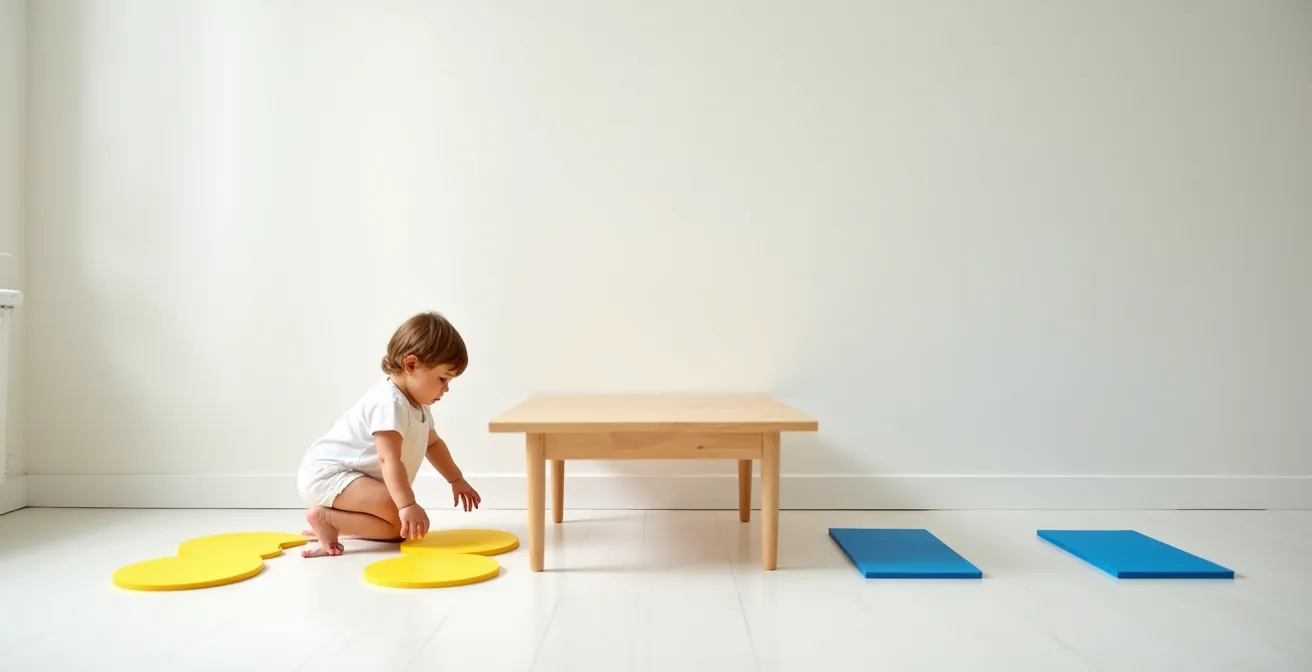
As education researcher Michelle Connolly states, “When children conquer puzzles and riddles, they’re essentially conducting a full workout for their brain, improving both speed and agility of thought.” A movement-based sequence is simply a physical riddle. By arranging the path from left to right across a room, as shown in the image, you are also subtly reinforcing the directional tracking their eyes will one day use for reading. You are building a “body memory” for a fundamental academic concept, all under the joyful guise of a game.
This playful method embeds the logic of “if-then” and “first-next-last” deep into their understanding, creating a solid foundation for more complex academic learning later on.
Key Takeaways
- The goal is cognitive scaffolding: The hunt’s purpose is to gently stretch a child’s thinking skills, not just to distribute treats.
- Calibrate for the ZPD: Clue difficulty must be tailored to the child’s “Zone of Proximal Development”—challenging enough to be engaging, but not so hard it causes frustration.
- Experience over expense: A well-designed, interactive experience where the child is the hero creates a far more powerful and lasting memory than any passive, expensive decoration.
Why Kids Remember Scavenger Hunts More Than Expensive Balloon Arches?
Why does a simple, homemade scavenger hunt often leave a more lasting impression on a child than a costly, professionally installed balloon arch or a mountain of presents? The answer lies in how our brains form and store memories, particularly what are known as episodic memories—the memories of personal experiences. Passive experiences, like looking at decorations, are processed differently than active experiences where the child is the protagonist.
A scavenger hunt creates a personal narrative. It has a beginning (receiving the first clue), a compelling middle (the journey of solving puzzles and overcoming challenges), and a satisfying end (discovering the final treasure). As one expert in developmental psychology puts it, “A scavenger hunt creates a personal narrative with a beginning, middle, and end, where the child is the hero.” This active role as the “hero” of the story is crucial. The effort, the moments of confusion, the “aha!” of discovery, and the feeling of accomplishment all trigger a much richer, multi-sensory encoding process in the brain. The child isn’t just seeing; they are thinking, moving, touching, and feeling.
This active participation leads to a more robust and emotionally resonant memory. The joy isn’t just in the prize; it’s baked into the entire problem-solving journey. Each solved clue is a small victory, a dopamine hit that solidifies the experience in their memory. Unlike a balloon arch, which is visually pleasing but requires no interaction, the scavenger hunt is an event they co-created through their own intellectual effort. They don’t just remember what they got; they remember what they *did* to get it. This is why the memory of the hunt, and the feeling of pride it instilled, will far outlast the fleeting novelty of a passive decoration.
It’s the journey of discovery and the sense of personal agency, not the material prize, that cements the scavenger hunt as a cherished childhood memory.
How to Turn Daily Play Into Learning Without Pressure?
The principles that make a cognitive scavenger hunt so effective—curiosity, problem-solving, and discovery—don’t have to be reserved for special occasions. With a slight shift in mindset, parents can transform everyday playtime into a rich, pressure-free learning environment. The key is to move from being an instructor to being a curious co-navigator. This involves using prompts that encourage a child to think about their own thought processes, a skill known as metacognition.
Instead of asking “What color is that?” (a test question with a right/wrong answer), try asking process-oriented questions like, “How did you figure out that piece goes there?” or “What do you think will happen if we add another block?” These open-ended questions invite conversation and reflection rather than performance. Another powerful, pressure-free technique is the “Sportscaster Method.” Simply narrate what your child is doing in a neutral, observational tone: “You are putting the red car on top of the blue block. Now you’re pushing it forward.” This validates their actions and helps them build a narrative around their play without the pressure of praise or correction.
You can even flip the script of the scavenger hunt. A “Reverse Hunt” is a wonderful activity where you ask your child to create two or three clues for *you* to solve. This challenges them to think from a different perspective, considering how to represent an object or location for someone else. By following their interests and embedding these small, thoughtful interactions into daily activities—from building with blocks to sorting laundry—you are constantly building their cognitive toolkit. You are fostering a love for thinking and problem-solving, turning every day into a small, joyful adventure in learning.
Now that you have the framework for creating these cognitive experiences, the next logical step is to start designing your own small-scale hunt, focusing on the process, not perfection.