
The key to a meltdown-free party isn’t avoiding fun, but strategically managing your child’s “sensory budget.”
- Environmental design (like a ‘cool-down corner’) is more effective than reactive discipline.
- Timing is critical: The party’s length and when you serve sugar directly impact behavior.
Recommendation: Shift from trying to control your child’s excitement to controlling the party’s sensory environment.
The scene is familiar to many parents: the joyous chaos of a birthday party, followed by the inconsolable wail of an exhausted, overstimulated child on the car ride home. You might blame the sugar, the noise, or the late hour. Common advice often suggests simply leaving early or avoiding sweets, but these are reactive measures that can feel like you’re depriving your child of the full experience. As a child psychologist, I see countless parents who dread these events, feeling helpless against the inevitable post-party meltdown.
But what if the solution wasn’t about restriction, but about strategy? The real challenge for sensitive children isn’t the excitement itself, but the phenomenon of stimulus stacking, where each sound, sight, taste, and social interaction piles up until their nervous system is overwhelmed. Managing this requires a shift in perspective. Instead of trying to contain a child’s big feelings after the fact, we can become “sensory architects,” proactively designing the party experience to stay within their capacity for enjoyment.
This guide moves beyond the generic tips. We will explore the neurobiological reasons behind these meltdowns, providing you with a clear framework to manage your child’s sensory environment. We will break down how to create effective calming spaces, choose activities that foster cooperation, understand the precise timing of a sugar crash, and determine the optimal party duration to keep the fun from turning into frustration.
By understanding the ‘why’ behind each strategy, you can transform parties from a source of anxiety into a genuine opportunity for joyful connection. This article provides a structured approach to help you do just that.
Summary: A Psychologist’s Guide to Preventing Party Meltdowns
- Why Excessive Noise and Sugar Lead to Meltdowns in 30 Minutes?
- How to Design a “Cool Down” Corner That Kids Actually Use?
- Structured Games or Free Play: Which Causes Less Social Friction?
- The Sugar Crash Timeline: When to Serve Cake Relative to Pickup Time?
- How Long Should a Toddler Party Last Before Behavior Deteriorates?
- Speed Games: Do They Help or Hinder Anxious Children?
- Why Tulle Lining Often Causes Tantrums After 30 Minutes?
- How to Choose Interactive Games That Teach Cooperation Instead of Competition?
Why Excessive Noise and Sugar Lead to Meltdowns in 30 Minutes?
A meltdown is not a temper tantrum; it’s a physiological response to overwhelming sensory input. Think of your child as having a “sensory budget.” Each stimulus—the music, the shouting, the flashing lights, the texture of their costume—is a withdrawal. When the budget is depleted, the brain’s processing ability short-circuits, triggering a fight-or-flight response. This isn’t a choice or “bad behavior”; it’s a sign that their neurological capacity has been exceeded. The first signs are often subtle: you might notice their voice changing in pitch or volume, an increase in fidgety movements, or their skin becoming flushed or pale.
Noise and sugar are particularly potent drains on this budget. Loud, unpredictable environments force the brain to work overtime to filter information. Sugar, meanwhile, provides a rapid energy spike followed by a crash, which destabilizes mood and lowers the threshold for frustration. The combination is a perfect storm. For children with sensory processing difficulties, the brain is already working harder to make sense of the world. In a party setting, this can lead to overload with startling speed.
Case Study: The Neurological Root of Meltdowns
Research highlights that the root cause of meltdowns, especially for those on the autism spectrum, lies in sensory processing difficulties. A study from the University of Alabama at Birmingham explains that in noisy, chaotic environments like parties, the brain can quickly become overloaded. In fact, for 80 to 100 percent of individuals with an autism diagnosis, this sensory overload is the direct trigger for meltdowns, demonstrating a clear neurological, rather than behavioral, origin.
This process of stimulus stacking is cumulative. It’s not just one thing, but the compounding effect of every sight, sound, and sensation. A child might be handling the noise well until the added physical sensation of a crowded room or the internal jolt of sugar pushes them over the edge. Understanding this helps shift the focus from blaming a single trigger to managing the overall sensory load.
How to Design a “Cool Down” Corner That Kids Actually Use?
A common piece of advice is to “find a quiet spot,” but this is often too little, too late. A truly effective strategy is to proactively design a “cool-down corner” or “chill out room” and introduce it to your child at the beginning of the party. This isn’t a timeout space for bad behavior; it’s a low-stimulus sanctuary where a child can go to voluntarily recharge their sensory budget before they feel overwhelmed. The key is to make it an inviting, positive space, not a punishment.
The design should focus on calming sensory inputs. Use soft pillows, a familiar blanket, or even a small tent to create a sense of enclosure and safety. Stock it with quiet, engaging items like books, simple crafts, a sensory bottle, or a weighted lap pad. The goal is to reduce auditory and visual noise while providing gentle, soothing tactile or visual input. For parties at someone else’s home, you can scout a location in advance—a spare bedroom or even a large closet can work. The simple act of giving your child permission to retreat empowers them to practice self-regulation.
To make this space one they’ll actually use, it’s crucial to frame it as a special, cozy fort. You might say, “Here’s a quiet spot with your favorite books if the party gets too loud. You can come here anytime you want.”

As the image suggests, the power of a cool-down corner lies in its textures and ambiance. Notice the soft lighting, plush materials, and lack of clutter. According to the Child Mind Institute, creating designated zones for different activities, including a dedicated quiet space, is a highly effective way to help children avoid feeling overwhelmed. They also suggest using creative seating, like decorated boxes, to provide children with a sense of personal space and physical boundaries even within a larger group.
Structured Games or Free Play: Which Causes Less Social Friction?
The social dynamics of a party are a major source of sensory input. While “free play” sounds liberating, for many sensitive children, it can be a minefield of unpredictable social cues, negotiation over toys, and shifting group dynamics. The lack of clear rules can lead to anxiety and conflict. In contrast, structured, collaborative games can significantly reduce social friction by providing a clear framework for interaction. When everyone knows the rules and their role, the cognitive load required to navigate the social scene is much lower.
The key is to choose games that emphasize cooperation over competition. A competitive game of musical chairs, for example, creates winners and losers, which can be a source of intense distress for a child already struggling with emotional regulation. A collaborative alternative, like a group scavenger hunt where everyone works together to find the items, fosters teamwork and shared success. Similarly, activities with built-in turn-taking provide a predictable rhythm that anxious children often find reassuring.
Case Study: Structuring for Success
Activities that can be high-energy, like trampolines or obstacle courses, don’t have to be off-limits. The secret is structure. By limiting the number of participants at one time and using a visual timer to manage turns, you transform a potentially chaotic free-for-all into a predictable and enjoyable activity. Making a scavenger hunt a team-based effort rather than a race also channels energy into collaboration, reducing the stress associated with direct competition and promoting a sense of shared accomplishment.
This doesn’t mean free play should be eliminated. The ideal party often includes a balance of both. Providing open-ended creative stations, like a block-building area or an art table, allows for individual, parallel play alongside more structured group games. This gives children the autonomy to choose the level of social engagement they are comfortable with at any given moment, allowing them to manage their own sensory budget effectively.
The Sugar Crash Timeline: When to Serve Cake Relative to Pickup Time?
The dreaded “sugar rush” is often blamed for post-party meltdowns, but it’s the subsequent “sugar crash” that is usually the real culprit. Understanding the physiological timeline of how the body processes sugar is a powerful tool for any parent acting as a sensory architect. When a child eats cake or other sugary treats, their blood sugar spikes, leading to a temporary burst of energy and excitement. However, the body responds by releasing insulin to bring those levels down, often causing them to dip below baseline. This drop is the crash, and it manifests as irritability, fatigue, and a dramatically lowered ability to cope with frustration.
So, when is the best time to serve the cake? The timing is everything. Data on glycemic response shows that after consuming sugar, blood sugar levels typically peak within 30 to 60 minutes. The subsequent crash, and the associated behavioral deterioration, tends to begin around 90 to 120 minutes after consumption. This gives us a clear, actionable window to work with.
To avoid having the sugar crash coincide with the end of the party and the stressful transition of leaving, you should aim to serve the cake relatively early. For a 90-minute party, serving cake about 30 minutes in is a good strategy. This allows the peak excitement to happen during the party’s activities. By the time the crash begins to loom, the party is winding down, and you’re heading home. Serving cake as the final activity, just before pickup, is a recipe for a difficult car ride. You’re essentially handing parents a child at the very peak of a sugar high, with the crash set to hit just as they’re trying to buckle a seatbelt.
According to patterns of glycemic response, this post-sugar dip in blood glucose can exacerbate feelings of stress and make the nervous system even more sensitive to other stimuli. By strategically timing the cake, you can mitigate one of the most significant physiological factors contributing to meltdowns.
How Long Should a Toddler Party Last Before Behavior Deteriorates?
For a young child, and especially a sensory-sensitive one, endurance is finite. Every minute at a party is another withdrawal from their sensory budget. While it’s tempting to plan a longer event to fit in more fun, this often backfires. When it comes to party duration, shorter is almost always better. The goal is to end the party on a high note, while the child still has resources in their sensory and emotional bank, rather than pushing them to their breaking point.
Experts in child development and sensory processing offer a clear guideline. For toddlers and preschoolers, the optimal party length is typically between 60 and 90 minutes. This is the sweet spot that allows enough time for a few activities, a snack, and the “Happy Birthday” song without completely depleting their reserves. A party that stretches to two or three hours, common for older children, is often far too long for a younger child’s developing nervous system to handle. By keeping it concise, you significantly increase the chances of a happy departure.
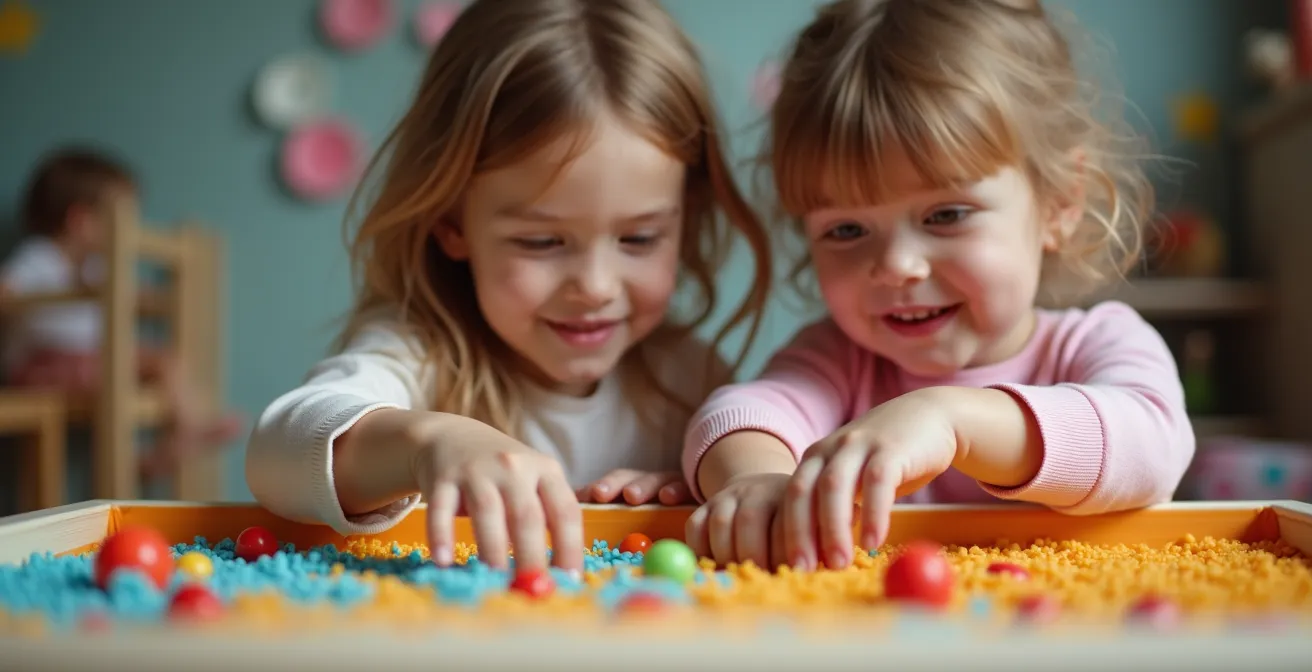
The intensity of the environment is just as important as the duration. As the “traffic jam” analogy from pediatric experts explains, sensory overstimulation occurs when the brain receives more information from the senses than it can effectively process, triggering the body’s stress response. A shorter, calmer party with structured activities, as shown in the image, is far more manageable than a long, chaotic one. For sensory-sensitive children, experts suggest that a party length of 60 to 90 minutes is the recommended maximum to prevent this “traffic jam” in the brain.
When you send out invitations, clearly stating the start and end times manages expectations for other parents and gives you a natural, pre-planned conclusion to the event. This simple structural element is one of the most effective tools for preventing overload.
Speed Games: Do They Help or Hinder Anxious Children?
Games involving speed can be a double-edged sword for anxious or sensory-sensitive children. On one hand, the fast pace and competitive pressure can quickly trigger a stress response, leading to frustration or withdrawal. The fear of not being fast enough, or of losing, can be intensely dysregulating. On the other hand, certain types of fast-paced activities, when structured correctly, can provide valuable proprioceptive and vestibular input—the deep-pressure and movement sensations that can be incredibly organizing and calming for the nervous system.
The deciding factor is the game’s structure and goal. Competitive speed games, where children are pitted against each other, are generally high-risk. However, collaborative speed games, where a team works together against a timer, can channel energy into teamwork rather than anxiety. Paced action games with a predictable rhythm, like passing a beanbag to a steady beat, can help with impulse control without the pressure of a race. It’s crucial to assess whether a game’s design will trigger a fight-or-flight response or provide a healthy outlet for physical energy.
The following table breaks down the impact of different game types and offers modifications to make them more inclusive for anxious children.
| Game Type | Effect on Anxious Children | Recommended Modifications |
|---|---|---|
| Competitive Speed Games | Triggers stress responses and expressions of agitation, frustration, or fear | Remove competition element |
| Paced Action Games | Can help with impulse control when predictable | Use visual timers and clear structure |
| Collaborative Speed Games | Channels energy into teamwork rather than anxiety | Use timers for structured turns, allow kids to return for multiple turns |
Your Game Selection Checklist: Fostering Fun, Not Fear
- Assess the Goal: Is the primary objective competition (creating winners/losers) or collaboration (achieving a shared outcome)?
- Analyze the Pace: Is the game frantic and unpredictable, or does it have a clear, predictable rhythm and structure for turns?
- Review the Rules: Are the instructions simple and easy to demonstrate visually, or are they complex and require sustained auditory focus?
- Plan for Opt-Outs: Is there a clear, shame-free way for a child to step back and observe or join the cool-down corner if they feel overwhelmed?
- Prepare Calming Transitions: What low-energy, grounding activity is planned immediately following a high-energy game to help the group co-regulate?
Why Tulle Lining Often Causes Tantrums After 30 Minutes?
For many parents, a special party outfit is part of the fun. But for a child with tactile sensitivity, that beautiful, starchy dress or handsome, collared shirt can feel like torture. The constant, irritating sensation of a scratchy fabric, a tight collar, or an intrusive tag is a significant and unrelenting drain on their sensory budget. This isn’t a matter of being “fussy”; it’s a genuine neurological response. For a child with tactile defensiveness, their nervous system interprets non-harmful touch as a threat. What is merely a tag to you can feel like a needle to them.
This discomfort is cumulative. A child might tolerate the outfit for the first 20 or 30 minutes, using up their cognitive resources to ignore the sensation. But as other party stimuli—the noise, the social demands—begin to stack up, their ability to suppress the tactile irritation vanishes. The scratchy tulle lining that was a minor annoyance at the start of the party becomes the final straw that breaks their sensory endurance, leading to a meltdown that seems to come out of nowhere. This phenomenon is surprisingly common; reports indicate that as many as 5-16% of school-aged children, or about 1 in 6 kids, have sensory processing differences that can make clothing a major challenge.
Case Study: When Clothing Overwhelms the System
According to experts at the Cleveland Clinic, children with high sensory sensitivity process tactile input differently. For them, the combined sensations of a long-sleeved shirt, a specific fabric, and a tag can be overwhelming. This constant barrage of information from the skin can lead to a state of overload that essentially freezes up their “mental computer screen,” making it impossible for them to process any other information or regulate their emotions.
The solution is to prioritize comfort over style. Opt for soft, familiar fabrics. Cut out all tags. If a special outfit is a must, try to have the child wear a soft, comfortable layer underneath it. Or, consider having them wear the special outfit just for photos and then change into their “play clothes.” Acknowledging and accommodating tactile sensitivity is a simple but profoundly effective way to conserve a child’s precious sensory budget.
Key Takeaways
- Meltdowns are a physiological response to sensory overload, not a behavioral choice.
- Proactive environmental design, such as creating a “cool-down corner,” is more effective than reactive discipline.
- The timing of a party’s duration (60-90 minutes) and when you serve sugar are critical factors in preventing overload.
How to Choose Interactive Games That Teach Cooperation Instead of Competition?
The ultimate goal of a sensory-friendly party is to create an environment where all children feel safe, included, and successful. The choice of games is central to achieving this. By intentionally selecting activities that promote cooperation, you not only reduce the social stress that can lead to meltdowns, but you also actively teach valuable social-emotional skills. Cooperative games shift the focus from individual victory to shared goals, fostering a sense of community and mutual support among the little guests.
Great cooperative games often have an open-ended structure. Setting up a large mural-painting station where everyone adds to the same picture, or a collaborative block-building project to create the “tallest tower ever,” encourages teamwork without the pressure of a single winner. Sensory bins filled with calming textures like rice or dried beans invite parallel play, where children can enjoy an activity side-by-side without the demand for complex interaction. Even a classic like a dance party can be made more inclusive by using mindful, instrumental music and framing it as a “movement break” for everyone to release energy together.
This focus on cooperative play is especially important given that early sensory processing patterns are strongly linked to later behavioral outcomes. An authoritative study from the University of Southern California (USC) found that for the 3% of children with elevated sensory traits that worsen over time, significant behavioral challenges at school age were common. Proactively creating positive, low-stress social experiences through cooperative play can be a foundational support for these children.
Ultimately, a successful party isn’t measured by how elaborate the games are, but by how many children leave feeling happy and successful. By choosing cooperation, you are architecting an experience that builds confidence and connection for everyone involved.
By shifting your focus from managing behavior to managing the environment, you can turn potentially stressful parties into joyful, connecting experiences. The next logical step is to start planning your child’s next event with these sensory-friendly principles in mind.