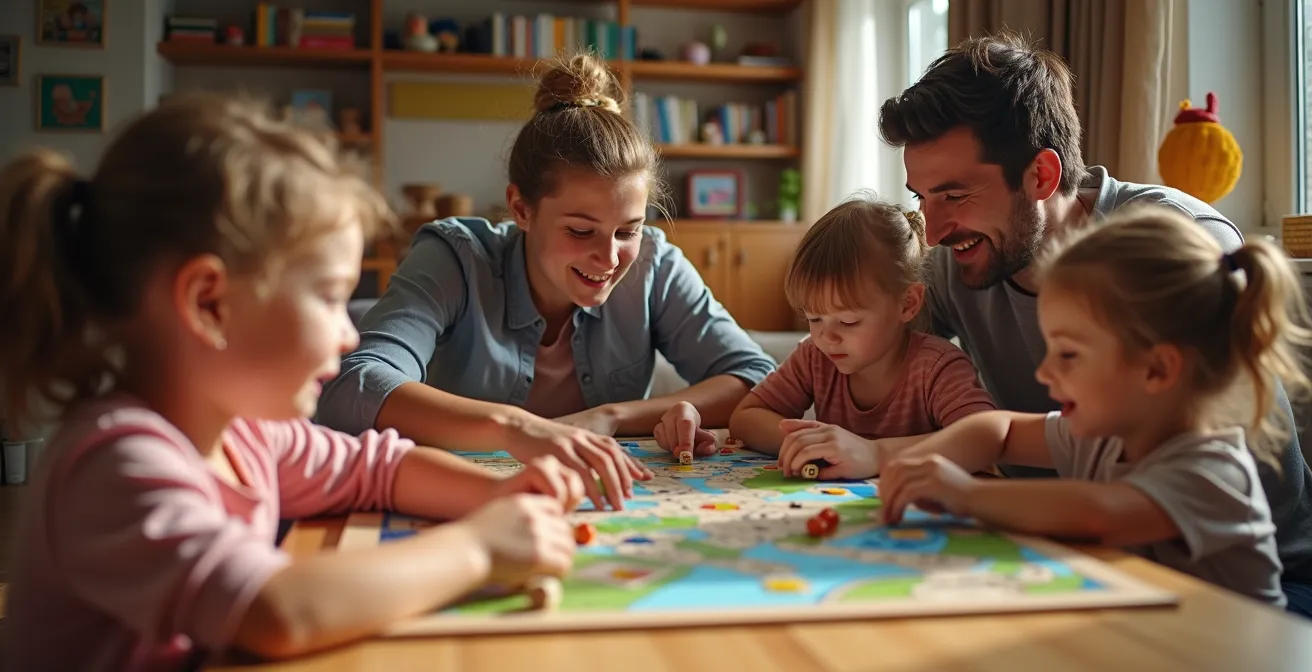
The secret to a successful family game night isn’t finding the “perfect” game, but becoming a “Game Night Architect” who actively shapes the experience.
- Cooperative games are the ideal starting point to build teamwork and eliminate the “sore loser” problem.
- Simple, dynamic handicaps can level the playing field, allowing a 5-year-old to compete meaningfully with a 10-year-old and an adult.
Recommendation: Instead of just enforcing rules, start modifying them. Simplify objectives for younger players or give them extra resources to create a fun and balanced challenge for everyone.
If the thought of playing another round of “Candy Land” makes you want to feign a headache, you’re not alone. The family shelf is often a graveyard of brightly colored boxes promising “fun for all ages,” yet delivering a mind-numbing experience for any player over the age of eight. Parents crave connection, but they also crave mental stimulation. The common advice is to just find better games, leading to an endless search for that one magical box that will please a 4-year-old, a 10-year-old, and two tired adults simultaneously. This quest is often fruitless.
The assumption is that the game itself is the solution. We look for titles with clever themes or supposedly simple-yet-deep mechanics. But what if this entire approach is flawed? The real key to transforming game night from a chore into a cherished, intellectually engaging ritual isn’t in what you play, but how you play. It’s about shifting your role from a mere rules-enforcer to a “Game Night Architect”—a designer of experiences. This means learning to see games not as rigid sets of instructions, but as flexible systems you can tweak, modify, and curate to fit your family’s unique dynamic.
This guide will not just give you a list of games. It will give you a strategic framework. We will explore how to use specific game mechanics to teach valuable skills, why starting with cooperative games is a non-negotiable first step, and how to master the art of rule modification. You’ll learn to become the kind of game master who can ensure every player, from the preschooler to the parent, is not just present, but deeply and happily engaged.
text
This article provides a comprehensive look at the strategies and mindset needed to elevate your family game nights. Below is a summary of the key topics we will cover to help you architect more engaging and stimulating experiences for everyone at the table.
Summary: The Parent’s Playbook for Genuinely Fun Family Game Nights
- How “Catan Junior” Teaches Trade and Negotiation to 6-Year-Olds?
- The “Cooperative First” Strategy: Why Start With Games You Win Together?
- Legacy Games: Are They Worth the Money for One-Time Campaigns?
- How to Handicap a Game so a 5-Year-Old Can Beat a 10-Year-Old?
- Short vs. Long Games: Which Fits Best on a School Night?
- How to Modify Rules So a 4-Year-Old and 8-Year-Old Can Play Together?
- How Long Should a Toddler Party Last Before Behavior Deteriorates?
- How Card Games Improve Math Skills Faster Than Drills?
How “Catan Junior” Teaches Trade and Negotiation to 6-Year-Olds?
Many parents dismiss “junior” versions of popular strategy games as overly simplified cash-ins. However, a game like Catan Junior is a brilliant training ground for complex life skills, disguised as a hunt for pirate treasure. Its core genius lies in how it isolates and teaches the fundamental concept of negotiation through resource trading. Unlike adult Catan, the market mechanism is fixed, providing a predictable “safety net” for trades. This allows a six-year-old to focus on the most important part: articulating their needs (“I need wood!”) and evaluating offers from other players.
The game’s design naturally encourages communication and critical thinking. To build a pirate lair, a child must assess their own resources, predict what they might acquire, and persuade a sibling to make a mutually beneficial deal. This is strategic scaffolding at its best. As one analysis of its mechanics points out, managing the emotions of a failed trade can be a challenge, but it’s also a crucial learning opportunity. The game teaches that forming alliances is a direct path to advancing your position.
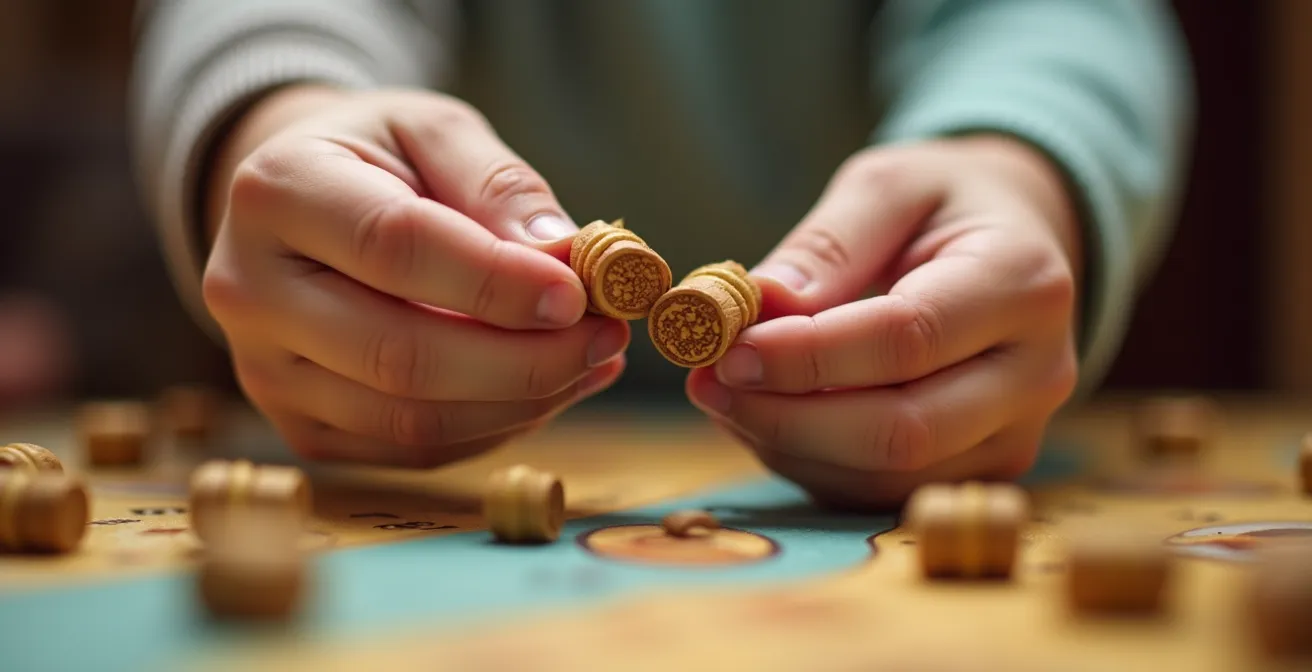
As you can see in the moment of exchange, the tactile nature of the pieces makes the abstract concept of a “deal” concrete. The game isn’t just teaching them to barter; it’s teaching them to see the world from another player’s perspective to find a win-win scenario. An analysis on the subject highlights this educational power perfectly.
In Catan Junior, children learn negotiation through trading resources, with the game encouraging communication skills as young players articulate their needs and offers. The game develops critical thinking by requiring players to strategize based on changing game states and predict opponents’ moves.
– Elemfun, Board Games for Eight-Year-Olds
By framing these interactions within a fun, low-stakes game, you’re giving your child a playbook for real-world negotiation that no lecture could ever provide.
The “Cooperative First” Strategy: Why Start With Games You Win Together?
The instinct for many families is to jump directly into competitive games, which often ends in tears for younger players and frustration for older ones. The “Cooperative First” strategy offers a powerful alternative: deliberately beginning your family’s gaming journey with titles where everyone plays on the same team against the game itself. This isn’t about avoiding competition forever; it’s about building a foundation of teamwork and positive association with game night. The market is responding to this need, with research showing a massive 20 million unit increase in cooperative board game sales in 2024.
The primary benefit of cooperative play is the removal of interpersonal conflict. When you all win or lose together, the dreaded “sore loser” or “poor winner” syndromes vanish. This creates a psychologically safe space where the focus shifts from individual victory to collective problem-solving. It’s in this environment that true strategic scaffolding can occur. As an adult, you are not an opponent; you are a coach. Because everyone is working toward the same goal, you can openly discuss strategy, model logical thinking, and guide younger players without it feeling like cheating.
Games with open information, where all players’ cards or resources are visible, are particularly effective. This allows for transparent coaching moments. You can ask leading questions like, “I see you have a card that could help us here. What do you think would happen if you played it now?” This process empowers children to make smart decisions while feeling like a valued member of the team. It transforms game night from a battle of wits into a collaborative learning lab, making the shared journey more important than the outcome.
By starting here, you teach the most important lesson of all: the ultimate goal of game night is not to win, but to have fun together.
Legacy Games: Are They Worth the Money for One-Time Campaigns?
The sticker shock on a “Legacy” game—a game that evolves as you play, with permanent changes like stickers added to the board and cards being torn up—can be a major deterrent for families. Why spend $80 on a game you can only “finish” once? The key is to shift your mindset from “cost of a product” to “cost of an experience.” When viewed through the lens of experience-per-dollar, these games often provide incredible value, delivering a 15-20 hour narrative journey that unfolds over weeks or months.
Unlike a traditional board game that offers the same experience every time, a legacy game tells a unique story starring your family. Each session ends on a cliffhanger, building anticipation for the next “chapter.” This transforms game night into a can’t-miss event, much like a favorite weekly TV show. The permanent changes you make to the game components become artifacts of your shared adventure, creating a tangible record of your family’s specific story. The completed game board can even become a piece of family art—a memento of your collective triumph (or failure).
To determine if the investment is right for your family, a direct comparison is helpful. This analysis is based on market trends and common game structures, as detailed in research on board game sales statistics.
| Aspect | Legacy Games | Traditional Board Games |
|---|---|---|
| Average Playtime | 10-20+ hours total campaign | 1-2 hours per session |
| Cost Range | $50-100 | $30-60 |
| Replayability | One complete campaign | Unlimited replays |
| Experience Type | Evolving narrative with permanent changes | Same experience each play |
| Memory Creation | Unique family story and artifacts | Individual game memories |
Your Action Plan: Maximizing Legacy Game Value
- Commitment Check: Before buying, get everyone to agree on a regular schedule (e.g., every Friday night) to maintain story momentum. Treat it like a season of a show.
- Document the Journey: Take a photo after each session. Note down funny quotes or brilliant moves. Create a simple “campaign diary” to enhance the memory-making.
- Embrace the Destruction: The act of permanently altering the game is part of the magic. Let the kids rip the card or place the sticker. It gives their choices weight and consequence.
- Calculate “Experience-Per-Dollar”: Divide the game’s cost by the estimated hours of play. Compare this to other family outings like movies or bowling. You’ll often find the value is superior.
- Plan a Finale: For the last session, make it an event. Order pizza, play some thematic music, and celebrate the conclusion of your family’s unique story.
For families that can commit, a legacy game isn’t just a purchase; it’s an investment in a deep, memorable, and entirely unique shared experience.
How to Handicap a Game so a 5-Year-Old Can Beat a 10-Year-Old?
The greatest challenge in mixed-age gaming is the skill gap. A 10-year-old’s developing strategic mind will almost always crush a 5-year-old’s more random approach, leading to frustration and disengagement. The solution is dynamic handicapping, an artful way of balancing the game not just at the start, but throughout play. It’s about creating equity, not just equality. Between the ages of eight and ten, kids rapidly improve at using logic and strategy, making these adjustments essential for family harmony.
This goes beyond simply letting the younger child win. It’s about giving them the tools to compete meaningfully. The goal is for the 10-year-old to still feel challenged while the 5-year-old feels empowered. One of the best techniques is to reframe the handicap as a “Challenge Mode” for the older player. Instead of saying, “You have to play with fewer resources,” you say, “You’re playing on ‘Hard Mode’ because you’re such a great player!” This appeals to their sense of pride and fairness.
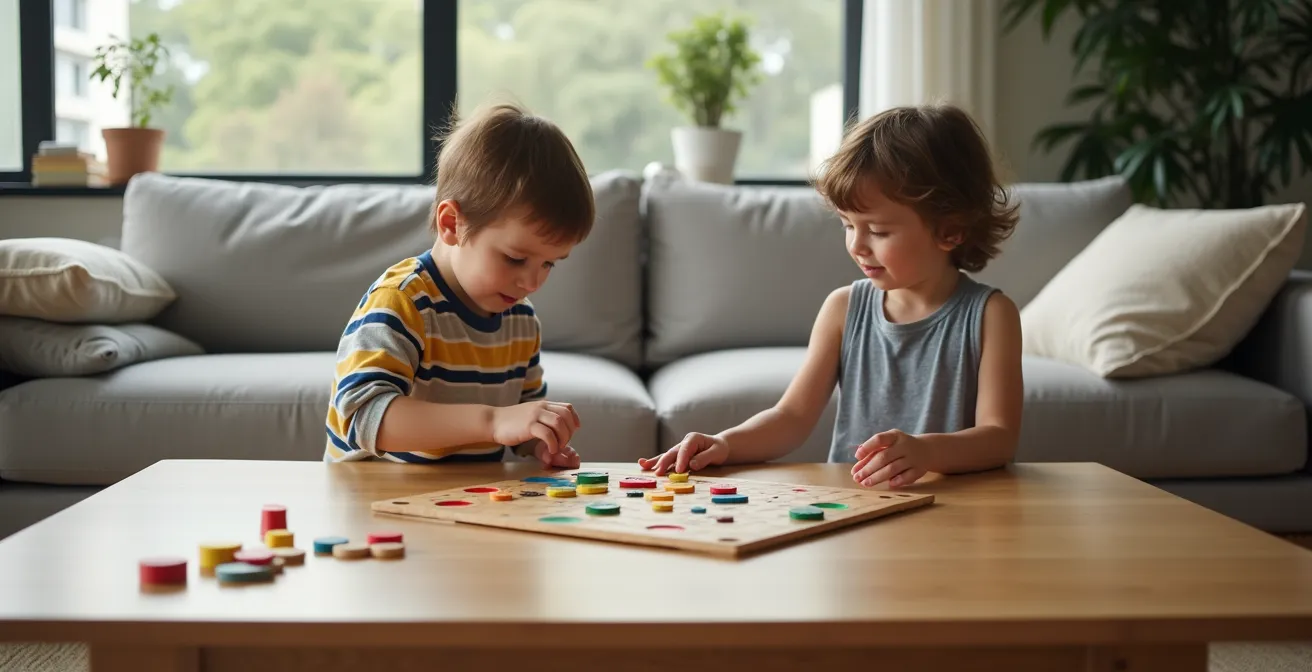
Effective handicapping can be implemented in many ways. You might give the younger player simplified victory conditions (e.g., “You only need to collect 3 gems instead of 5”) or give them extra resources at the start of the game. Another powerful method is to adjust the available components based on age. Here are some concrete strategies:
- Varying Card Sets: In a number-based game, a preschooler might only use cards 0-5, while an older child uses the full 0-20 deck.
- Resource Buffs: Give the younger player one extra resource token or card draw each turn.
- Goal Simplification: The older player needs to complete three objectives to win; the younger player only needs one.
- ‘Challenge Mode’ Nerfs: The older player cannot use a specific powerful location on the board or must pay an extra cost for certain actions.
By becoming a skilled handicapper, you transform a potentially unbalanced competition into a tailored, engaging experience where every player has a real shot at victory.
Short vs. Long Games: Which Fits Best on a School Night?
A crucial part of being a Game Night Architect is logistics, and the most common hurdle is time. The epic 90-minute strategy game you love is a non-starter on a Tuesday night with homework and an early bedtime looming. Choosing the right game length for the occasion is critical to preventing fatigue and ensuring game night remains a joy, not a source of stress. The decision isn’t just about total playtime, but also setup time and cognitive load—the amount of mental energy a game demands.
On a busy school night, the ideal game takes less than 5 minutes to set up and under 30 minutes to play. The cognitive load should be low to medium, focusing on quick decisions, luck, and social interaction rather than deep, multi-turn strategy. Games like King of Tokyo or Sleeping Queens are perfect examples. They provide meaningful choices and exciting moments without requiring the intense focus of a heavier game. These “filler” games are the workhorses of a consistent game night routine.
Longer, more complex games should be reserved for weekends or holidays. These are your “event” games, where you can afford the 10+ minute setup and hour-long playtime. This deliberate scheduling manages expectations and energy levels for everyone. The following guide, based on analysis from game reviewers, can help you curate your collection for any calendar slot.
| Game Length | Best For | Setup Time | Cognitive Load | Examples |
|---|---|---|---|---|
| 5-15 minutes | Weeknight after homework | <2 minutes | Low | The Mind, Taco Cat Goat Cheese Pizza |
| 20-30 minutes | Early evening school night | 2-5 minutes | Medium | Sleeping Queens, King of Tokyo |
| 45-60 minutes | Friday evening/Weekend | 5-10 minutes | High | Ticket to Ride, Catan Junior |
| 60+ minutes | Weekend afternoon | 10+ minutes | Very High | Pandemic, Legacy games |
By being realistic about the time and mental energy you have, you ensure that game night finishes on a high note, leaving everyone eager for the next one.
How to Modify Rules So a 4-Year-Old and 8-Year-Old Can Play Together?
When you have a significant age gap, like a 4-year-old and an 8-year-old, even handicapping might not be enough. This is where you level up to active rule modification. The key principle is: “Simplify, Don’t Eliminate.” Instead of removing a complex rule entirely, find its core purpose and create a simpler version for the younger player. If a rule involves complex point calculation, change the goal for the 4-year-old to something tangible, like being the first to collect one of each resource type.
One of the most effective strategies is to create specialized roles. The 4-year-old might not be ready for deep strategy, but they can be the official “Dice Master” who rolls for everyone, or the “Banker” in charge of handing out resources. This keeps them engaged, feeling important, and learning the flow of the game without the pressure of making optimal strategic choices. Another great option is team play: pairing the parent with the 4-year-old against the 8-year-old creates a natural balance of skill.
For many games, especially those with direct conflict, a simple modification can save the night. Removing “take that” cards that allow players to steal from or penalize others is a great way to reduce frustration for younger players who take such moves personally. Consider these modifications for your toolkit:
- The Sidekick Role: The younger child is officially an “assistant” to an older player, helping them track resources or move their piece. They learn by watching.
- Remove Negative Actions: Take out all cards or actions that directly harm another player. Focus the game on building and achieving goals.
- Simplify Win Conditions: Instead of tracking victory points, create a simple, visual goal. “First to build a road from here to here wins!”
- Use Team Play: An adult and younger child team up. The adult can talk through their strategic thoughts out loud, providing a running commentary of “why” they’re making certain moves.
By tailoring the rules, you aren’t “dumbing down” the game; you’re personalizing the challenge to make it compelling for every single person at the table.
How Long Should a Toddler Party Last Before Behavior Deteriorates?
While the title suggests a party, this question holds the key to a successful family game night: knowing when to stop. Every parent has seen it—the moment when fun curdles into frustration. Recognizing the fun-to-frustration tipping point is arguably the most critical skill for a Game Night Architect. A game that ends on a high note, even if unfinished, leaves a positive memory that builds excitement for the next one. A game that drags on until a meltdown occurs can poison the well for weeks.
Younger children, in particular, have finite reserves of focus and emotional regulation. It’s your job to watch for the subtle cues that signal cognitive fatigue, long before the tears start. Is the child who was previously engrossed now more interested in stacking the game pieces into a tower? That’s a sign of disengagement. Are they starting to wiggle, ask “is it my turn?” every 30 seconds, or let out a “frustration yawn”? These are clear indicators that their brain is overloaded and it’s time to graciously wrap things up.
One of the best strategies is to “call the game” after a particularly joyful or exciting moment. If your youngest just made a brilliant move that put them in the lead, you can say, “What an amazing move! That’s a perfect high point to end on for tonight. Let’s write down the scores and pick this up next time!” This preserves their feeling of success and freezes the game in a positive state. A stunning 96% of families who play games together report feeling closer, and protecting that positive feeling is paramount. Don’t let the rigid goal of “finishing the game” undermine the real goal: family bonding.
Ending a game 15 minutes early with everyone smiling is an infinitely greater success than finishing it an hour later with someone crying.
Key Takeaways
- Shift your role from player to “Game Night Architect,” actively designing the experience.
- Use cooperative games as a foundation to build teamwork before introducing competition.
- Master dynamic handicapping and rule modification to create a balanced and engaging challenge for all ages.
How Card Games Improve Math Skills Faster Than Drills?
For many parents, the educational benefit of board games is a happy accident. But the truth is far more powerful: certain games, especially card games, are a more effective tool for teaching mathematical fluency than traditional drills. The reason is simple: games provide context, motivation, and a direct application for skills. A flashcard asks a child to solve “8 + 5.” A game like Sleeping Queens asks them to figure out if they can wake the ’13’ queen with their ‘8’ and ‘5’ cards, a far more compelling proposition.
Research confirms that this “gamified” learning is incredibly sticky. Studies show that numerical card games significantly improve foundational math skills like numeral identification and symbolic magnitude comparison. More importantly, these benefits are not fleeting; they have been shown to persist for at least eight weeks after the games are played, demonstrating true, enduring learning. The games also enhance crucial executive functions like working memory and cognitive flexibility, as children have to hold numbers in their heads and adapt their strategies.
The beauty of this approach is that you can target specific skills with different games. By curating a small collection of card games, you can create a powerful, fun-filled math curriculum without your kids even realizing they’re “learning.” It’s the ultimate synthesis of fun and function, turning a core academic subject into an exciting challenge.
- Addition/Subtraction: Games like Sleeping Queens or Zeus on the Loose require constant, quick addition to reach target numbers.
- Probability: Simple dice games like Farkle or card games like Monopoly Deal teach risk assessment in a tangible way.
- Number Sequencing: A classic game like Rack-O is entirely built around the skill of ordering numbers.
- Basic Multiplication: Fast-paced games like SMACK IT! turn times tables practice into a reflex-based competition.
By integrating these games into your routine, you’re not just creating a fun family activity; you’re deploying a proven educational tool that will give your children a lasting advantage in their mathematical journey.