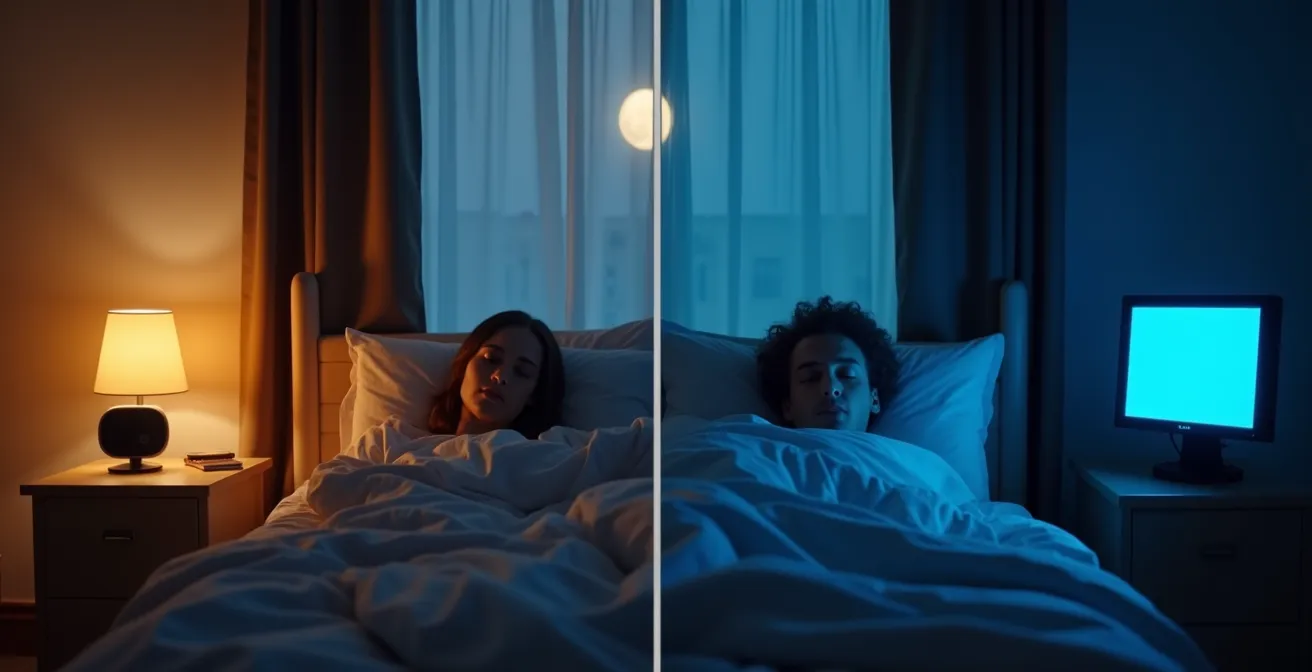
Contrary to popular belief, seeing your baby isn’t the key to reducing parental anxiety; the secret is managing your personal ‘data-to-anxiety’ ratio.
- High-definition video can disrupt parental sleep cycles through blue light exposure and trigger over-analysis of normal baby movements.
- Secure, audio-only (DECT) monitors often provide sufficient reassurance without the cognitive load or the significant cybersecurity risks associated with WiFi models.
Recommendation: Choose the technology that delivers just enough data to calm you, not so much that it feeds your anxiety. The goal is confident reassurance, not constant surveillance.
The soft glow of a video monitor screen at 3 AM has become a modern symbol of parenthood. It promises peace of mind, a constant visual connection to the most precious person in your life. The conventional wisdom is clear: seeing is believing, and therefore, a video monitor must be better than a simple audio one for soothing parental anxiety. We buy the tech, set it up, and prepare for a new level of reassurance, believing more information will make us feel safer.
But what if this assumption is flawed? For many new parents, the constant stream of high-definition data does the opposite. Instead of soothing, it amplifies. Every twitch, every snuffle, every shift in the crib becomes a potential threat to be analyzed. This is where we must move beyond a simple feature comparison and into the psychology of monitoring. The critical question isn’t “Which monitor has a better camera?” but “Which technology best supports a parent’s mental well-being?”
The key lies in understanding and managing your personal ‘data-to-anxiety’ ratio. This is the delicate balance between receiving enough information to feel reassured and being overwhelmed by data that triggers your brain’s threat-detection system. Too little data can lead to anxiety of the unknown, but too much data can create anxiety from over-analysis and hyper-vigilance.
This article will deconstruct the technology not by its specs, but by its psychological and physiological impact. We will explore how video screens can directly disrupt your sleep, why security is more than just a password, and when the most reassuring act is to finally trust the silence. We will equip you to make a choice that serves not just your baby’s safety, but your own sanity.
To navigate this complex decision, this guide breaks down the key factors that influence parental anxiety, from the technology’s impact on your sleep to the practicalities of daily use. Explore the sections below to build a monitoring strategy that truly brings you peace.
Summary: Audio vs. Video Monitors: Which Reduces Parental Anxiety More Effectively?
- Why Video Monitor Screens Disrupt Parental Sleep Cycles?
- How to Secure Your Wifi Monitor Against Unauthorized Access?
- Breathing Mats: Do They Prevent SIDS or Just Create False Alarms?
- Long Range vs. Wifi: Which Is Reliable for Thick Walls and Basements?
- When to Stop Monitoring: Signs You Are Ready to Trust the Silence
- Zip-Up Onesies or Separates: Which Makes 3 AM Diaper Changes Faster?
- Why Standard Cotton Pesticide Residues Trigger Nighttime Itching?
- How to Keep a Baby’s Head Warm Without Overheating During Car Rides?
Why Video Monitor Screens Disrupt Parental Sleep Cycles?
The promise of a video monitor is reassurance through sight, but this constant visual access comes at a hidden physiological cost. The primary culprit is the blue light emitted from the parent unit’s screen. When you glance at that screen in the middle of the night, you’re sending a powerful signal to your brain that mimics daylight. This exposure suppresses the production of melatonin, the hormone that regulates your sleep-wake cycle. The result is a lighter, more fragmented sleep for you, even if your baby is sleeping soundly. You wake up feeling less rested, which in turn can heighten feelings of anxiety and reduce your emotional resilience for the day ahead.
Beyond the biology, there’s the psychological impact. A high-definition video feed encourages a state of hyper-vigilance. Instead of simply being alerted to a cry, you are now tasked with interpreting every minor movement, shadow, and sound. Is that a normal sleep twitch or a sign of distress? This continuous analysis increases your cognitive load, keeping your mind active and preventing you from entering the deep, restorative stages of sleep. The technology designed to help you rest becomes the very thing that prevents it, creating a feedback loop where poor sleep fuels next-day anxiety, which makes it even harder to sleep the following night.
Action Plan: Minimize Video Monitor Sleep Disruption
- Set a technology curfew: Turn off the video screen or switch your monitor to audio-only mode at least 1 hour before your own bedtime.
- Use blue light filters: Apply a physical screen filter or activate the monitor’s built-in “night mode” to reduce blue light emissions after sunset.
- Position the monitor away from your bed: Place the parent unit at least 3 feet from your sleeping position to reduce the temptation for constant checking.
- Adjust brightness settings: Lower the screen’s brightness to the minimum level needed for a quick check, rather than keeping it at full intensity.
- Schedule check-in times: Resist the urge for continuous monitoring. If you must check, set specific times (e.g., once before you fall asleep) and trust the audio alerts for the rest of the night.
How to Secure Your Wifi Monitor Against Unauthorized Access?
While managing your own anxiety is crucial, the fear of a hacked baby monitor introduces an external threat that can feel overwhelming. WiFi-enabled monitors, which transmit video over your home internet network, are inherently more vulnerable than their non-internet-connected counterparts. The convenience of checking on your baby from your phone anywhere in the world comes with a significant security trade-off. In fact, the threat is growing; a recent report indicated a 300% increase in smart baby monitor hacks, with over 170,000 devices targeted. This isn’t just a theoretical risk; it’s an active and escalating problem.
The alternative technology is a closed-loop system, often using DECT (Digital Enhanced Cordless Telecommunications) or FHSS (Frequency-Hopping Spread Spectrum). These monitors create a private, encrypted connection directly between the baby unit and the parent unit. They do not connect to the internet, making remote hacking virtually impossible. An intruder would need to be physically near your home with sophisticated equipment to even attempt to intercept the signal. This fundamental difference in architecture is the single most important factor in monitor security.
This illustration highlights the conceptual difference between an open, internet-facing network and a secure, closed-loop system for protecting your family’s privacy.
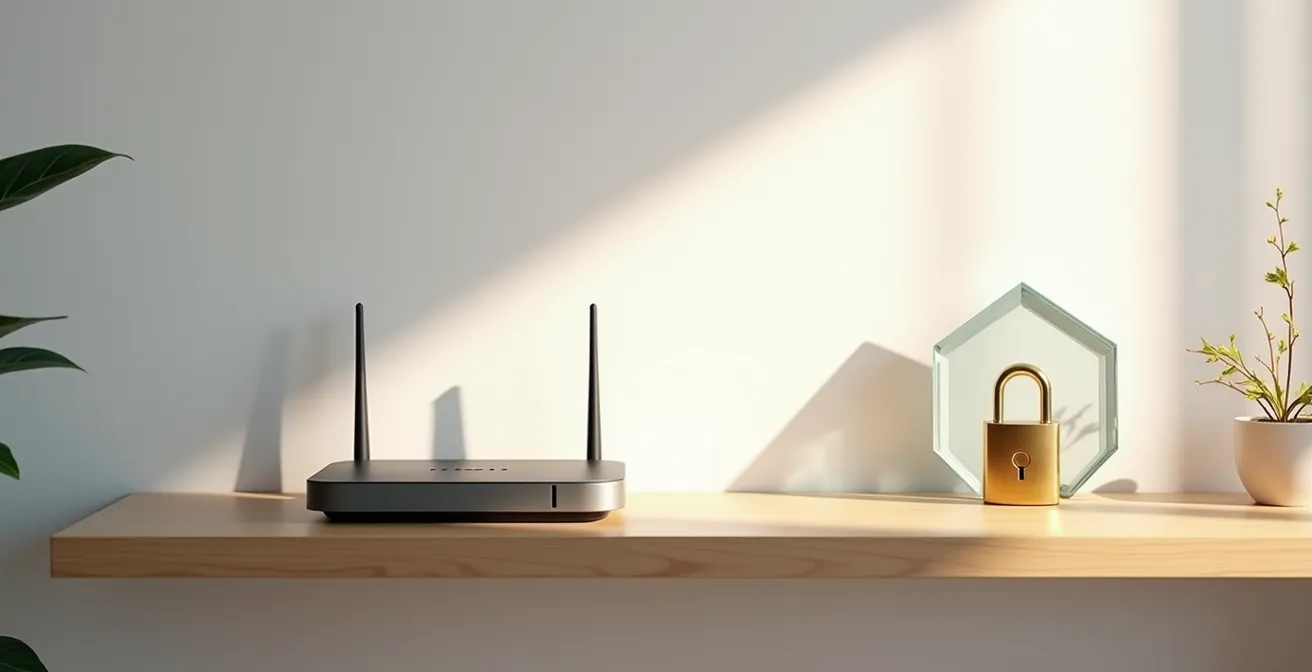
For parents whose primary anxiety is external threats and privacy invasion, the choice is clear. A non-WiFi monitor eliminates an entire category of risk, reducing the ‘data-to-anxiety’ ratio by removing the need to worry about unseen digital intruders. The table below breaks down the key security differences.
| Feature | WiFi Monitors | DECT/FHSS Monitors |
|---|---|---|
| Remote Hacking Risk | Vulnerable if unsecured | Nearly impossible |
| Required Security Measures | Strong passwords, 2FA, firmware updates | None beyond physical security |
| Frequency Hopping | Not applicable | Changes frequency milliseconds |
| Internet Dependency | Yes | No |
| Hack Detection Time | Average 47 days undetected | Requires physical proximity |
Breathing Mats: Do They Prevent SIDS or Just Create False Alarms?
In the quest to mitigate every possible risk, many parents turn to high-tech breathing and movement monitors, such as under-the-mattress mats or smart socks. These devices promise to alert you if your baby stops breathing, seemingly offering the ultimate safety net against Sudden Infant Death Syndrome (SIDS). However, the medical community is unequivocal on this point: these consumer-grade devices do not prevent SIDS, and relying on them can create a false sense of security while actively increasing parental anxiety.
The highest authority on child safety, the American Academy of Pediatrics, has consistently advised against their use for SIDS prevention. Their official guidance is a crucial piece of information for any anxious parent considering these products. As they stated in their most recent recommendations:
Home cardiorespiratory monitors should not be used as a preventive measure for SIDS because there is no evidence supporting their effectiveness in reducing the risk of sudden and unexpected death.
– American Academy of Pediatrics, 2022 Safe Sleep Recommendations
The core problem is two-fold: a lack of accuracy and the high rate of false alarms. These devices are not medical-grade equipment. Their sensors can be unreliable, leading to terrifying alarms that send parents into a panic, only to find their baby is perfectly fine. This has a significant negative impact on the ‘data-to-anxiety’ ratio, delivering high-stress, low-accuracy data that erodes parental confidence and can lead to unnecessary emergency room visits.
Case Study: JAMA Study on Consumer Baby Monitor Accuracy
The danger of this false reassurance was quantified in a landmark 2018 study. Research published in the Journal of the American Medical Association examined consumer-grade baby monitors designed to track vital signs. The study found they do not accurately measure oxygen or heart rates. Researchers concluded these devices provide parents with a false sense of security while causing unnecessary anxiety through frequent false alarms, which in turn led to unwarranted hospital visits for perfectly healthy babies. The real prevention for SIDS lies in following safe sleep practices: placing the baby on their back, in their own sleep space, with a firm mattress and no soft bedding.
Long Range vs. Wifi: Which Is Reliable for Thick Walls and Basements?
A monitor is only as good as its connection. For parents living in larger homes, older houses with thick plaster walls, or multi-story residences, signal reliability becomes a primary source of anxiety. A dropped connection in the middle of the night can be just as jarring as a real alarm. This is another area where WiFi and dedicated DECT/FHSS monitors differ significantly in their performance. WiFi monitors are entirely dependent on the strength and stability of your home’s wireless network. Dead zones in a basement, a detached garage, or a backyard are common, and these will be dead zones for your monitor as well.
This conceptual illustration shows how different materials and distances within a home can create stronger or weaker signal zones, affecting monitor reliability.

In contrast, long-range audio monitors using DECT technology are specifically engineered for this challenge. They operate on a protected, low-frequency band (around 1.9 GHz) that is excellent at penetrating solid objects like concrete and plaster. Because they create their own dedicated point-to-point connection, they are not competing with your laptops, smart TVs, and phones for bandwidth. This results in a much more stable and reliable signal over long distances and through challenging materials. For a parent who needs to be in the garden or the basement while the baby sleeps upstairs, the reliability of a long-range DECT monitor often provides far more practical peace of mind than a WiFi monitor with theoretically “unlimited” but practically unstable range.
When to Stop Monitoring: Signs You Are Ready to Trust the Silence
Perhaps the most overlooked aspect of using a baby monitor is the exit strategy. The technology that feels indispensable in the newborn phase can slowly become a source of prolonged anxiety, tethering parents to their child’s sleep long after it’s necessary. The goal of parenting is to foster independence in our children, but we must also foster our own independence from the need for constant surveillance. Continuing to monitor a toddler or preschooler can interfere with their development of self-soothing skills and perpetuate a parent’s own sleep disruption and anxiety.
Recognizing you’re ready to stop is a process. Key signs include your child consistently sleeping through the night, being old enough to call for you or get out of bed on their own if they need you, and, most importantly, your own growing realization that the monitor is causing more stress than it relieves. It can feel like a crutch that you’re afraid to let go of, as one parent powerfully described:
My partner and I only just ditched our baby monitor a few weeks ago, and our son is nearing 6 years old. It wasn’t that I needed it, but it was a safety net and a ‘just-in-case’ that I was in no way rushing to say goodbye to. Honestly, it was the only thing that made me feel like I could save my children should something go wrong at night, and my anxiety worsened because of it.
– Parent, Romper
Transitioning away from the monitor should be a gradual process, allowing both you and your child to adjust. It’s about rebuilding trust—trust in your child’s ability to sleep safely and trust in your own ability to parent without constant technological oversight. The following plan can help you wean yourself off the monitor and reclaim your nights.
Your Checklist: The Parent Weaning Protocol
- Week 1: Switch from video to audio-only monitoring during nighttime hours to reduce visual stimulation.
- Week 2: Lower the monitor’s volume by 50% and consciously increase your response time before checking on non-distress sounds.
- Week 3: Turn the monitor off completely but keep it accessible nearby for ’emergency’ use if your anxiety spikes.
- Week 4: Remove the monitor from your bedroom entirely. Conduct confidence check-ins (physically walking to their room) before you go to bed, but otherwise trust the silence.
- Bonus Week 5: Acknowledge and celebrate your successful transition. Pay attention to your own improved sleep quality and reduced nighttime anxiety.
Zip-Up Onesies or Separates: Which Makes 3 AM Diaper Changes Faster?
Managing parental anxiety isn’t just about the big fears; it’s also about reducing the small, friction-filled moments that accumulate into stress. A 3 AM diaper change is a perfect example. Fumbling with tiny snaps in the dark, with a crying baby, under the dim glow of a monitor screen, can quickly elevate your stress levels. This is where we can apply the concept of reducing cognitive load. The best choice of clothing is the one that requires the least amount of thought and dexterity when you are sleep-deprived.
While separates (a top and bottom) might seem practical, they often involve pulling clothing over a baby’s head or wrestling with a waistband, which can fully wake a drowsy infant. Snap onesies are notoriously difficult, as aligning the snaps correctly in low light is a challenge for even the most coordinated parent. This leaves the zip-up onesie, particularly those with a two-way zipper, as the clear winner for nighttime efficiency. It allows you to access the diaper with a single, simple motion, minimizing disruption for the baby and cognitive load for the parent.
Choosing the right tool for the job—in this case, the right pajamas—is a form of proactive reassurance. It’s one less thing to struggle with in the dead of night, contributing to a calmer experience for everyone. The following comparison breaks down the key differences in nighttime usability.
| Feature | Zip-Up Onesies | Snap Onesies | Separates |
|---|---|---|---|
| Time to Change (3 AM) | 30-45 seconds | 60-90 seconds | 45-60 seconds |
| Fumbling Risk in Dark | Low | High | Medium |
| Baby Wake Risk | Minimal | Moderate | High |
| Parent Cognitive Load | Lowest | Highest | Medium |
| Works with Monitor Light | Excellent | Poor | Fair |
Why Standard Cotton Pesticide Residues Trigger Nighttime Itching?
Sometimes, a parent’s anxiety is fueled by ‘mystery’ issues detected on the monitor. A baby who seems restless, fusses intermittently, or cries without an obvious cause can send a parent down a rabbit hole of worry. Before assuming the cause is a major health issue, it’s critical to consider the most immediate environmental factor: what is touching the baby’s skin? Standard, non-organic cotton is one of the most pesticide-intensive crops in the world. Even after processing, residual chemicals can remain in the fabric. A baby’s skin is significantly thinner and more permeable than an adult’s, making it highly sensitive to these potential irritants.
This low-grade skin irritation can manifest as nighttime itching, restlessness, and unexplained crying—all of which look alarming on a video monitor. This is a prime example where the monitor is accurately reporting a problem, but the solution isn’t more monitoring; it’s proactive reassurance through environmental changes. Switching to certified organic cotton or other natural, untreated fabrics like bamboo can often resolve these issues by removing the source of the irritation. Instead of anxiously watching the screen, you’ve proactively created a more comfortable and non-toxic sleep environment.
Sleep consultants have observed this connection directly in the field. By analyzing monitor data, they can often spot patterns of distress that don’t align with hunger or temperature. According to one analysis of monitor logs, parents who made the switch from conventional to organic cotton sleepwear reported a significant change, noting a 65% reduction in these ‘mystery cry’ episodes within just one week. This demonstrates that focusing on the foundational elements of comfort can be a more effective anxiety-reducer than simply upgrading your surveillance technology.
Key Takeaways
- The “best” monitor is not about video vs. audio; it’s about finding your optimal ‘data-to-anxiety’ ratio to avoid being overwhelmed.
- For security and privacy, non-internet (DECT/FHSS) monitors are fundamentally safer than WiFi-enabled models, which are increasingly targeted by hackers.
- True peace of mind comes from proactive reassurance—creating a safe sleep environment, choosing comfortable materials, and trusting safe sleep practices—rather than reactive surveillance.
How to Keep a Baby’s Head Warm Without Overheating During Car Rides?
Parental anxiety doesn’t stop at the nursery door. The car seat, particularly a rear-facing one, creates a unique “no-visibility situation” that can be highly stressful. You can’t see your baby, you can’t easily check on them, and fears about their temperature—especially overheating—are common. Bulky hats and winter coats are dangerous as they interfere with proper car seat harness fit, so how do you ensure your baby is warm enough without creating a new risk? This scenario is the ultimate test of trusting proactive measures over reactive monitoring.
The solution lies in smart fabric choices and low-tech checks. A thin, breathable beanie made from a temperature-regulating fabric like merino wool or bamboo is the ideal choice. These materials provide warmth while wicking away moisture, actively preventing overheating. This turns the clothing itself into a passive safety feature. You are managing the risk upfront rather than worrying about what you can’t see. As one medical expert notes, this proactive choice is a direct response to the anxiety of the situation.
The absence of visual monitoring in rear-facing car seats creates unique parental anxiety. The choice of appropriate headwear becomes a critical proactive measure to control overheating risk in this no-visibility situation.
– Dr. Rachel Fadden, Atrium Medical Center HEAL Program
To supplement this, you can rely on the most effective temperature monitor available: your own hand. At every stop, perform the “neck check” by placing two fingers on the nape of your baby’s neck. If it feels warm and dry (not sweaty or cold), their temperature is just right. This combination of smart preparation and simple, reliable physical checks provides genuine reassurance without the need for complex, and often distracting, in-car camera systems.
Ultimately, choosing the right monitoring strategy is a deeply personal decision. By understanding the psychological and technological factors at play, you can move from a place of anxiety to one of informed confidence. Your goal is not to eliminate all risk—an impossible task—but to build a system of safety and reassurance that allows both you and your baby to get the rest you need.
Frequently Asked Questions on Audio vs. Video Monitors
Can DECT monitors work through concrete basement walls?
Yes, DECT/FHSS monitors typically have better penetration through thick walls and concrete than WiFi signals, as they use dedicated frequencies between 1.88-1.90 GHz specifically designed for this purpose.
What’s the typical range difference between WiFi and DECT monitors?
DECT monitors usually offer 1000-1500 feet of range in optimal conditions, while WiFi monitors have unlimited range as long as both devices have internet access, but depend on your home network stability.
Do WiFi monitors work during internet outages?
Most WiFi baby monitors will not function during internet outages unless they have a local network fallback option. DECT monitors continue working regardless of internet status since they create their own dedicated connection.
How can I monitor my baby’s temperature without a car seat monitor?
The neck check method: Place two fingers at the nape of your baby’s neck. It should feel warm but not sweaty. This low-tech ‘temperature monitor’ provides immediate, reliable feedback at every stop.
Which fabrics act as passive temperature regulators?
Merino wool and bamboo fabrics naturally regulate temperature through moisture-wicking and breathability, functioning as built-in safety features that prevent overheating without active monitoring.
Should I use a mirror monitor for rear-facing car seats?
While mirror monitors can reduce anxiety by providing visibility, ensure they’re crash-tested and securely mounted. They should supplement, not replace, regular physical checks during stops.